How to check zoning for data centers with AI
A zoning code can define the use, file it under another name, or never mention it. Here is how to tell which.

Denielle Abaquita
To check whether a county or city zoning code allows a data center, find the current adopted code, then search its definitions, its use table, and its planned-development and overlay sections for "data center" and the older names for it. Then check for a moratorium and ask staff for a written interpretation. An AI assistant such as Claude or ChatGPT can search the code text and quote the sections it finds, but only once the adopted code is in front of it, and a code that says nothing is not the same as a code that allows the use.
A site can have power, fiber, and land, and still stop at the zoning code. Many zoning codes were written before data centers were a common use, so what a code says about them differs from one county or city to the next.
This post is a way to read a code for that use. The steps work for any county or city, and they work without an AI assistant. They get faster with one.
The problem: the code may not use the name you are searching for
If you search a zoning code for "data center", three things can happen.
Some codes define the use and list the districts where it is permitted or conditional. Some file it under a different name, such as an older "data processing" or "computer center" use written for offices, or a general industrial services category. Some never mention it, which leaves the question to staff to decide case by case.
All three look the same at first: a search box, a result count, and a number that may be zero. A zero is neither permission nor a ban. Reading a code for this use is a matter of knowing where else to look and what to ask.
Adopted codes run to hundreds of pages and are split into chapters. Supplements and amendments follow, and the table that matters is often several chapters away from the definition. At an hour or two per jurisdiction, a shortlist of ten takes most of a week.
The result: a short answer you can defend
Done well, the work ends with a short note per jurisdiction: how the code treats the use, the section that says so, the districts involved, and what is still unknown. That is enough to decide which sites deserve a call to the planning office and which do not.
The note is not a yes. The written answer still has to come from planning staff.
Five steps to read a code for data centers
1. Start with the adopted code, not a summary
Find the current adopted code, including supplements and recent amendments. Zoning codes change often, and a data center rule may be only a few months old. Note the date of the version you read.
2. Read the definitions first
Search the definitions chapter for the use by name, then for what it might be called instead. Try "data center", "data processing", "computer center", "server", "colocation", "telecommunications facility", and "data storage". A definition written for a different building type can still capture a campus, so read it for what it covers, not only for the words.
3. Open the use table for each district
Definitions say what a term means. The table of permitted uses says where it is allowed. Find the row for the use, or the row it is filed under, and read across the industrial, commercial and office districts. Note whether each entry is permitted outright, conditional, or requires a special exception or hearing.
4. Check planned developments, overlays, and the comprehensive plan
Some uses are allowed only inside a planned development or an overlay district, or are named only in the comprehensive plan. A search of the base districts will miss them. Check those sections before you decide a code is silent.
5. Check for a pause, then get staff's answer in writing
A code can say nothing about the use while a moratorium is in force, and the moratorium decides what you can do. See how to track data center moratoriums. Whatever the code says, ask planning staff for a written interpretation for your parcel before you spend money on it. A staff email usually carries more weight than your own reading of the code.
Why an AI assistant can't do this on its own
AI assistants like Claude and ChatGPT increasingly work as agents: you give them a task in plain English and they research and act on it. Reading a code is the kind of work they do well when the text is in front of them. They can search every chapter, compare definitions across jurisdictions, and quote the section behind each answer.
The problem is getting the text there. Adopted codes are posted by code publishers and county sites in formats that resist automation, split into chapters, and updated on the publisher's schedule. An assistant working alone may read a summary page, an older version, or a neighboring jurisdiction's code, and write the answer in the same confident tone. It keeps nothing for the next question, so each jurisdiction starts over.
How it was done: Ploti
Ploti, the real estate data layer for AI, collects adopted ordinances as part of the county and city records its data agents compile. Where Ploti holds a code, an assistant connected to it can search the full text by exact word and by meaning, and quote the section it found, with a link to that section. Coverage of adopted codes varies by place, so ask your assistant what Ploti holds for your county first. Where it does not hold a code yet, you can file a data request for it. What Ploti collects stays in Ploti for the next question, so nobody refetches or rereads it.
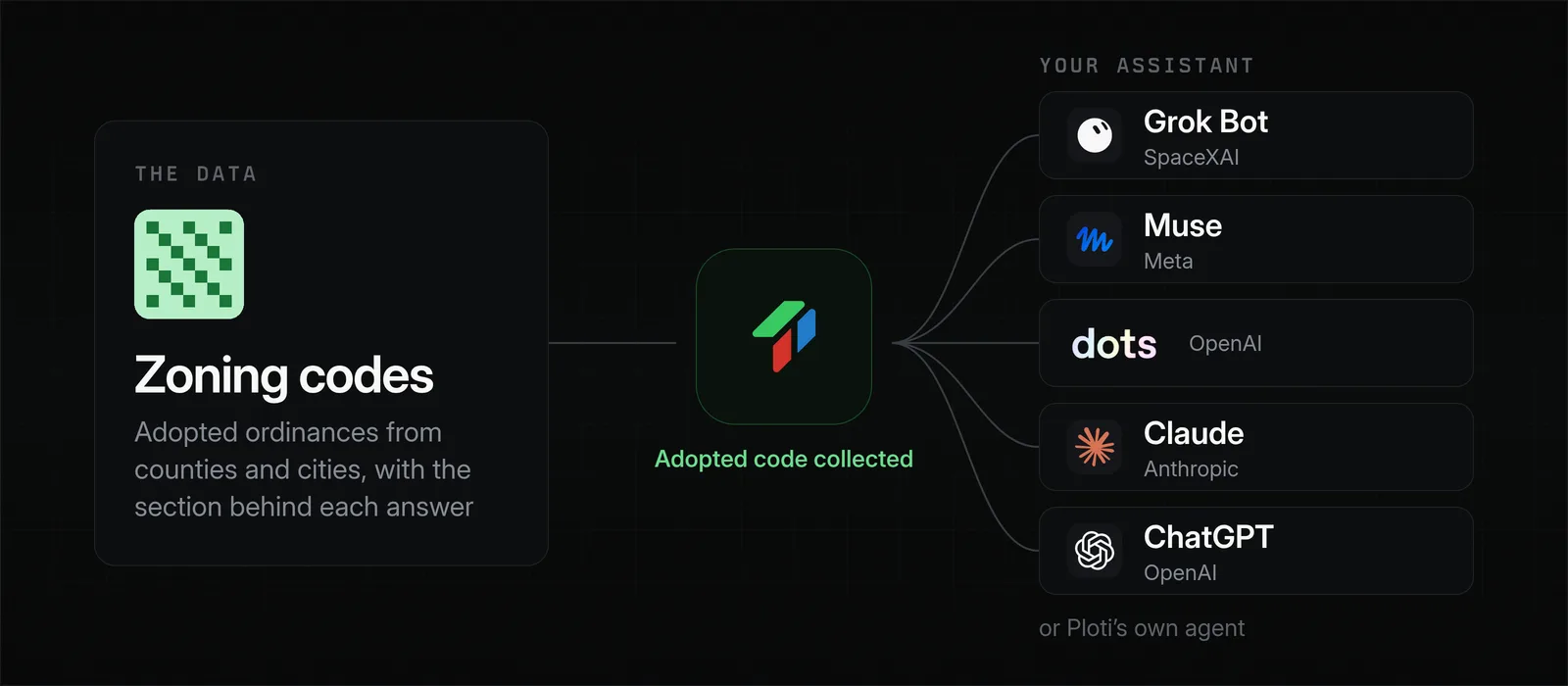
The whole code is there to search, not only the slice the first question needed. Ploti's agents also work with sources that resist scripts, such as permit portals and meeting archives, and when a county does not publish a document online they can email the county for it and manage the exchange. Each section the assistant quotes comes with a link to where it was read, which gives your question to staff in step 5 something specific to cite.
Why not a traditional data provider
Traditional real estate data providers sell their data through contracts negotiated with sales. Ploti works differently:
- No contract. You sign up yourself and start with a 7-day trial.
- You pay for the counties you work in. Pricing starts at $50 per county a month.
- Full access in your counties. Your assistant can search each code Ploti holds in full, along with everything else in your coverage areas.
- It builds up over time. Ploti keeps pulling data in your coverage areas on its own, so the code you need is often there before you ask.
What else the same steps are good for
The five steps work for any use that is newer than the code, such as battery storage, solar, or cell towers. For the same approach applied to a wireless use, see how to find a cell tower site. For a use with grid constraints, see how to find powered land for data centers, which covers the power side that the code does not.
Frequently asked questions
How do I find out if my county allows data centers?
Open the adopted zoning code and search the definitions, the table of permitted uses by district, and any planned-development or overlay sections. Search for "data center" and for older names such as "data processing" and "computer center". Then check whether a moratorium is in force and ask planning staff for a written determination.
What does it mean if a zoning code does not mention data centers?
It means the code has no use category with that name. The use may fall under a broader category such as industrial services or an office-style data processing use, or staff may decide it case by case. Silence is not permission and it is not a ban.
Why do data centers show up under other names in zoning codes?
Many codes were written before large data centers existed, so the use sits under older terms for computer or data processing facilities, or inside general industrial categories. A modern campus can fall under wording written for an office.
Can an AI assistant check a zoning code for me?
Yes, when it can read the adopted code. Through Ploti's MCP connector, Claude, ChatGPT, and other assistants can search ordinance text that Ploti holds and quote the sections. Where Ploti does not hold a code yet, you can file a data request for it.
How you can do it yourself
If you already use an assistant, add Ploti as a connector and ask it to read the code. Setup takes about two minutes for Claude, ChatGPT, Gemini, Claude Code, Codex, and Cursor, and works with any assistant that supports MCP connectors. Then try something like:
- "Does the zoning code in my county define data centers, and under what name?"
- "In which districts is a data center permitted, conditional, or not listed, and which section says so?"
- "Is there a moratorium in force in these three counties, and what does it cover?"
If you don't use an assistant, ask Ploti's agent directly on the web, in the Mac or Windows app, or soon on your phone. Pick the counties you work in and start a 7-day trial.