How to find a site for a contractor yard with AI
A landscaping company's building and outdoor storage, sited in 17 minutes.

Brennen Fountain
A contractor yard needs a zoning district that allows the business by right, rules that permit outdoor storage behind screening, and a parcel large enough for the building, parking, and equipment that stays clear of flood zones and wetlands. Those answers sit in the local land development code, the zoning map, and county parcel and environmental data. An AI assistant such as Claude or ChatGPT can read the code and screen parcels against it once both are in one place, but it cannot gather a city's code and parcel data on its own.
A growing landscaping company in Flagler County, Florida needed a home of its own: a building for the office and shop, and a yard for trucks, trailers, mulch, and plants. The request was one line:
I am looking for a site to build a 10k foot building for a landscaping company, it will require outdoor storage.
The problem: zoning has to allow the business and the yard
For a contractor, the yard is usually what rules a site out. A parcel can be zoned commercial and still not allow a landscaping business, or allow the business but not outdoor storage, or allow both but require screening and buffers that eat half the lot.
Those rules sit in the city's land development code: a table of permitted uses, a section on outdoor storage, dimensional limits for each district, and buffer rules next to homes and wetlands. The zoning map, parcel records, flood maps, and wetland maps are each somewhere else. Most owners or brokers start with what is for sale and only then discover what the code allows.
Working the other way, from the code to the parcels, means reading the code first and then checking every candidate lot against flood, wetlands, road access, and neighbors. That can take a consultant several days for a single business.
The result: a ranked shortlist in 17 minutes
Seventeen minutes after asking, the company had its answer. It started with the rules: landscaping services are allowed by right in four of the city's commercial and industrial districts and by special exception in one more; outdoor storage needs a screen at least six feet tall, nothing stacked above it, and limits on shipping containers. With the district's floor area and impervious cover limits, a 10,000 square foot building fits on about an acre or more.
From there the screen found 58 vacant or underused parcels of 1 to 5.5 acres in those districts, checked each for flood zone, wetlands, road frontage, traffic, water service, and residential neighbors, and dropped the ones that failed. Some lots that looked right on paper were mostly wetland or flood zone. What remained was a ranked shortlist of eight sites, the strongest an industrial-zoned parcel with no flood zone, almost no wetland, city water, and no homes next door.
Most of the top sites were not on the market, so the shortlist doubled as a list of owners to approach before anyone else does.
Why an AI assistant can't screen parcels against a zoning code on its own
AI assistants like Claude and ChatGPT are increasingly used as agents: you give them a task in plain English and they research it and act on it. Give one a zoning code and it will explain the outdoor storage rules clearly.
What it cannot do on its own is apply those rules to real land. Ask an assistant for a contractor yard site and it will search the web, find a few listings and maybe the city's code, and stop there. It cannot load the county's parcels, overlay zoning, flood zones, and wetlands, and test every lot against the code, and nothing it finds is saved for the next question.
How it was done: Ploti
The company asked Ploti, the real estate data layer for AI. Ploti's data agents fetch and compile public records from local governments, including parcels, zoning maps, and the land development codes behind them, along with state and federal layers like flood zones, wetlands, and traffic counts, and store them so an AI agent can query all of it. Everything this request needed was already in Ploti for the county: the city's code, its zoning and future land use maps, county parcels, FEMA flood zones, wetlands, water service areas, and state traffic counts.
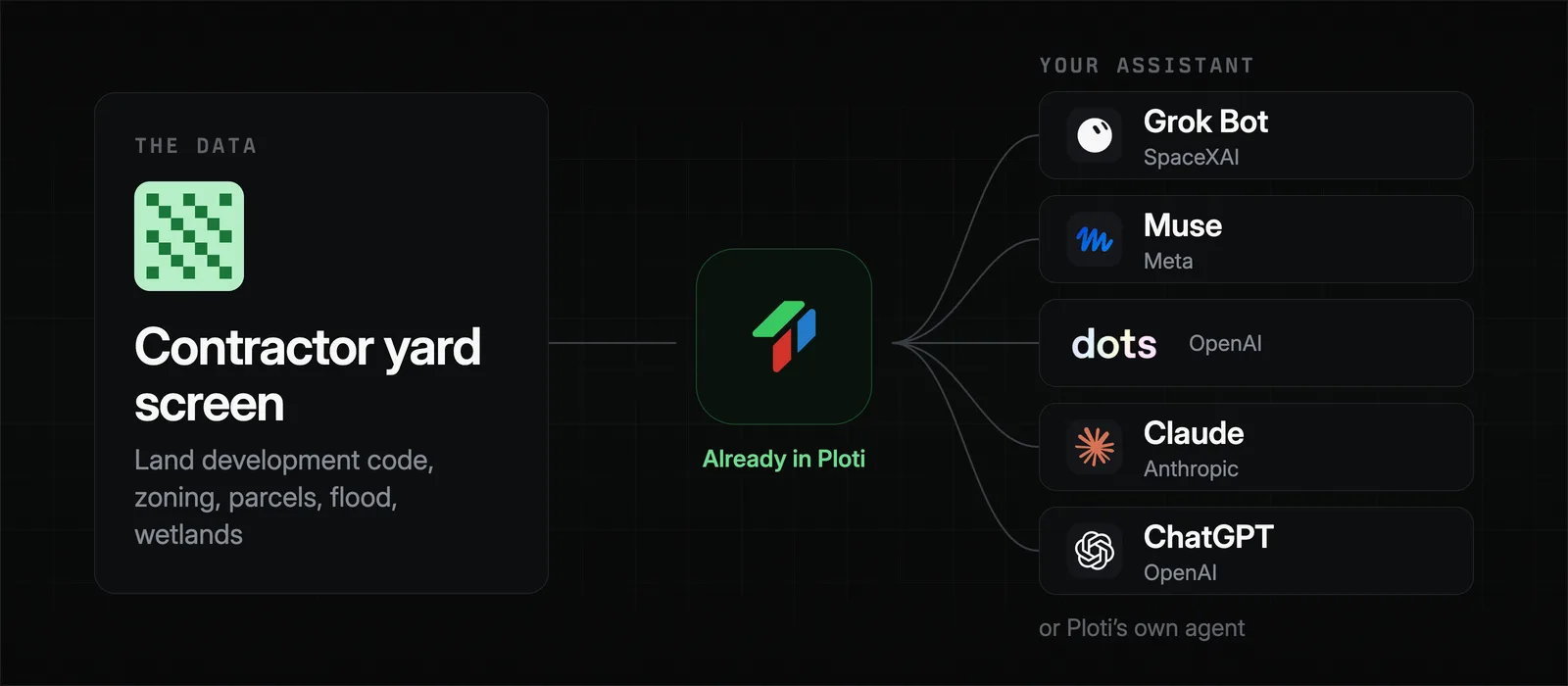
Because nothing had to be fetched, the answer took minutes. Ploti fetches a source once and keeps it ready to query, so every later question about the same county starts from the full dataset. The company's assistant can widen the search to two acres of yard, add a neighboring county, or check one specific lot, through an MCP connector in Claude or ChatGPT, or through Ploti's own agent.
When a city's code or map is only a scanned PDF or not online at all, Ploti can request it from the county and manage that exchange, and the same agents work through permit portals and meeting archives to see what was recently approved nearby.
Why not buy site data from a data provider
Traditional real estate data providers sell parcels and some zoning on annual contracts negotiated through sales, often in the tens of thousands of dollars, with seat or export limits. The local code that decides whether a landscaping yard is allowed, and what the screening has to look like, is rarely part of what they sell. For a single business looking for one site, that rarely makes sense.
Ploti is set up differently:
- No contract. Sign up and start with a 7-day trial.
- Pay for the counties you work in. Pricing is per county, starting at $50 a month, so one county costs $50 a month.
- Full access in your counties. Your assistant can query every parcel, district, and code section in your coverage areas.
- It builds up over time. Ploti keeps pulling data in your counties on its own, which is why this request needed nothing new.
Other businesses that need a yard
The same data serves more than one kind of business:
- Any use with a yard. Pool contractors, tree services, equipment rental, and fleet parking all ask the same zoning and storage questions.
- Off-market outreach. Owner records on each candidate turn the shortlist into a call list.
- Expansion. When the company outgrows the site, the same screen runs in the next county.
For a larger version of this search, see how to find land for self storage with AI, which covers flex and industrial outdoor storage across two states. Anything your site search needs that Ploti does not have yet, you can ask for as a data request.
Frequently asked questions
What zoning allows a contractor yard?
Usually industrial districts and some heavy commercial districts, though it varies by town. Check the table of permitted uses for terms like landscaping services, contractor's office, or building contractor, and whether the use is allowed by right or needs a special exception.
Is outdoor storage allowed in commercial zoning?
Sometimes, with conditions. Many codes allow outdoor storage in industrial districts and a few commercial ones if it is screened by a fence or wall of a set height, kept out of front yards, and not stacked above the screen.
How much land does a 10,000 square foot contractor building need?
Often an acre or more. Floor area ratio limits, impervious cover caps, parking, and room for trucks and stored material all add to the footprint, and buffers apply next to homes or wetlands.
Can an AI assistant find industrial land for my business?
Yes, once it can query parcels, zoning, and the local code. Connect Claude, ChatGPT, or another assistant to Ploti with an MCP connector and describe the building and storage you need, or ask Ploti's own agent.
How you can do it yourself
If you already use an assistant, connect Ploti and describe the building and yard you need. Setup takes about two minutes for Claude, ChatGPT, Gemini, Claude Code, Codex, and Cursor, and works with any assistant that supports MCP connectors. Then ask:
- "Which zoning districts allow landscaping services by right, and what does the code require for outdoor storage?"
- "Find vacant parcels of one to five acres in those districts outside flood zones and wetlands."
- "Which of those share a property line with residential zoning?"
If you don't use an assistant, ask Ploti's agent on the web, in the Mac or Windows app, or soon on your phone. Pick the counties you work in and start a 7-day trial.