How to track data center moratoriums with AI
We checked 41 central Florida municipalities for data center moratoriums in about a week.

Denielle Abaquita
Data center moratoriums are adopted one city and county at a time, in ordinances, agendas, and meeting minutes, and few governments publish them as a list. Tracking them means checking every local government in your market, then checking again as new proposals come up. An AI assistant such as Claude or ChatGPT can screen sites against a moratorium ledger once it exists, but it cannot read dozens of city records archives and keep the ledger current on its own.
A site-selection team asked about four central Florida counties: Marion, Orange, Seminole, and Volusia. They wanted to rule out places that had paused data centers and other large power users, and put it this way:
...municipalities that don't have a moratorium on industrial development.
The problem: moratoriums are passed one town at a time
Power is often what decides a data center site, and in Florida in 2026 local approval has become the other half of the question. Counties across the state have moved to pause data center applications this year:
- Manatee County approved a one-year moratorium on new data center projects on October 8, 2026, by a unanimous vote (ABC7 Sarasota).
- Palm Beach County voted 6-0 on September 24, 2026 to pause applications for projects with a peak load of 50 megawatts or more, for up to a year (CBS12).
- Leon County commissioners unanimously approved an 18-month moratorium on large-scale data centers on July 14, 2026 (WCTV).
- Orange County commissioners agreed in September to move toward a temporary moratorium of six to 18 months, with a vote expected at the December 1 meeting (Orlando Weekly).
A county moratorium usually covers unincorporated land only. Each city decides for itself, in its own ordinances, agendas, and minutes, and few of them publish anything you could call a list. A site that looks clear at the county level can sit inside a city that paused data centers last month, or one whose council asked staff to draft a pause last week.
A complete answer means checking every city and the county itself, then checking again. In these four counties that is 41 cities and towns, plus the four counties. If each one takes an hour or two to search its records portal, read the relevant agenda items, and confirm what was adopted, that is a week or more of reading before you know which places are open, and the answer starts going stale the day you finish.
The result: a moratorium ledger for 41 municipalities
About a week after it was asked, the question had an answer. Of the 41 municipalities in the four counties, 32 had no development moratorium on record. Every moratorium found from 2026 targeted data centers and other large power users, often defined as 50 megawatts and up, rather than industrial development in general.
A web search at the start of the request turned up two moratoriums. The town-by-town check found pauses in effect in Marion County (unincorporated land, data centers of 50 MW and up, until September 2027), two Volusia cities (Ormond Beach and Edgewater), and a Volusia County pause on applications whose ordinance is awaiting a final hearing. Two more cities had data center moratoriums proposed or pending, and two where councils had asked staff to look into one.
Each city's result cites the record it came from, and the ones still being filled say so. With that in hand, the cities with no moratorium on record could be ranked against nearby substations and transmission lines, and the cities with a moratorium pending or under discussion went on a watch list instead of a shortlist.
Why an AI assistant can't do this on its own
AI assistants like Claude and ChatGPT increasingly work as agents: you give them a task in plain English and they research it, analyze it, and act on it. Once the records are in front of them, they read ordinances well.
Getting the records is the hard part. Ask an assistant which central Florida cities have a data center moratorium and it will search the news and summarize what loads. Small towns rarely make the news, many city records portals are hard for a script to search, and some records are only available from the city clerk on request. What it finds is not saved, so next month's question starts from zero, even though new proposals keep arriving.
How it was done: Ploti
The request was filed in Ploti, the real estate data layer for AI. Ploti's data agents fetch and compile public records from local governments, including city and county legislative archives, records portals, and municipal codes, and store them so any AI agent can query all of it.
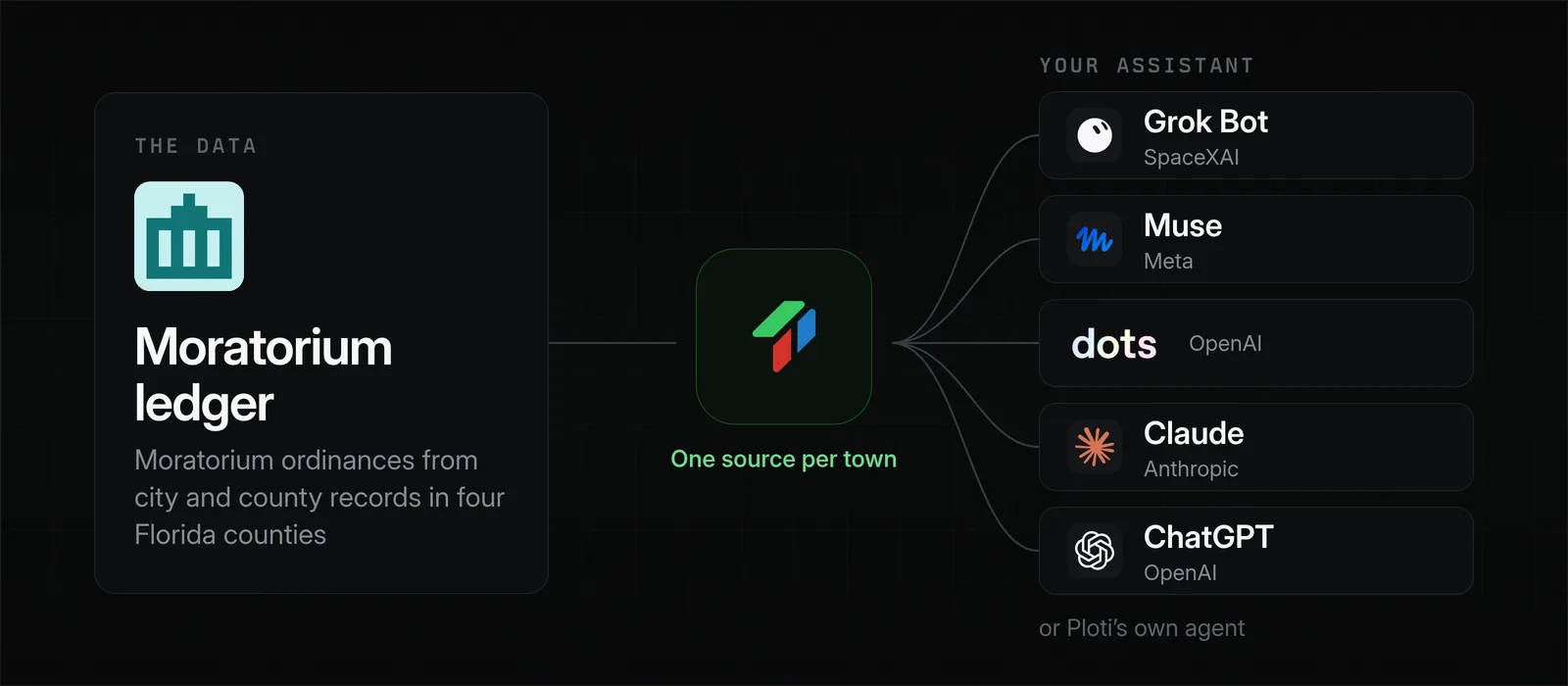
First, Ploti checked what it already had. Grid data for the four counties was in place: transmission lines with voltage, substations, power plants with megawatt capacity, and city boundaries. A list of moratoriums was not, so Ploti filed one data request per county for a ledger of local development moratoriums.
Each county request became a plan with one source per town: the county itself and each city, about 50 town-level sources in all. The request page shows that plan as it works. Each source is listed by name with where it stands (Done, First results, Collecting, or Not available), under one line that counts how many of the county's sources are done, so you can see which towns are left without asking anyone.
By October 20, Seminole County's ledger covered all eight of its jurisdictions. Orange County's covered 13 jurisdictions with one town still being researched; Marion's covered five of its six places, with Dunnellon still open; and Volusia's covered the county and its cities except Lake Helen, which was waiting on the city's records office.
Some records are not online at all. As of October 20, a few small towns were still being researched, and some of them were waiting on records requests to their city clerks. Ploti makes those requests and handles the back-and-forth, so the requester does not have to.
The reading happened once. The ledgers stay in Ploti and keep updating as the remaining towns are filled in, so the assistant can go back to all four counties whenever a site comes up, with each answer traced to the ordinance or agenda item it rests on. It works through an MCP connector in Claude or ChatGPT, or through Ploti's own agent, and the assistant can query the whole ledger alongside the grid data rather than just the slice the first question needed.
Why not buy moratorium data from a data provider
City-by-city moratorium records are not something traditional real estate data providers are known to sell. Their local data tends to come on annual contracts negotiated through sales, often in the tens of thousands of dollars, and capped by seats, exports, or lookups. A team screening four Florida counties would struggle to justify that.
Ploti is set up differently:
- No contract. You sign up yourself and start with a 7-day trial.
- You pay for the counties you work in. Pricing is per county, starting at $50 a month, so tracking moratoriums in these four counties costs about $200 a month, not an enterprise license.
- Full access in your counties. Your assistant can query the entire moratorium ledger, the grid layers, and every other dataset in your coverage areas.
- It builds up over time. The moratorium ledger keeps updating as councils act, and the substations, zoning, and parcels in the same counties are already there when a new site comes up.
What else a moratorium ledger is good for
The same ledger answers more than one site search:
- Timing. When each moratorium expires, so you know when a paused market may reopen and what rules are likely to replace the pause.
- Early warning. Councils that have asked staff to draft a moratorium, which can come months before a vote.
- Other large loads. Some of these ordinances also cover crypto mining and other high-energy uses, so the ledger matters for more than data centers.
Paired with other data in the same counties, it goes further. With substations, transmission lines, and utility territories, as in our post on finding powered land for data centers, you can rank open places by grid strength. With zoning and parcels, you can find industrial land in the cities that are still open.
Frequently asked questions
What is a data center moratorium?
A temporary pause, set by a city or county ordinance, on accepting or approving applications for data centers while the government writes rules for them. Many Florida pauses in 2026 are defined by power demand, for example projects with a peak load of 50 megawatts or more.
Where can I find out whether a city has a data center moratorium?
In the city's and county's own legislative records: ordinances, agendas, minutes, and public notices. Few local governments publish a list, and a county moratorium usually covers unincorporated land only, so each city has to be checked separately.
How long does it take to check a region for moratoriums?
By hand, days of reading per county. For four central Florida counties, a town-by-town ledger covering 41 municipalities was ready about a week after the question was asked, and it kept updating after that.
Can my AI assistant track moratoriums?
Yes, once the records are compiled into a dataset it can query. Connect Claude, ChatGPT, or another assistant to Ploti with an MCP connector and ask which places in your markets have a moratorium, or ask Ploti's own agent.
How you can do it yourself
If you already use an assistant, add Ploti as a connector and ask about the counties you work in. Setup takes about two minutes for Claude, ChatGPT, Gemini, Claude Code, Codex, and Cursor, and works with any assistant that supports MCP connectors. Then try something like:
- "Which cities in my counties have a data center moratorium in effect or pending, and when does each one expire?"
- "Which cities with no moratorium on record are close to a major substation?"
- "Has any council in my counties asked staff to draft a data center moratorium this year?"
If you don't use an assistant, ask Ploti's agent directly on the web, in the Mac or Windows app, or soon on your phone. Pick the counties you work in and start a 7-day trial.