How to find development permits for a site with AI
Building, stormwater, and zoning approvals for one Jacksonville site, in one place.

Brennen Fountain
A property's development permits are split across agencies: the city or county issues building and site permits, Florida's water management districts issue environmental resource and stormwater permits, and zoning approvals such as rezonings, PUDs, and variances are recorded in city council or planning board actions. To see a site's full history, each source has to be searched by parcel or address and the results combined. An AI assistant such as Claude or ChatGPT can summarize that history in seconds once it is collected, but it cannot search permit portals and agency databases on its own.
Someone doing due diligence on a commercial site in Jacksonville, Florida asked a question most buyers of developed or partly developed land end up asking:
I need information on the development permits associated with the property.
The problem: one site, three agencies
Before buying a commercial site, you want to know what has already been approved on it and what is still open. A stormwater permit with capacity to spare can save months; an expired site plan or an open building permit can add them. Conditions from an old rezoning may still limit what can be built.
In Florida, that history is split between at least three agencies. The City of Jacksonville issues building, site, and civil permits through its online permit system. The St. Johns River Water Management District issues the environmental resource and stormwater permits, with the approved drainage plans in its own e-permitting database. Rezonings and planned unit developments are City Council ordinances, recorded in the council's legislative records. Each searches differently, and a site that spans several parcels has to be searched parcel by parcel in each one.
By hand, that is a day or more per site of searching portals, opening permit files, and matching them back to the right parcels, and it is easy to miss a permit filed under an older address or a former owner.
The result: the site's full development history
The buyer ended up with every parcel making up the site, its zoning, and the permits and approvals tied to it from all three sources in one place: building and site permits from the city with their status and dates, the water management district's environmental resource and stormwater permits with links to the permit documents, and the council ordinances behind the PUDs nearby.
Seen together, the history answered the practical questions: what was built and when, which approvals were still active, what drainage capacity the site already had, and which conditions would carry over to a new owner. Flood zones and mapped wetlands on and around the site came with it, since they drive the next round of stormwater permitting.
Why an AI assistant can't pull permit records on its own
AI assistants like Claude and ChatGPT are increasingly used as agents: you describe a task in plain English and they research it, reason through it, and report back. Give one a site's permit files and it will summarize them well.
It has no way to get the files. Ask an assistant for a site's development permits and it will search the web and point you to the city's permit portal. It cannot work through a portal built for one search at a time, query a water management district's permit database by parcel, or tie council ordinances back to the land they cover. Nothing it finds is kept for the next site, and it may fill gaps with guesses.
How it was done: Ploti
The buyer asked Ploti, the real estate data layer for AI. Ploti's data agents fetch and compile public records from local governments, including permit portals, water management district databases, and council records, and store them so an AI agent can query all of it. Duval County parcels, zoning, flood zones, and wetland maps were already in Ploti. For this request the agents added the City of Jacksonville's permit records, the St. Johns River Water Management District's environmental resource permits, and the city's zoning and PUD actions, and matched them to the site's parcels.
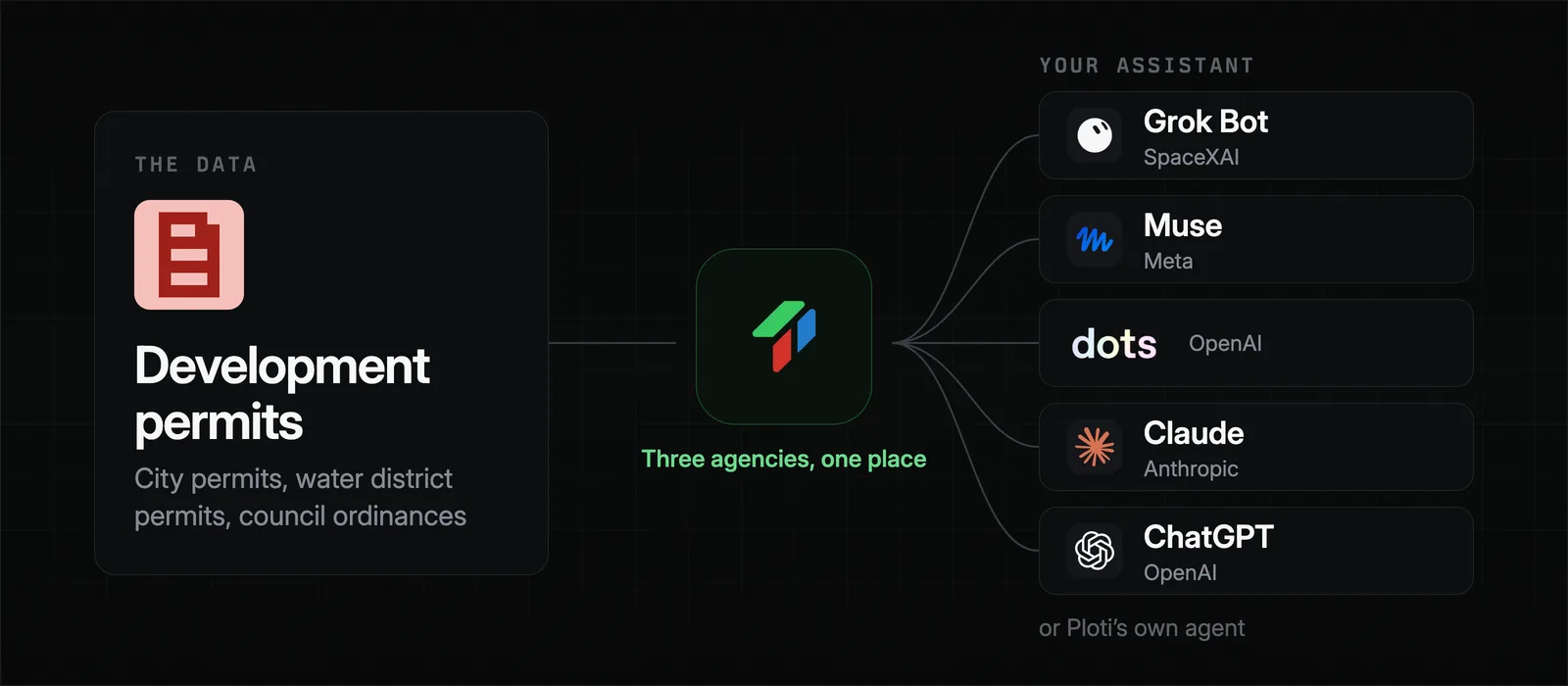
The agents fetched each source for the whole city, so all of it stays ready to query. The buyer's assistant can ask about the next site in Jacksonville, every stormwater permit along a corridor, or what was permitted on neighboring parcels last year, through an MCP connector in Claude or ChatGPT, or through Ploti's own agent.
Permit portals are among the harder public sources to work with, since many are built for one lookup at a time and resist automated access. When an agency keeps older permit files offline, Ploti can email for them and manage the exchange.
Why not buy permit data from a data provider
Some data providers sell building permit feeds, usually on annual contracts negotiated through sales and often in the tens of thousands of dollars, priced by seat or lookup. Water management district permits and the ordinances behind rezonings and PUDs are rarely part of those feeds, and those are often the records that decide what a buyer can do with a site.
Ploti works differently:
- No contract. Sign up and start with a 7-day trial.
- Pay for the counties you work in. Pricing is per county, starting at $50 a month, so Duval County on its own costs $50 a month.
- Full access in your counties. Your assistant can query every permit, parcel, and zoning record in your coverage areas, not a capped number of lookups.
- It builds up over time. Ploti keeps pulling data in your counties on its own, so the permits around your next site are often there before you ask.
Other questions permit records answer
The same records serve more than one deal:
- Corridor activity. See where new building and stormwater permits are clustering before projects break ground.
- Stalled projects. Find sites with approved plans and expired or inactive permits, often motivated sellers.
- Entitlement precedent. Read which PUDs and rezonings the council approved nearby, and with what conditions.
For a county-wide view of permit history, see how to look up building permit history with AI. Anything your due diligence needs that Ploti does not have yet, you can ask for as a data request.
Frequently asked questions
How do I find the permits on a property in Jacksonville?
Building, site, and civil permits are issued by the City of Jacksonville and searchable in its online permit system by address or parcel. Stormwater and environmental resource permits come from the St. Johns River Water Management District, and rezonings and PUDs are recorded as City Council ordinances.
What is an environmental resource permit in Florida?
A state permit for work that affects stormwater, wetlands, or surface waters, issued by a water management district or the Florida Department of Environmental Protection. Most commercial sites need one, and the permit file often includes the approved site and drainage plans.
Why look up permits before buying a site?
Past permits show what was approved, what is still open or expired, and which conditions run with the land, such as stormwater capacity or PUD limits. They can save a new owner months of redesign or reveal work that was never closed out.
Can an AI assistant look up permit history?
Yes, once the permit records are in a place it can query. Connect Claude, ChatGPT, or another assistant to Ploti with an MCP connector and ask for a site's permits, or ask Ploti's own agent.
How you can do it yourself
If you already use an assistant, connect Ploti and ask about the sites you are looking at. Setup takes about two minutes for Claude, ChatGPT, Gemini, Claude Code, Codex, and Cursor, and works with any assistant that supports MCP connectors. Then ask:
- "List every building, site, and stormwater permit on these parcels, with status and date."
- "Which environmental resource permits were issued within a mile of this site in the last five years?"
- "What PUD or rezoning ordinances apply to this property, and what conditions do they set?"
If you don't use an assistant, ask Ploti's agent on the web, in the Mac or Windows app, or soon on your phone. Pick the counties you work in and start a 7-day trial.