How to look up building permit history with AI
Twenty years of a county's permit portal, ready to query in two days.

Brennen Fountain
Building permit history lives in the permit portal of the county or city that issued the permits, where you can usually search one address or record number at a time. To see a parcel's full history, or everything in permitting around it, the portal's records have to be pulled out and kept somewhere you can search them together. An AI assistant such as Claude or ChatGPT can answer permit questions in seconds once it can query that record, but on its own it cannot work through a permit portal.
A real estate team weighing a site in Pasco County, Florida, north of Tampa, needed two answers before going further:
Find existing permits and previously permitted plans on a subject parcel, and identify industrial projects under construction or in permitting nearby.
The problem: permit history is locked in a portal
Permit history tells you what you are really buying. Past permits on a parcel show what has been built, approved, or started and abandoned there. The projects in permitting nearby tell you what the area is about to become, and who you will be competing with for tenants, labor, and road capacity.
That history sits in the county's permit portal. Like most, Pasco's is built for looking up one record at a time: type an address or a record number, open the result, read it, go back. That works for checking a single address. It does not tell you what is in permitting within a mile of your site, because the portal gives you no simple way to ask that question.
To answer it by hand, you would page through the county's applications one by one. Pasco has more than 35,000 planning applications going back to 2006, and at a minute each that is close to 600 hours of clicking before you see the picture around one site.
The result: twenty years of applications in two days
A little over two days after asking, the team had Pasco County's full planning application record: 35,705 applications from October 2006 to September 2026. Each comes with its record number, date, project name, type, status, address, description, and the parcels it covers, plus a link back to the application in the county's portal.
With the parcel numbers attached, the subject parcel's history is one search, and so is every site-development and industrial project within reach of it. The county's building permits, from the same portal, are being collected now and will join the same record.
Why an AI assistant can't do this on its own
AI assistants like Claude and ChatGPT increasingly work as agents: you hand one a task in plain English and it researches, analyzes, and reports back. Point one at a table of permits and it will sort, filter, and summarize it well. The permits have to get there first.
Ask an assistant for the permit history around a site and it will search the web, which does not reach inside a county permit portal. Portals sit behind search forms, sessions, and page-by-page results that an assistant's browsing does not work through, and a single search returns one record, not 35,705. It might find a news story about a large project. It will not find the record of everything in permitting nearby, and nothing it does find is kept for the next question.
How it was done: Ploti
The team asked Ploti, the real estate data layer for AI. Ploti's data agents fetch and compile public records from local governments, and permit portals are a large part of that work: they are where permits live and where general tools give up. Here the agents worked through Pasco County's portal record by record and brought back the whole planning application history, not only the parcel the team named.
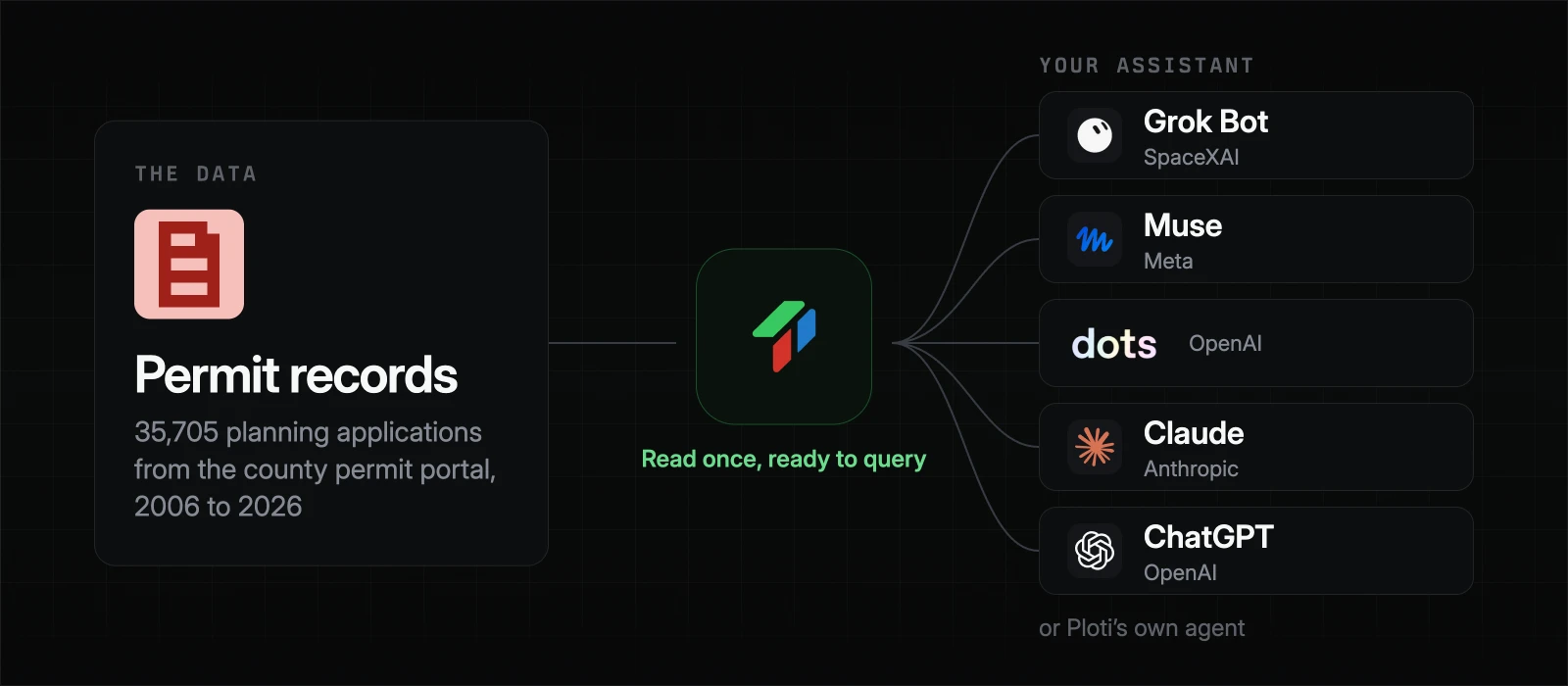
The portal was read once. Now the team's assistant can search all twenty years whenever a new question comes up: the history of another parcel, every application of a certain type this year, every application near the site that is still under review. It reaches the record through an MCP connector in Claude or ChatGPT, or through Ploti's own agent. Each answer links back to the application in the county's portal, so it can be checked.
Not every county puts its permits online. When one keeps them on paper or only shares them on request, Ploti can email the county for the records and manage the exchange, and the same agents read meeting archives when a question turns on what a commission decided rather than what was permitted.
Why not buy permit data from a data provider
Permit data is sold by a handful of providers, typically on annual contracts negotiated through sales, often in the tens of thousands of dollars, with lookups or exports capped by plan. Coverage and refresh timing vary by county, and fields like the full project description are sometimes trimmed in the process.
Ploti is set up for the way a real estate team works a county:
- No contract. Sign up and start with a 7-day trial.
- Pay for the county you work in. Pasco on its own starts at $50 a month, and adding the neighboring counties keeps the bill in the tens or low hundreds of dollars.
- The whole record, not a lookup quota. Your assistant can query every application in your coverage areas, with the description text as the county wrote it.
- It keeps growing. Ploti keeps collecting data in your counties on its own, and it already holds more than 300 permit datasets, so the next county you look at may be ready before you ask.
What else it unlocks
The same record answers more than one site:
- Where development is heading. Map applications by type and year and you can see which corridors are filling with industrial, residential, or commercial projects.
- Competition. See which nearby projects are approved, under review, or withdrawn, and who filed them.
- Parcel due diligence. Check any parcel's history before an offer, including applications that were approved, withdrawn, or denied.
Paired with zoning, parcels, and rezoning history in the same county (everything Ploti maintains in your coverage areas), it shows both what is allowed on a site and what is actually being built around it. For more on how the pieces fit together, see what a real estate data layer for AI is. If the permits you need are not in Ploti yet, file a data request.
Frequently asked questions
Where can I find the permit history for a property?
In the permit portal of whoever issued the permits: the county for unincorporated land, or the city or town for property inside its limits. Most portals let you search by address, parcel number, or record number, one record at a time.
Can I see every permit near a site, not just one address?
Rarely from the portal itself, since most are built for looking up one record. Seeing everything in permitting around a site means pulling the portal's full record and searching it by location or parcel.
How long does it take to get a county's permit records?
Paging through a portal by hand can take weeks for a busy county. Ploti delivered 35,705 Pasco County planning applications, 2006 to 2026, a little over two days after a customer asked.
Can my AI assistant search permits?
Yes, once the permits are somewhere it can query. Connect Claude, ChatGPT, or another assistant to Ploti with an MCP connector and ask about permits on a parcel or near a site, or ask Ploti's own agent.
How you can do it yourself
If you already use an assistant, connect Ploti and ask about permits in your own markets. Setup takes about two minutes for Claude, ChatGPT, Gemini, Claude Code, Codex, and Cursor, and works with any assistant that supports MCP connectors. Then try:
- "What has been permitted or applied for on this parcel since 2010?"
- "List industrial and site-development applications within two miles of this site since 2023, with their status."
- "Which applications near this site are still under review, and what are they for?"
If you don't use an assistant, ask Ploti's agent on the web, in the Mac or Windows app, or soon on your phone. Pick the counties you work in and start a 7-day trial.