How to find maturing commercial loans with AI
Which industrial owners still carry a loan from before rates rose, read from a county's own records.


Denielle Abaquita
To find maturing commercial loans, start from the mortgages recorded with the county. A lender records the mortgage at closing and records a release, called a satisfaction in some states, when the loan is paid off, so a mortgage with no release is, as far as the public record shows, still open. Its recording date plus a typical commercial term of five, seven, or ten years tells you roughly when it comes due. An AI assistant such as Claude or ChatGPT can screen those open loans once they are in a dataset, but it cannot pull and match millions of county records on its own.
Many commercial property loans were signed between 2016 and 2022, most of them before interest rates began rising that year. Commercial loans usually run five, seven, or ten years, so many of them are coming due now. The Mortgage Bankers Association estimates that $875 billion of commercial mortgages, about 17% of the total, is scheduled to mature in 2026, including 23% of loans on industrial property (MBA). Owners with one of those loans will have to refinance at rates well above what they borrowed at, sell, or work something out with the lender. For a lender or a debt broker, that is a refinance to offer. For a buyer, an owner who can't refinance may be ready to sell. One question finds them:
Which industrial properties in this county still carry an open mortgage, and when is it likely to come due?
The problem: the answer is in the county's recorded documents
Listing sites and many property reports show only the loan taken out when a property was bought. A refinance replaces that loan, and a loan that was paid off years ago can still show up on those sites. To know which properties carry a loan today, you have to go to the record itself.
That record is kept by the county. When an owner borrows against a building, the lender records (files a copy of) the mortgage with the county. When the loan is paid off, the lender records a release, called a satisfaction of mortgage in Florida and many other states. In some states, such as Texas and California, the loan is recorded as a deed of trust instead, and its release as a reconveyance or release of lien; the method is the same. A mortgage with no matching satisfaction is, as far as the public record shows, still open. A lender can also record a modification, a change to the loan's terms such as an extension, and an assignment when the loan moves to a new lender.
Counties keep all of this in an index of recorded documents, run by the clerk, recorder, or comptroller depending on the state. The index is a searchable list of every filed document, with the names, the document type, and the date, but not the document's text. It is public, but its search site is built for looking up one name or one document at a time, and a large county's index holds millions of records. To answer the question for every industrial property in such a county (warehouses, factories, and other land the county's property appraiser, the assessor in most states, classifies as industrial: several thousand properties), you would look up each owner, find each mortgage, check for a satisfaction, and note any later changes. At five minutes a property, that is hundreds of hours of searching.
The mortgage document usually states the loan amount and often the maturity date, but the index doesn't, so each one has to be opened to read them. What the index does give you is the date each mortgage was recorded, and with typical terms of five, seven, or ten years, the recording date is a reasonable guide to when the loan matures.
The result: open loans on nearly one in five industrial properties
For one large Florida county, the whole index of recorded documents since 2014 was pulled and matched to the county's industrial properties. It took about two weeks, most of it spent getting the index. Once the index was in, the search itself took about 20 minutes:
- About 1,000 properties, nearly one in five, carried an open mortgage. The rest showed no open loan recorded since 2014: owned outright, paid off, or financed before 2014, where these records start.
- About 500 of them took their newest open loan between 2016 and 2022, mostly before rates rose.
- Counting loans signed through 2024 as well, about 680 carry an open loan likely to come due between 2026 and 2029, assuming whichever of a five-, seven-, or ten-year term lands in that window.
- About 90 had a modification recorded on the newest open loan, often an extension. Those are worth reading first, since an extension moves the due date.
A property can carry more than one open loan, such as a second mortgage, which is why the counts speak of the newest one. And an old loan that still shows as open, past any typical term, may be a satisfaction that was never recorded, so check those before calling.
Each property in the result links to the recorded documents behind it, so the estimated due date can be checked against the loan itself before anyone picks up the phone.
Why an AI assistant can't do this on its own
AI assistants like Claude and ChatGPT increasingly work as agents: you give them a task in plain English and they research it and act on it. Give one a table of open loans and it will sort, filter, and summarize it well.
It can't build that table. A county's records search site answers one lookup at a time, and this job takes millions of records, each mortgage matched to its satisfaction and to a property. An assistant's session doesn't last long enough to pull them, the records are not in its training data, and nothing it finds is saved for the next question.
How it was done: Ploti
The question was answered in Ploti, the real estate data layer for AI: a service that gathers county property data so AI assistants can search it. When Ploti does not have the data a question needs, it goes and gets it, which is what we call a data request. Its data agents, software that works through government records sites the way a researcher would, pulled the county's full index of recorded documents from 2014 onward: mortgages, satisfactions, modifications, assignments, and deeds.
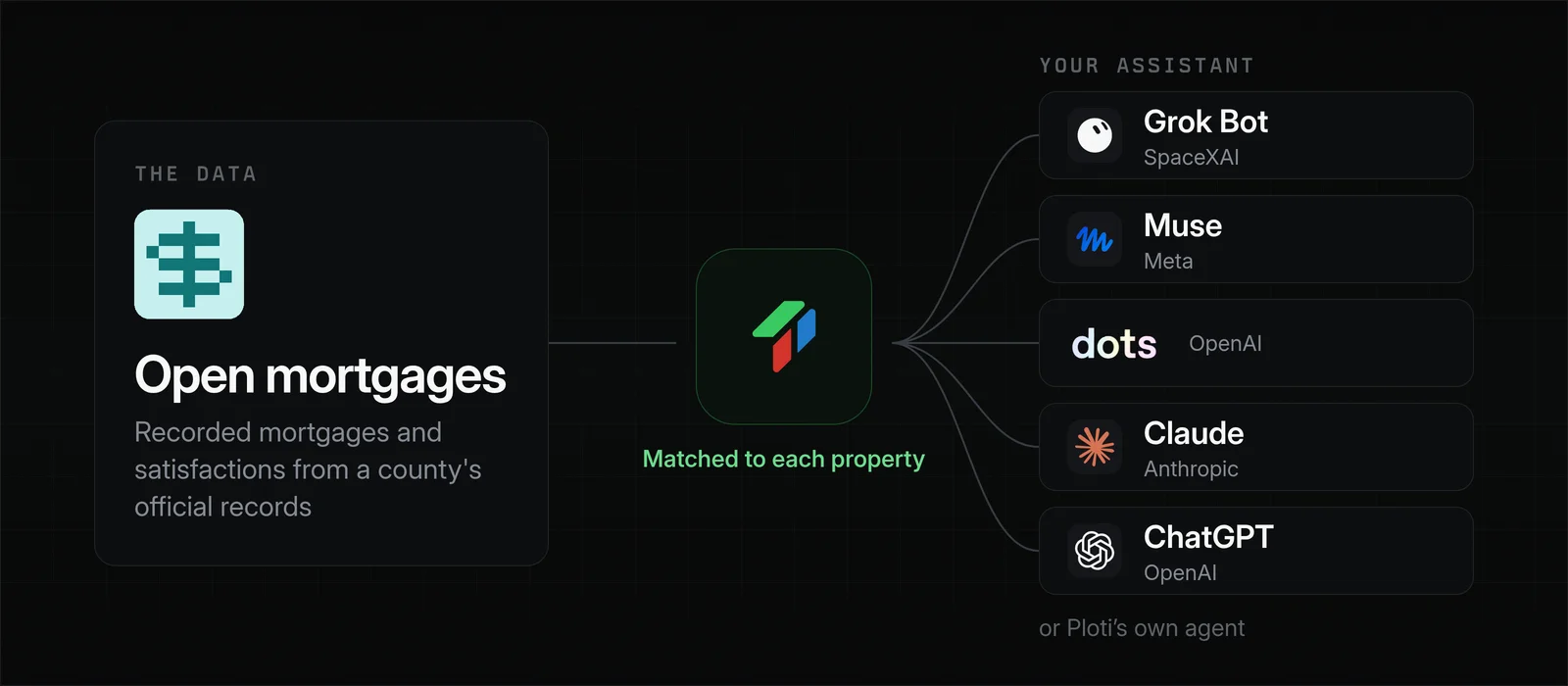
Each mortgage was then matched to the property appraiser's parcel records, which give each property's use and current owner, and checked for a satisfaction or a later sale, since a sale usually pays the loan off at closing. What was left were the loans still open, each with its lender as recorded, the date it was recorded, and any later modifications or assignments.
The index stays in Ploti, so the next question starts from it without fetching anything again: the same search for office or retail property, loans recorded in a different period, or every open loan from one lender. Your assistant can query the entire index whenever it needs to.
County records sites often limit searches and are hard to work through with ordinary scripts, which is why getting the index took most of the time. Ploti's data agents work through sites like these, as they do with permit portals and meeting archives. When a county does not publish a dataset online, Ploti can email the county for it and manage the exchange.
What the records can't tell you
Treat the result as a list to check. The index carries no loan amounts or due dates, so every due date is an estimate until someone opens the document. Mortgages recorded before 2014 are not in it, a loan that covers several properties may be matched to only one of them, and a satisfaction is sometimes recorded late or not at all.
Why not buy recorded mortgage data from a provider
Several national providers sell mortgage data built from county records, usually through subscriptions negotiated with sales and priced for enterprise budgets that can run into the tens of thousands of dollars a year. Some loan trackers follow only loans packaged into bonds (commercial mortgage-backed securities), and a local bank's loan on a small warehouse is often not among them.
With Ploti:
- No contract. You sign up yourself and start with a 7-day trial.
- You pay for the counties you work in. Pricing starts at $50 per county a month, so screening one county's industrial loans costs tens of dollars a month.
- Full access in your counties. Your assistant can query the entire index of recorded documents, along with everything else in your coverage areas, with no seat or lookup limits.
- It builds up over time. Ploti keeps gathering data in your coverage areas on its own, so parcels and other county data are often in place before you ask.
What else the recorded documents show
- Who holds the loan now. An assignment shows a loan moving to a new lender, so you know who to talk to about it.
- Recent sales. Deeds show which properties changed owners and when, next to the loans still open.
- Borrowers with several loans due. Grouping open loans by borrower shows which owners have more than one loan coming due.
With other data in the same county, building permits show which owners have been investing in their properties, and tax delinquency lists show which owners with a loan coming due are also behind on their taxes.
Frequently asked questions
What is an open mortgage?
A mortgage recorded against a property with no recorded release (a satisfaction of mortgage), the document a lender files when the loan is paid off. Until a release is recorded, the county's records show the loan as still in place.
How can I tell when a commercial loan matures?
The maturity date is in the loan documents, and sometimes in the recorded mortgage, but county record indexes usually do not list it. A practical estimate is the recording date plus a typical commercial term of five, seven, or ten years, confirmed by opening the recorded document.
Where can I find mortgages recorded on commercial property?
In the official records kept by the county clerk, recorder, or comptroller. Each county keeps an index of recorded documents, including mortgages (deeds of trust in some states), satisfactions, deeds, assignments, and modifications, that can be searched by name, date, or document number.
Can my AI assistant find commercial loans coming due?
Yes, once the county's recorded mortgages are in a dataset it can query. Connect Claude, ChatGPT, or another assistant to Ploti and ask which properties in your counties carry an open mortgage recorded in a given period, or ask Ploti's own agent.
How you can do it yourself
If you already use an assistant, connect it to Ploti and ask about the counties you work in. Setup guides cover Claude, ChatGPT, Gemini, Claude Code, Codex, and Cursor, and any assistant that supports MCP, the standard way assistants connect to outside tools, works too. Then try something like:
- "Which industrial properties in my county carry an open mortgage recorded between 2016 and 2022?"
- "List the open loans that have a recorded modification, with the lender and the date."
- "Which borrowers have open loans on more than one property?"
If you don't use an assistant, ask Ploti's agent directly on the web, in the Mac or Windows app, or soon on your phone. Pick the counties you work in and start a 7-day trial.