How to find tax delinquent properties with AI
1,421 tax accounts, each looked up one by one, the same day.


Brennen Fountain
Counties publish tax delinquent properties through the county treasurer or tax collector, usually as a delinquent list or tax-lien sale list in a PDF, a spreadsheet, or an account-by-account lookup portal. A list shows who is behind this year; an owner's full payment history, which separates a motivated seller from a late payer, usually means looking up each account in the portal. An AI assistant such as Claude or ChatGPT can score and filter those owners in seconds once the lists and histories are in one place, but it cannot collect them from county portals on its own.
A land investor screening counties in Arizona, Colorado, and South Carolina wanted to find owners who might be ready to sell. For each county, the ask was the same:
Property tax delinquency and tax-sale lists, for distressed-owner motivation scoring.
The problem: a list says who is behind, not for how long
Owners who fall behind on property taxes are some of the likeliest sellers in a county, and for a land investor they are often the best first calls. The counties publish who is behind. What they publish is a snapshot, though. An owner who missed one payment and an owner who has not paid in six years sit on the same list, and only the second is likely to take an offer.
The history that tells them apart sits in the county treasurer's portal, one account at a time. Each county also publishes its lists differently. In this request, one Colorado county split its delinquent records across four separate PDFs, another published a spreadsheet, a South Carolina county posted a dated list, and an Arizona county published its tax-sale lists and kept every account's history behind a lookup portal.
Looking up the Arizona county's 1,421 accounts by hand, at even two minutes each, is more than 47 hours of typing account numbers before you can rank a single owner.
The result: four counties of delinquency, histories included, within a day
Within about 11 hours of asking, the investor had all four counties:
- Arizona: the county's 1,450-row tax-sale and over-the-counter lien lists, plus every one of the 1,421 accounts looked up in the treasurer's portal, giving 4,466 account-year records from 2008 to 2026 with amounts due, lien balances, and payment histories.
- Colorado, county one: 3,884 records combined from four treasurer publications covering real property, mobile homes, personal property, and county-held liens.
- Colorado, county two: 2,106 delinquent accounts on the county's list for its November tax-lien sale.
- South Carolina: 4,952 accounts on the county's delinquent list, ready in under an hour.
With the histories attached, the investor could rank owners by years behind and growing balances instead of treating everyone on a list the same, and the lists stay in place for the next pass.
Why an AI assistant can't do this on its own
AI assistants like Claude and ChatGPT are increasingly used as agents: you give one a job in plain English and it researches, works through the details, and reports back. Give one a table of delinquent accounts with their histories and it can score them in seconds. Getting that table is the part it cannot do.
Ask an assistant for tax delinquent properties in a county and it will search the web and point you to the treasurer's page. It cannot run 1,421 lookups in a county portal, it struggles to turn four differently formatted PDFs into one table, and it has nowhere to keep the results. The next time you ask, it starts over.
How it was done: Ploti
The investor used Ploti, the real estate data layer for AI. Ploti's data agents go to the county offices that hold the records, treasurers, recorders, assessors, planning departments, and compile what they publish into tables an AI agent can query. For this request they pulled each county's lists in whatever form the county used, and in the Arizona county went on to look up every account on the lists in the treasurer's portal, one at a time.
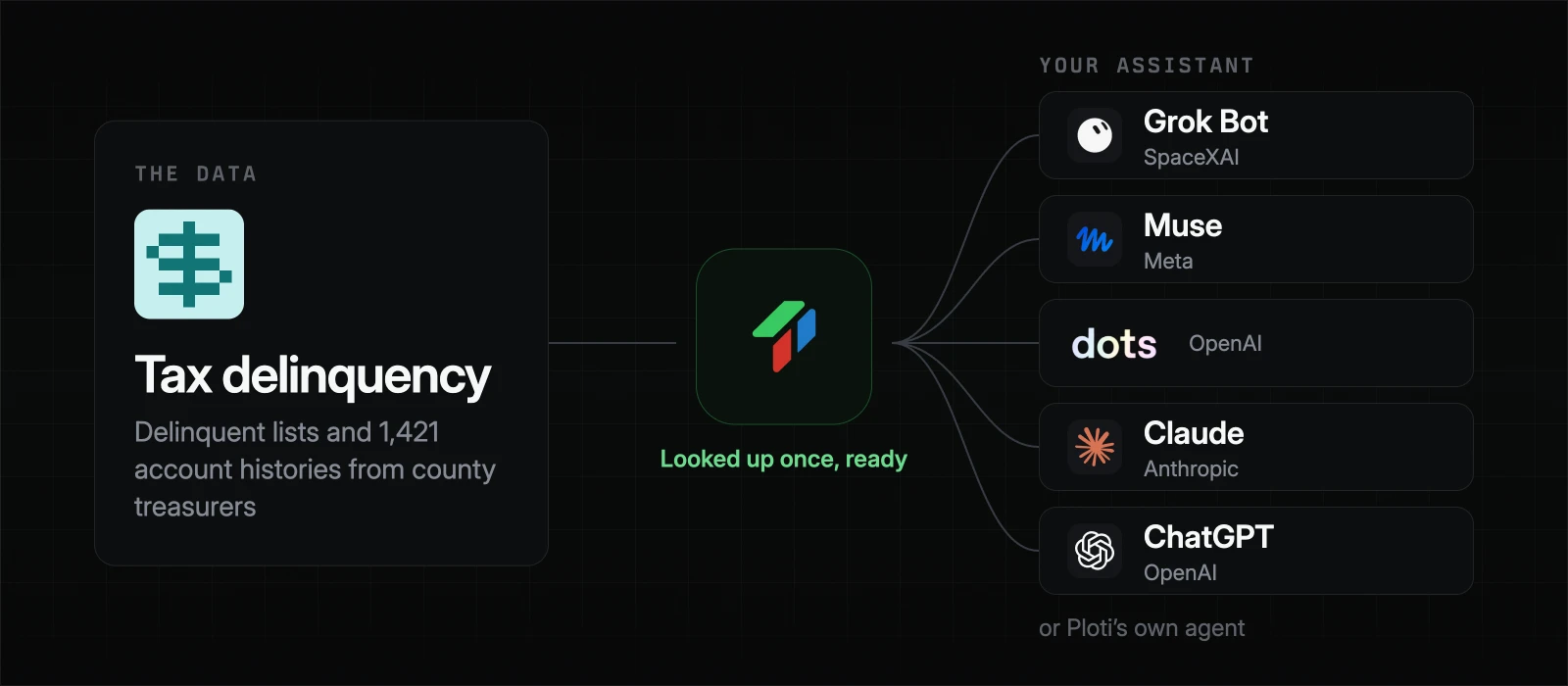
Those lookups ran once. The investor's assistant can now sort all four counties by years delinquent, amount owed, or any combination, as often as the model changes, through an MCP connector in Claude or ChatGPT, or through Ploti's own agent. Each record links back to the county publication or portal page it came from.
Not every county posts its list online. When one only provides it on request, Ploti can email the treasurer's office for it and handle the follow-up, and the same agents work through permit portals and meeting archives when a screen needs more than tax data.
Why not buy a delinquent list from a data provider
Tax delinquent lists are sold by list vendors and property data providers, usually as subscriptions or per-record exports, and the larger platforms come with annual contracts in the tens of thousands of dollars. Lists are often refreshed on the vendor's schedule rather than the county's, and full payment histories are rarely part of them.
Ploti is set up for an investor working a handful of counties:
- No contract. Sign up and start with a 7-day trial.
- Pay for the counties you buy in. Pricing is per county, starting at $50 a month, so the four counties here come to $200 a month.
- Every account, in full. Your assistant can query every delinquent account and its history in your coverage areas, not a capped number of records or exports.
- It fills in over time. Ploti keeps collecting data in your counties on its own, so the zoning, parcels, and utilities you screen with next are often already there.
What else it unlocks
Delinquency is one signal in a land investor's screen, and it gets stronger next to the others:
- Motivation scoring. Rank owners by years behind, balance growth, and whether the account is headed to a lien sale.
- Buildable and motivated. Pair the lists with zoning and utilities in the same counties to find delinquent owners of land you could actually build on. The same investor's zoning screen is in how to find county zoning maps with AI.
- Lien sale prep. See which accounts are on the next sale list and what each owes before the auction.
Anything your screen needs that Ploti does not have yet, you can ask for as a data request.
Frequently asked questions
Where can I find a list of tax delinquent properties?
From the county treasurer or tax collector. Most publish a delinquent list or a tax-lien sale list each year, as a PDF, a spreadsheet, or a newspaper notice, and many have a portal where you can look up one account at a time.
What is the difference between a delinquent list and a tax-lien sale list?
A delinquent list shows accounts behind on taxes. A tax-lien sale list shows the accounts the county will offer at its lien sale, usually a subset that is still unpaid close to the sale date. Some counties also keep an over-the-counter list of liens left unsold.
How do I see how long an owner has been delinquent?
Look up the account in the treasurer's portal, which usually shows each tax year, the amount due, and payments. For one Arizona county, Ploti looked up all 1,421 accounts on the tax-sale lists and returned 4,466 account-year records from 2008 to 2026.
Can an AI assistant find motivated sellers from tax data?
Yes, once it can query the lists and payment histories. Connect Claude, ChatGPT, or another assistant to Ploti with an MCP connector and ask which owners in your counties are behind for several years, or ask Ploti's own agent.
How you can do it yourself
If you already use an assistant, connect Ploti and build your own list. Setup takes about two minutes for Claude, ChatGPT, Gemini, Claude Code, Codex, and Cursor, and works with any assistant that supports MCP connectors. Then ask:
- "Which owners in my counties are delinquent for three or more tax years?"
- "List vacant parcels over five acres on this year's tax-lien sale list, with the amount due."
- "Whose delinquent balance has grown every year since 2020?"
If you don't use an assistant, ask Ploti's agent on the web, in the Mac or Windows app, or soon on your phone. Pick the counties you buy in and start a 7-day trial.