How to find land for self storage with AI
Self storage, flex, and outdoor storage sites across two states.

Brennen Fountain
Finding land for self storage starts with parcels of the right size and use, then narrows to zoning districts that actually allow storage, sites outside flood zones, roads with enough traffic for visibility, and markets where existing storage supply leaves room for more. Industrial outdoor storage adds truck access to highways and freight corridors. An AI assistant such as Claude or ChatGPT can run that screen once the data is in one place, but it cannot assemble zoning, traffic counts, and competitor supply on its own.
A developer working on self storage, flex storage, and industrial outdoor storage wanted to find their next sites, and did not want to limit the search to one market. The ask covered two states:
Find land that will support self storage, flex storage or IOS development.
The problem: "supports storage" is several questions
A site that supports storage has to pass more than one test. It needs the right size and a usable shape. It needs zoning that allows storage, which many towns limit to certain districts or a special permit. Self storage depends on visibility and traffic, outdoor storage on truck access to highways, and both on whether the market already has too much supply.
Those answers come from different places. Parcel records give size and use, but often only a raw local zoning code with no explanation of what it allows. The permitted uses sit in each town's ordinance. Traffic counts come from the state department of transportation. Existing storage facilities are scattered across operator sites and local records.
Across all of Massachusetts and Colorado, that is hundreds of towns' worth of zoning to read before the first site makes a shortlist.
The result: a shortlist that answers each test
The developer ended up with candidate sites in both states screened on every test at once: parcels of the right size that are vacant or underused, in districts where storage or outdoor storage is allowed, outside flood hazard areas, on roads with the traffic a storage facility needs, and close to the highways and freight corridors that matter for outdoor storage. Existing storage supply around each candidate showed which markets had room.
Rather than a statewide sweep that produces thousands of loose matches, Ploti suggested starting with one metro in each state, the Denver Front Range and Greater Boston, where the shortlist could be specific enough to act on.
Why an AI assistant can't do this on its own
AI assistants like Claude and ChatGPT increasingly work as agents: you give one a task in plain English and it researches, analyzes, and comes back with an answer. Give one parcels, zoning, traffic, and supply data and it can weigh them well. Gathering them is the hard part.
Ask an assistant where to build self storage in Colorado and it will search the web and return market reports, a few listings, and general advice. It cannot read what each town's zoning allows, load state traffic counts, or map competing facilities against candidate parcels, and it keeps none of it for the next question.
How it was done: Ploti
The developer used Ploti, the real estate data layer for AI. Ploti's data agents fetch and compile public records from local and state governments, parcels, zoning, traffic counts, and more, and store them so an AI agent can query all of it. For this search they brought in what makes a storage screen work: zoning with the uses each district allows, state traffic counts for road frontage, and the existing storage supply in each market, alongside the flood, freight, highway, and demographic data already in Ploti.
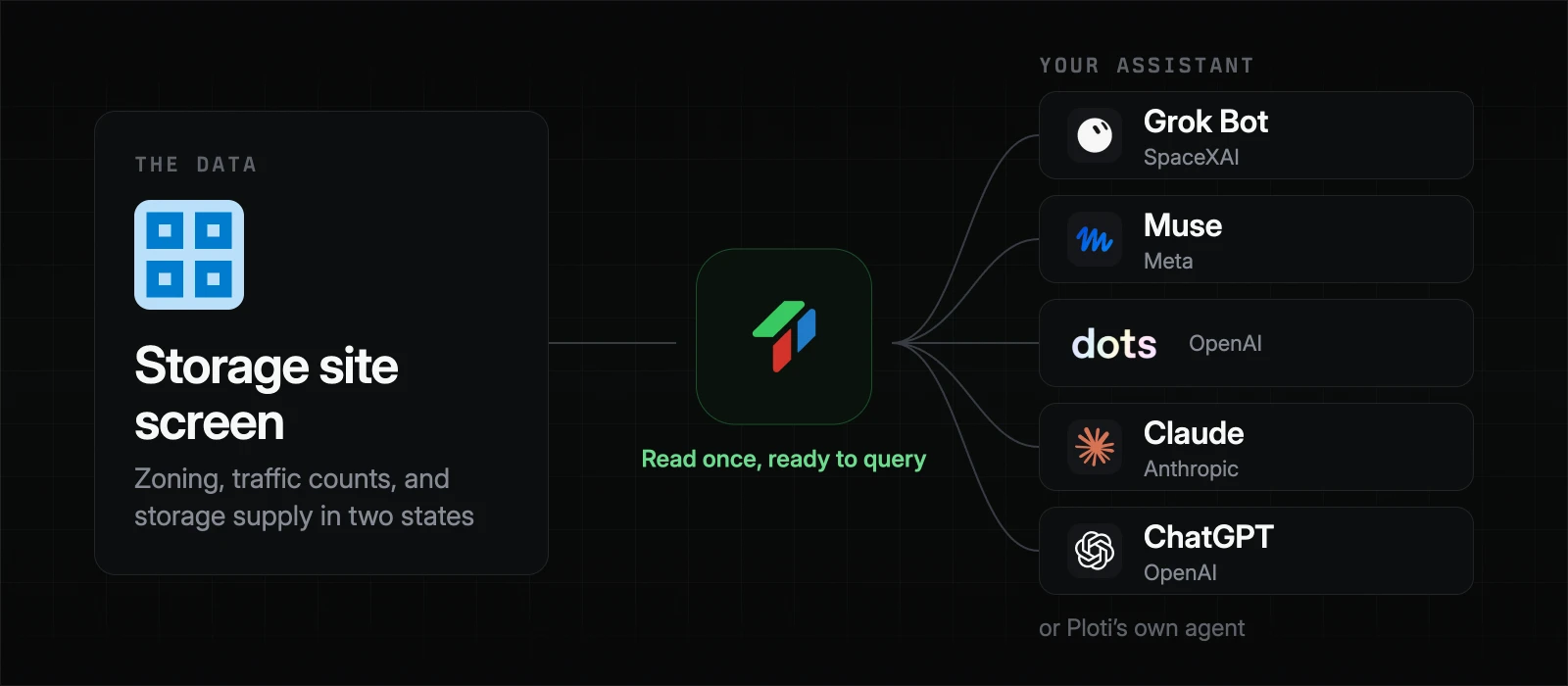
Each source was fetched once and stays ready. The developer's assistant can now rerun the screen for a different minimum acreage, a new metro, or outdoor storage only, through an MCP connector in Claude or ChatGPT, or through Ploti's own agent.
When a town's permitted uses are only in a scanned ordinance, Ploti's agents read it, and when a record is not online at all, Ploti can email the town for it and handle the back-and-forth.
Why not buy site data from a data provider
Storage developers often license parcel, demographic, and supply data from several providers, each on its own annual contract negotiated through sales, often in the tens of thousands of dollars. Town-by-town permitted uses, the test that rules out most sites, are rarely included.
Ploti works differently:
- No contract. Sign up and start with a 7-day trial.
- Pay for the counties you develop in. Pricing is per county and gets cheaper as you add more, so a metro's worth of counties costs tens or hundreds of dollars a month.
- Full access in your counties. Your assistant can query every parcel, district, and dataset in your coverage areas.
- It builds up over time. Ploti keeps collecting data in your counties on its own, so permits and rezonings are often ready for the next question.
What else it unlocks
The same screen supports more than one product:
- Flex and small-bay industrial. Swap the use test and traffic threshold to find flex sites in the same districts.
- Conversions. Look for vacant big-box and light industrial buildings in districts that allow storage.
- Entitlement risk. Separate by-right sites from special-permit sites, and read how the board ruled on past storage applications. For more on that, see how to find rezoning history with AI.
Anything your screen needs that Ploti does not have yet, you can ask for as a data request.
Frequently asked questions
What zoning allows self storage?
It varies by town. Self storage is often allowed in industrial and some commercial districts, sometimes only by special permit, and some towns restrict it near downtowns or residential areas. The town's table of permitted uses is the place to check.
How much land does a self storage facility need?
Commonly a few acres, depending on whether it is a single-story drive-up layout or a multi-story climate-controlled building. Industrial outdoor storage sites are often larger and need room for truck circulation.
What is industrial outdoor storage (IOS)?
Land used mainly for parking or storing trucks, trailers, equipment, or materials outdoors, usually with a small building. Good IOS sites sit close to highways and freight routes and are zoned industrial.
Can an AI assistant find self storage sites?
Yes, once it can query parcels, zoning, traffic, and supply data. Connect Claude, ChatGPT, or another assistant to Ploti with an MCP connector and ask for parcels that fit your storage criteria, or ask Ploti's own agent.
How you can do it yourself
If you already use an assistant, connect Ploti and run your own storage screen. Setup takes about two minutes for Claude, ChatGPT, Gemini, Claude Code, Codex, and Cursor, and works with any assistant that supports MCP connectors. Then ask:
- "Find vacant parcels of three to eight acres in districts that allow self storage by right, outside flood zones."
- "Which of these front a road with more than 20,000 cars a day?"
- "How many existing storage facilities are within three miles of each site?"
If you don't use an assistant, ask Ploti's agent on the web, in the Mac or Windows app, or soon on your phone. Pick the counties you work in and start a 7-day trial.