How to find rezoning history and comparables with AI
We read twenty years of rezoning votes in two and a half days.

Brennen Fountain
Most counties do not publish rezoning history as data; past cases and their votes live in planning commission and board meeting minutes. To find comparable rezonings, those archives have to be read and turned into a searchable record of every case, request, recommendation, and vote. An AI assistant such as Claude or ChatGPT can search that record and find comparables in seconds, but it cannot build the record from the PDFs on its own.
A land developer was weighing a site they planned to rezone. One question weighs heavily on a deal like that, and it is easy to ask and hard to answer:
Find comparable rezonings near my site.
The problem: rezoning risk you can't see
Rezoning is often one of the larger unknowns in a land deal, and precedent is a practical way to gauge it. If the last five similar requests nearby passed with conditions, you know what to ask for, what it will cost you, and how likely you are to get it.
Few counties publish that history as data. It lives in planning commission and board meeting minutes, agendas, and staff reports, usually as PDFs on a county website, one meeting at a time.
Doing it by hand means opening and reading each of those documents. For this county that was 1,823 of them; at even five minutes apiece, that is more than 150 hours of reading before you have a single answer. So many teams go in with a hunch and a few phone calls.
The result: twenty years of votes in two and a half days
Two and a half days after asking, the developer had the county's full rezoning record from 2005 to 2026: 324 cases, each with who applied, what they asked for, how staff and the commission recommended, the final vote, and the conditions attached. Every case links back to the page of the meeting record it came from.
Instead of a hunch, they could see which requests like theirs had passed nearby, what the commission tended to ask for in return, and how often staff recommendations held. And they could keep asking new questions of the same record whenever they needed to.
Why an AI assistant can't do this on its own
It is natural to assume you could ask ChatGPT or Claude for this. AI assistants like these are increasingly used as agents: you give them a task in plain English, and they research, analyze, and act on it for you. They reason well over information once they have it. Getting it is the problem.
Ask one for the county's rezoning history and it will search the web and summarize whatever loads. It cannot work through twenty years of PDF minutes on a county website, the history is not in its training data, and nothing it finds is saved for the next question. You get a few scattered cases at best, often with no way to check them.
How it was done: Ploti
The developer used Ploti, the real estate data layer for AI. Ploti's data agents fetch and compile public records from local governments (the planning archives, GIS servers, recorders, and permit portals a county runs) and store them so an AI agent can query all of it. For this request that meant finding the county's planning commission and board archives, reading all 1,823 meeting documents, and building the record of 324 cases, each tied to the page it came from.
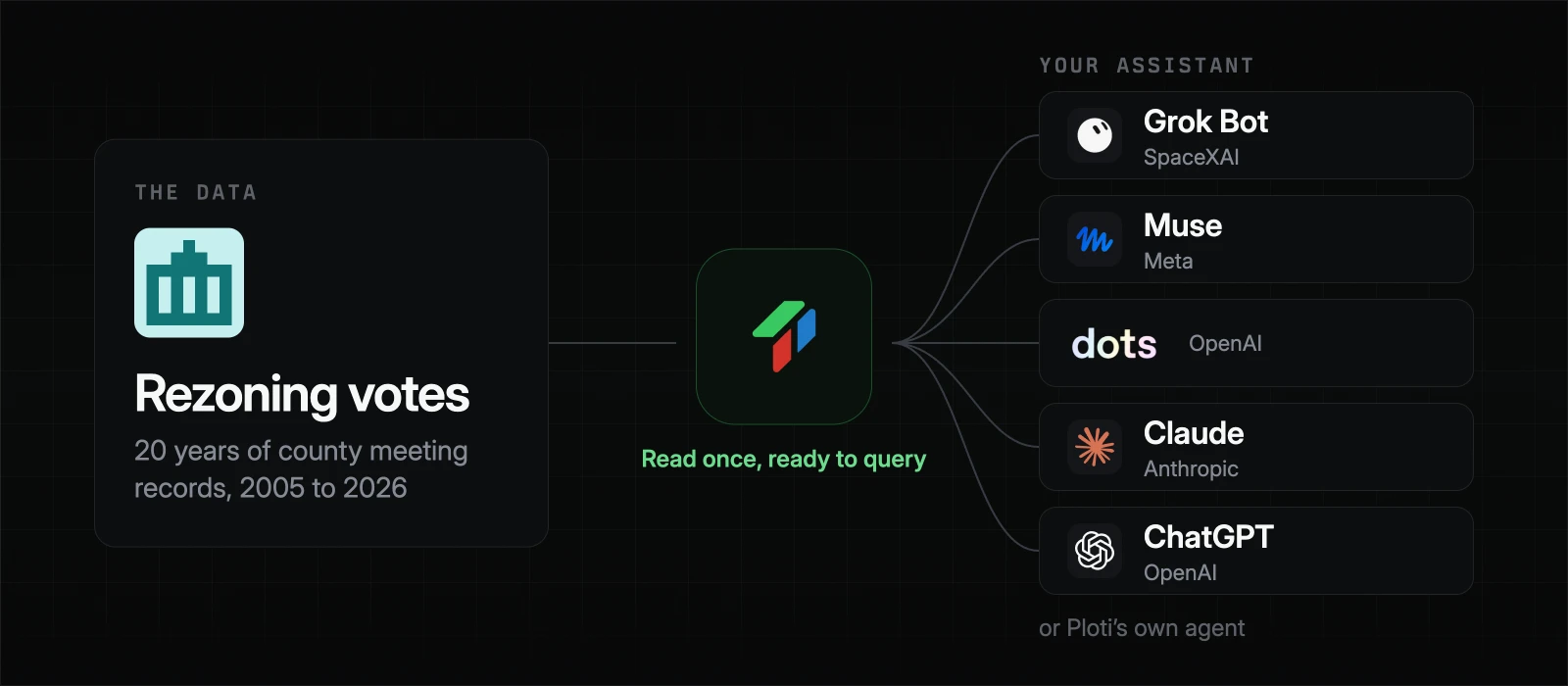
The developer asked for it in one sentence, as a data request. That reading happened once: the whole archive stays ready to query, so their assistant can go back to all twenty years whenever a new question comes up, in seconds, through an MCP connector in Claude or ChatGPT, or through Ploti's own agent.
Meeting archives are one kind of hard-to-reach source. The same agents work through permit portals built to resist automation, and when a county keeps records offline, Ploti can email the county for them and handle the back-and-forth.
Why not buy rezoning history from a data provider
Rezoning votes are rarely part of what traditional real estate data providers sell, and the local data they do sell usually comes with an annual contract negotiated through sales, often in the tens of thousands of dollars, and access limited by seats, exports, or lookups. For one developer looking at one county, that math rarely works.
Ploti is set up differently:
- No contract. You sign up yourself and start with a 7-day trial.
- You pay for the counties you work in. Pricing is per county, starting at $50 a month, so keeping this county's rezoning record at hand costs tens of dollars a month, not an enterprise license.
- Full access in your counties. Your assistant can query the entire rezoning archive and every other dataset in your coverage areas, not a capped number of lookups.
- It gets more useful the longer you use it. Ploti keeps pulling data in your counties on its own, so the zoning, parcels, permits, and meeting records around your next site are often already there before you ask.
What else it unlocks
The same history answers more than one deal:
- Where the county is heading. Which areas keep getting rezoned toward the use you want, and which keep saying no.
- Hearing prep. The conditions the commission tends to attach, so you can offer them before they are asked for.
- Which counties to work in. With the same history pulled for each county you are considering, you can compare how often each one approves requests like yours.
Paired with other data in the same market (everything Ploti maintains in your coverage areas) it goes further: with current zoning and parcels, you can find land where a rezoning like yours has already passed next door; with building permits, you can see which approved rezonings actually turned into construction.
Frequently asked questions
Where can I find the rezoning history for a county?
In the county's planning commission and board of commissioners meeting records: agendas, staff reports, and minutes, usually published as PDFs one meeting at a time. Very few counties publish rezoning history as a dataset.
What are comparable rezonings?
Past rezoning requests near your site that asked for a similar change, with how staff recommended and how the commission voted. They are a useful guide to whether your own request is likely to pass and what conditions to expect.
How long does it take to compile rezoning history?
By hand, days of reading per county. Ploti read 1,823 meeting documents covering 2005 to 2026 for one Georgia county and delivered 324 rezoning cases about two and a half days after the request.
Can my AI assistant search rezoning history?
Yes. Connect Claude, ChatGPT, or another assistant to Ploti with an MCP connector and ask it about past rezonings in your markets, or ask Ploti's own agent.
How you can do it yourself
If you already work in an assistant, add Ploti as a connector and ask it the same kind of question about your own markets. Setup takes about two minutes for Claude, ChatGPT, Gemini, Claude Code, Codex, and Cursor, and works with any assistant that supports MCP connectors. Then try something like:
- "Which rezonings from agricultural to residential passed near my site in the last five years, and with what conditions?"
- "How often does the commission follow staff's recommendation on residential rezonings?"
- "Which past cases asked for the same zoning I need, and how did each vote go?"
If you don't use an assistant, ask Ploti's agent directly on the web, in the Mac or Windows app, or soon on your phone. Pick the counties you work in and start a 7-day trial.