How to find land sale comps with AI
Is a $200,000-an-acre offer right? Comps checked against the deed records.

Brennen Fountain
Land sale comps come from recorded deeds at the county clerk or recorder, from the property appraiser's sales data, and from brokerage reports of verified sales. A useful comp ties a reported sale to its recorded deed and parcel, so the price, date, acreage, and zoning can be checked. An AI assistant such as Claude or ChatGPT can compare comps and price per acre in seconds once they are verified and in one place, but it cannot pull deed records and match them to sales on its own.
A land advisor's client had a letter of intent on a residential development site in Pasco County, Florida, at roughly $200,000 an acre. Before answering, the advisor needed evidence:
Evidence on whether the ~$200k/acre LOI is correct or should be increased, using true market land transactions rather than assessor records alone.
The problem: a comp you can't check doesn't hold up
In a land negotiation, the side with better comps usually wins the argument. Recent sales of similar land nearby, at a known price per acre, are what move a buyer off a number. A comp only helps if it is real, though: the right parcel, the right date, the right price, and land that was bought for the same kind of use.
The easy sources do not get you there. Assessor records show what the county thinks land is worth, not what it sold for. Brokerage reports and listings name sales, but a reported price, date, and city are not proof that a sale happened that way. The proof is the recorded deed at the county clerk, and finding the deed for each reported sale means searching the clerk's records by party, date, and parcel, then checking the acreage and zoning against the property appraiser.
For a couple of dozen sales, that is several days of record searching before you have a table you can put in front of the other side.
The result: 19 land sales, 16 checked against the deeds
The advisor ended up with 19 residential-development land sales in Pasco County from 2024 and 2025, each with its sale date, price, gross and usable acreage, and price per acre. 16 of them were tied to the recorded deed, with the buyer, seller, parcel, current zoning, and future land use attached. The other three stayed in the table, marked as unverified, so the advisor could decide whether to use them.
To test the price from the other direction, they also had 225 multifamily comps for the same area: 213 current unit rents across three properties, lease-up occupancy, and four verified sales with price per unit. One number was left empty on purpose: transaction cap rates sit behind paid industry databases, so instead of filling them with survey averages, the table says where they would come from.
With that, "is $200,000 an acre right" became a table the advisor could defend, line by line, with a source for every number.
Why an AI assistant can't do this on its own
AI assistants like Claude and ChatGPT increasingly act as agents: describe a task in plain English and they research it, work through it, and come back with an answer. Give one a verified comp table and it will compute price-per-acre ranges, adjust for size, and draft the argument well. Building the table is the hard part.
Ask an assistant for land comps in Pasco County and it will search the web and return listings, a news story or two, and maybe assessor values. It cannot search the clerk's deed records for each sale, it has no way to confirm a reported sale against the recorded deed, and anything it does find is gone when the chat ends. Worse, it may present an asking price or an assessed value as a sale, and you would not know.
How it was done: Ploti
The advisor used Ploti, the real estate data layer for AI. Ploti's data agents pull records from the local offices that keep them, clerks, recorders, property appraisers, planning departments, and compile them so an AI agent can query them with every value traced to its source. For this request they collected the reported land sales, searched the county clerk's deed records for each one, and attached the parcel, zoning, and land use behind every verified sale.
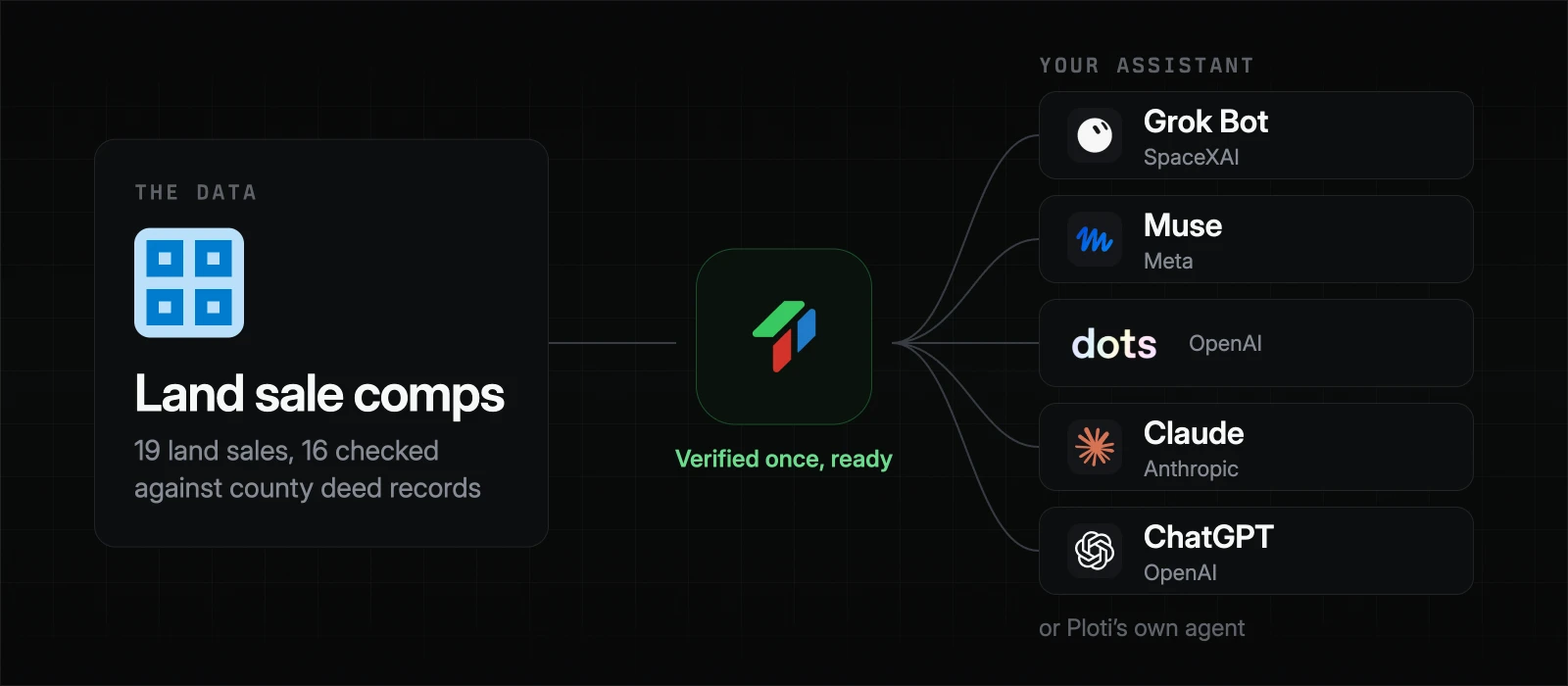
The work was done once. The advisor's assistant can now filter the sales by size, date, or zoning, recompute price per acre, or pull the deed behind any row whenever the negotiation moves, through an MCP connector in Claude or ChatGPT, or through Ploti's own agent.
Deed searches are one kind of hard-to-reach record. The same agents work through permit portals and meeting archives, and when a record is only available on request, Ploti can email the county for it and handle the back-and-forth.
Why not buy land comps from a data provider
Commercial comp databases sell sales data on annual subscriptions negotiated through sales, often in the tens of thousands of dollars, with exports and seats limited by plan. Land sales in growing exurban counties are often thin or unverified in them, and you still have to check each one against the deed before relying on it.
Ploti works differently:
- No contract. Sign up and start with a 7-day trial.
- Pay for the county you work in. Pasco County on its own starts at $50 a month, tens of dollars instead of an annual license.
- Every record, with its source. Your assistant can query every sale and deed in your coverage areas, not a capped number of exports.
- It builds up over time. Ploti keeps collecting data in your counties on its own. Pasco's planning application history is already there, which you can read about in how to look up building permit history with AI.
What else it unlocks
Verified comps support more than one negotiation:
- Pricing a listing. Set an asking price per acre with sales the buyer's broker cannot easily dispute.
- Residual land value. Pair land sales with rent and sale comps for the planned use to check whether the project supports the price.
- Entitlement premium. Compare sales by zoning and future land use to see what approved land sells for against unentitled land.
Anything your analysis needs that Ploti does not have yet, you can ask for as a data request.
Frequently asked questions
Where can I find land sale comps?
From the county clerk or recorder's deed records, the property appraiser's sales data, and brokerage reports of land sales. Recorded deeds are the proof; reports and listings help find the sales worth checking.
What makes a land comp verified?
It can be tied to a recorded deed and parcel, so the buyer, seller, date, price, and acreage match the public record. A reported sale that cannot be tied to a deed is a lead, not a comp you can defend.
How many land comps do I need?
Enough recent, similar sales to show a range, usually a handful to a couple of dozen depending on the market. In one Pasco County, Florida request, Ploti found 19 residential-development land sales and verified 16 against the county's deed records.
Can an AI assistant pull land comps?
Yes, once the sales are somewhere it can query. Connect Claude, ChatGPT, or another assistant to Ploti with an MCP connector and ask for land sales near a site, or ask Ploti's own agent.
How you can do it yourself
If you already use an assistant, connect Ploti and pull comps for your own sites. Setup takes about two minutes for Claude, ChatGPT, Gemini, Claude Code, Codex, and Cursor, and works with any assistant that supports MCP connectors. Then ask:
- "List residential land sales over 10 acres in this county since 2024, with price per acre and the recorded deed."
- "Which of these sales were zoned for residential use at the time, and what did they sell for per acre?"
- "What range of price per acre do the verified sales support for a 40-acre site?"
If you don't use an assistant, ask Ploti's agent on the web, in the Mac or Windows app, or soon on your phone. Pick the counties you work in and start a 7-day trial.