How to check convenience store zoning rules with AI
Every county and city in Georgia, one set of rules to query.

Brennen Fountain
Convenience store rules come from several places: the local zoning ordinance decides where a store is allowed and under what conditions, the state building code sets construction standards, and separate state and local licenses cover food sales, alcohol, and fuel. In Georgia that means checking the ordinance of whichever of 159 counties or more than 500 cities a site sits in. An AI assistant such as Claude or ChatGPT can compare sites against those rules in seconds once they are collected in one place, but it cannot read hundreds of local codes on its own.
A site selection consultant planning convenience store sites in Georgia needed to know, for any site, whether a store was allowed and what it would take to open one. The request covered the whole state:
Convenience store building requirements: statewide Georgia zoning, building code, licensing, and site standards.
The problem: the rules change at every city limit
For a convenience store, the site question is rarely just "is it zoned commercial". Some codes allow stores by right in one district and only with a special-use permit in the next. Fuel sales are often a separate use with their own conditions. Parking ratios, setbacks, hours, and distance rules for selling alcohol near schools and churches all vary from place to place.
Each of those answers sits in the zoning ordinance of whichever local government the site falls under, and Georgia has 159 counties and more than 500 cities. On top of the local codes come the state's construction codes and a stack of licenses: food sales, beer and wine, fuel tanks, a business license.
Checking one site by hand means finding the right ordinance, reading the use table and the sections it points to, and then working through the state rules. That is often a few hours a site, and a consultant comparing dozens of sites across several counties repeats it for each new jurisdiction.
The result: one set of rules for the whole state
What the consultant gets back is the rules as data rather than a stack of ordinances. For each county and city, where convenience stores and fuel sales are allowed, by right or with approval, and the conditions that come with them, each linked to the section of the ordinance it came from. Alongside sit the state's minimum construction codes and the licenses and permits a store needs, with the agency that issues each one.
With that, a site's question becomes a lookup: is a store allowed here, does it need a hearing, and what will it need to open. The consultant can compare sites across city lines on the same terms and spend site visits on the ones that pass.
Why an AI assistant can't do this on its own
AI assistants like Claude and ChatGPT increasingly work as agents: you give one a task in plain English and it researches, reasons through it, and reports back. Give one a site and the right ordinance sections, and it can explain what is allowed and what approvals are needed. Assembling those sections is where it falls short.
Ask an assistant whether a convenience store is allowed on a parcel in a small Georgia city and it will search the web, maybe find the city's code, and often read the wrong section or an old version. It cannot work through hundreds of ordinances, many published as long PDFs or on code hosting sites that do not load well for it, and it keeps nothing for the next site. The answer sounds confident either way, which makes it risky to act on.
How it was done: Ploti
The consultant asked Ploti, the real estate data layer for AI. Ploti's data agents collect public records from local governments, including zoning ordinances, planning documents, and permit records, plus the state and federal sources that sit on top of them, and store them so an AI agent can query all of it. For this request, they gather each Georgia county's and city's zoning rules for convenience stores, the state construction codes, and the state and local licensing requirements, and keep each rule tied to its source.
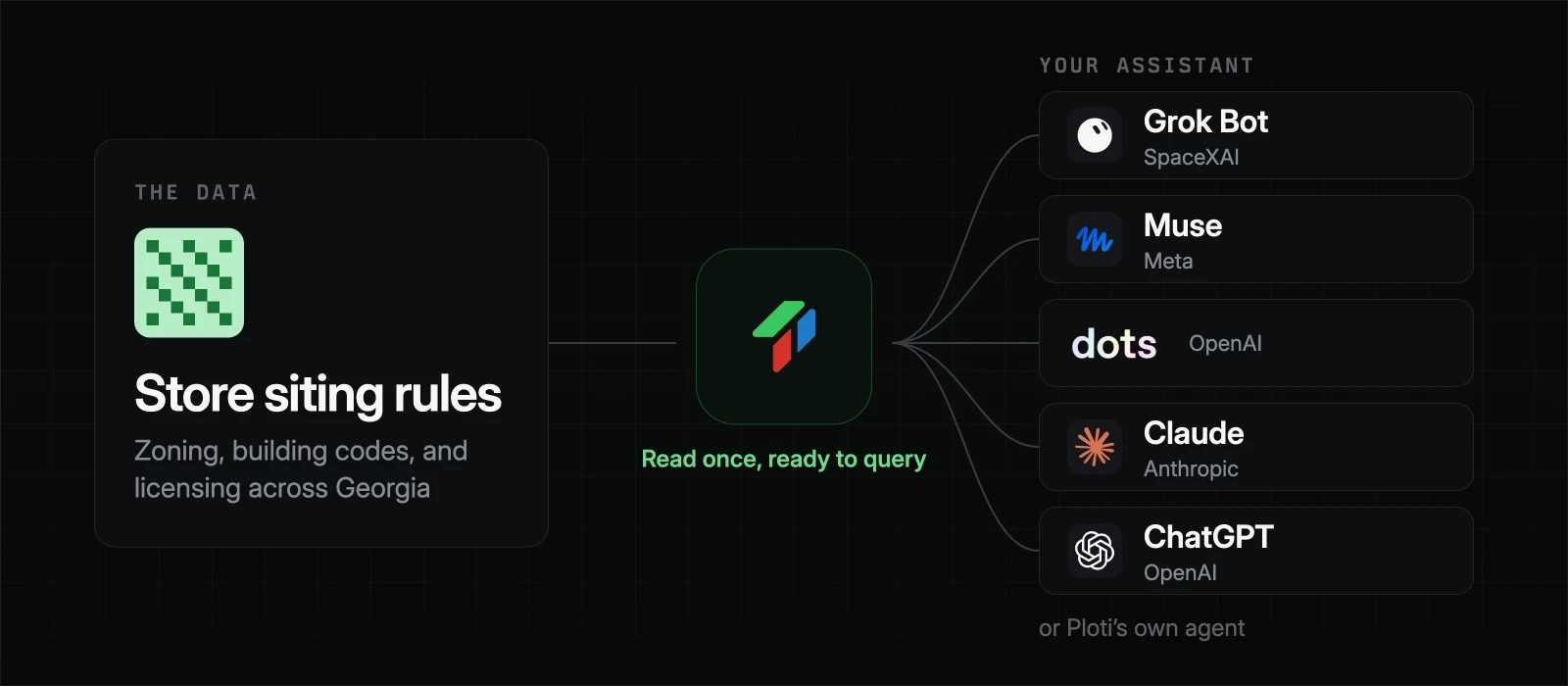
Each ordinance is read once and stays ready. The consultant's assistant can check any site against the rules for its jurisdiction, or compare every county the client is considering, whenever a new site comes in, through an MCP connector in Claude or ChatGPT, or through Ploti's own agent.
Some local rules are not online at all. When a small town keeps its ordinance on paper, Ploti can email the clerk for it and handle the exchange, and the same agents work through permit portals and meeting archives when a site's history matters as much as its zoning.
Why not buy zoning rules from a data provider
Zoning and land use rule databases exist, sold on annual contracts negotiated through sales, often in the tens of thousands of dollars, and priced by seat or lookup. Coverage tends to favor large cities, and use-specific details such as fuel sales or alcohol distance rules are often missing.
Ploti works differently:
- No contract. Sign up and start with a 7-day trial.
- Pay for the counties you're siting in. Pricing is per county, starting at $50 a month and getting cheaper as you add counties, so a regional siting program costs tens or hundreds of dollars a month.
- The rules in full. Your assistant can query every rule and its source text in your coverage areas, not a capped number of lookups.
- It builds up over time. Ploti keeps collecting data in your counties on its own, so the zoning maps, parcels, and permits you need next are often already there.
What else it unlocks
The same rules support more than one decision:
- Site screening. Pair the rules with zoning maps and parcels to list every parcel where a store is allowed by right. How those maps come together is in how to find county zoning maps with AI.
- Approval risk. Flag sites that need a special-use permit or a variance, and look at how past requests like them were decided.
- Market entry. Compare how open each county is to convenience stores and fuel before committing to a region.
Anything your siting process needs that Ploti does not have yet, you can ask for as a data request.
Frequently asked questions
Where can I find the zoning rules for a convenience store?
In the zoning ordinance of the county or city where the site is, usually in its table of permitted uses and its sections on conditional uses, parking, and setbacks. Many ordinances are posted on the local government's website or a code hosting site; some only as PDFs.
Is a convenience store with gas pumps zoned differently?
Often, yes. Many ordinances treat fuel sales as a separate use with its own districts, conditions, or special-use approval, and fuel storage tanks bring state environmental rules on top of zoning.
What licenses does a convenience store need in Georgia?
Commonly a local business license, a food sales license from the Georgia Department of Agriculture, local and state licenses to sell beer and wine, and state registration for underground fuel tanks if the store sells gas. Requirements vary by location, so check the county or city as well.
Can an AI assistant check zoning for a store site?
Yes, once it can query the rules. Connect Claude, ChatGPT, or another assistant to Ploti with an MCP connector and ask whether a convenience store is allowed on a site and what approvals it needs, or ask Ploti's own agent.
How you can do it yourself
If you already use an assistant, connect Ploti and check your own sites. Setup takes about two minutes for Claude, ChatGPT, Gemini, Claude Code, Codex, and Cursor, and works with any assistant that supports MCP connectors. Then ask:
- "Is a convenience store with fuel sales allowed on this parcel, and does it need a special-use permit?"
- "Which of these five sites allow a convenience store by right?"
- "What licenses and permits does a new convenience store selling beer and wine need in this county?"
If you don't use an assistant, ask Ploti's agent on the web, in the Mac or Windows app, or soon on your phone. Pick the counties you're siting in and start a 7-day trial.