
This example uses regional datasets (Orange County urban service area,
water service providers, wastewater service providers) to verify utility
availability. Utility verification is available in areas where we’ve
integrated local infrastructure data. Learn more about regional data
coverage.
The Opportunity
Infill lots with verified utilities are valuable because:- Water and sewer connections already exist—no extension costs
- Established neighborhoods with known comparable values
- Shorter entitlement timelines than greenfield development
- Strong buyer demand for new construction in desirable areas
Walkthrough: Finding Buildable Residential Lots
Let’s find vacant residential lots that are truly development-ready—inside the urban service area with both water and wastewater service confirmed.Step 1: Write the Research Request
Begin the request by naming the geography you want to search.Step 2: Add the Criteria
We asked:Find vacant residential lots between 0.25 and 1 acre inside the urban service area with water and wastewater service availableThis query combines four layers in one request:
- Vacant residential (land use codes 460, 465)
- 0.25 to 1 acre (single-family buildable size)
- Inside urban service area (infrastructure zone)
- Water + wastewater service (utility verification)
Step 3: Review the Research Approach
The research run used this multi-layer approach: Ploti identified:- 4,043 vacant residential lots in the study area
- 963 lots in the target size range (0.25-1 acre)
- 12 water service territories to check against
- 5 wastewater service territories to verify
Step 4: Review Final Results
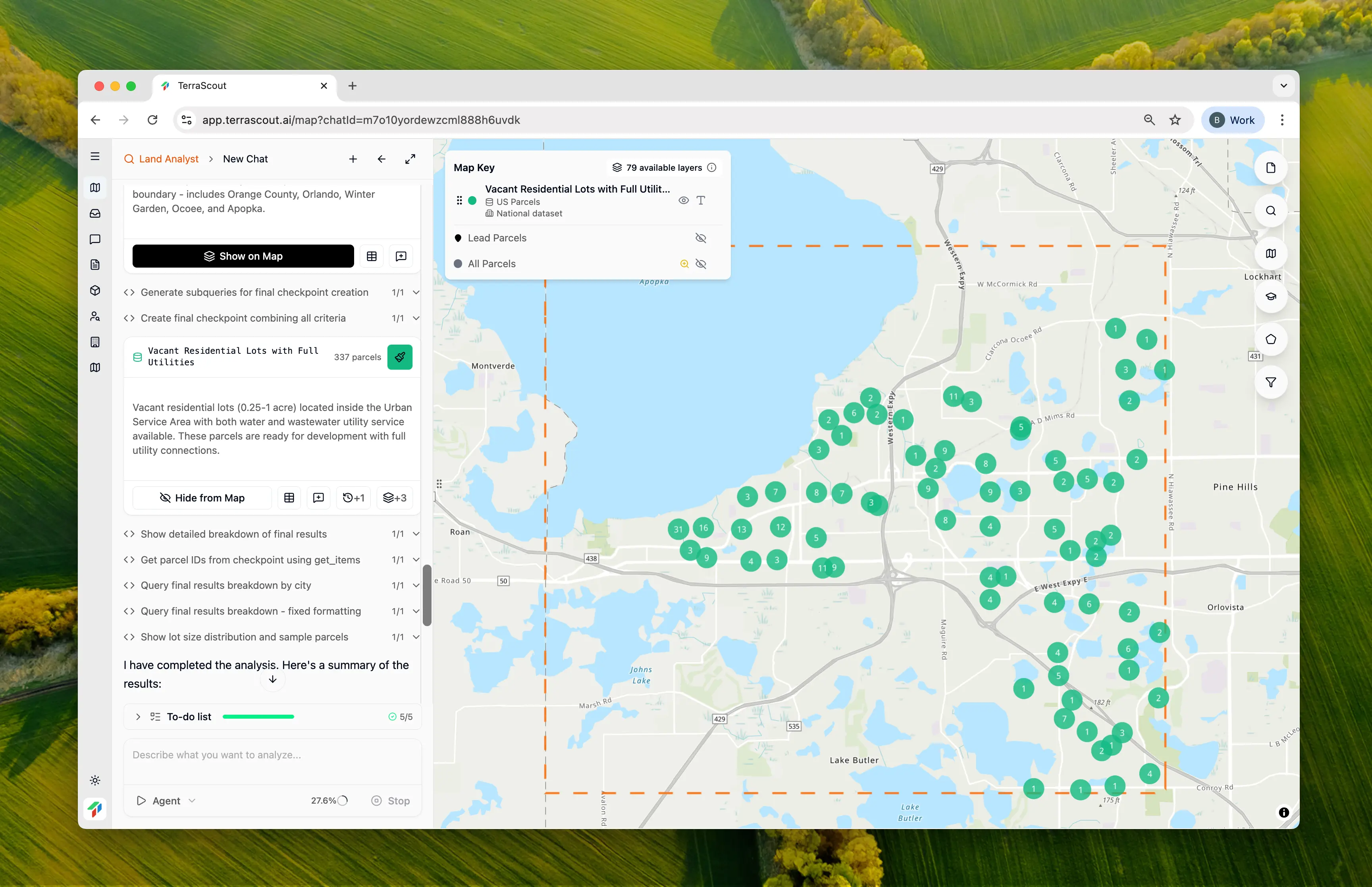
65% of size-appropriate vacant lots lack full utility service. Without utility verification, you’d waste time on lots that require expensive infrastructure extensions.
Step 5: Analyze Distribution
Ploti breaks down results by location and characteristics:
Size distribution:
- 0.25-0.50 acres: 202 parcels (60%)
- 0.50-0.75 acres: 84 parcels (25%)
- 0.75-1.00 acres: 51 parcels (15%)
Step 6: Explore Utility Service Layers
Toggle on the supporting layers to visualize the utility infrastructure: Urban Service Area — The boundary where urban-level utilities are provided: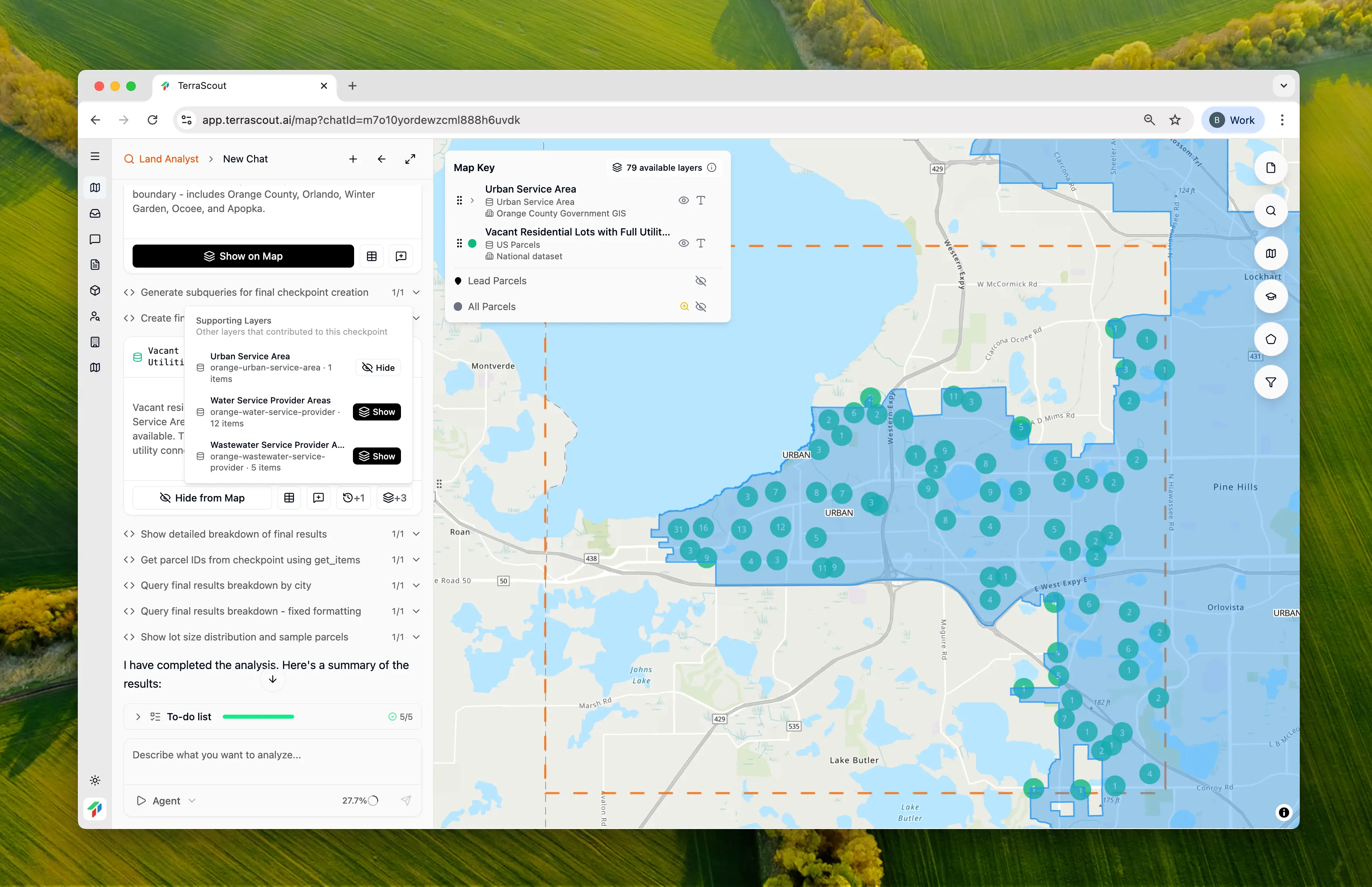
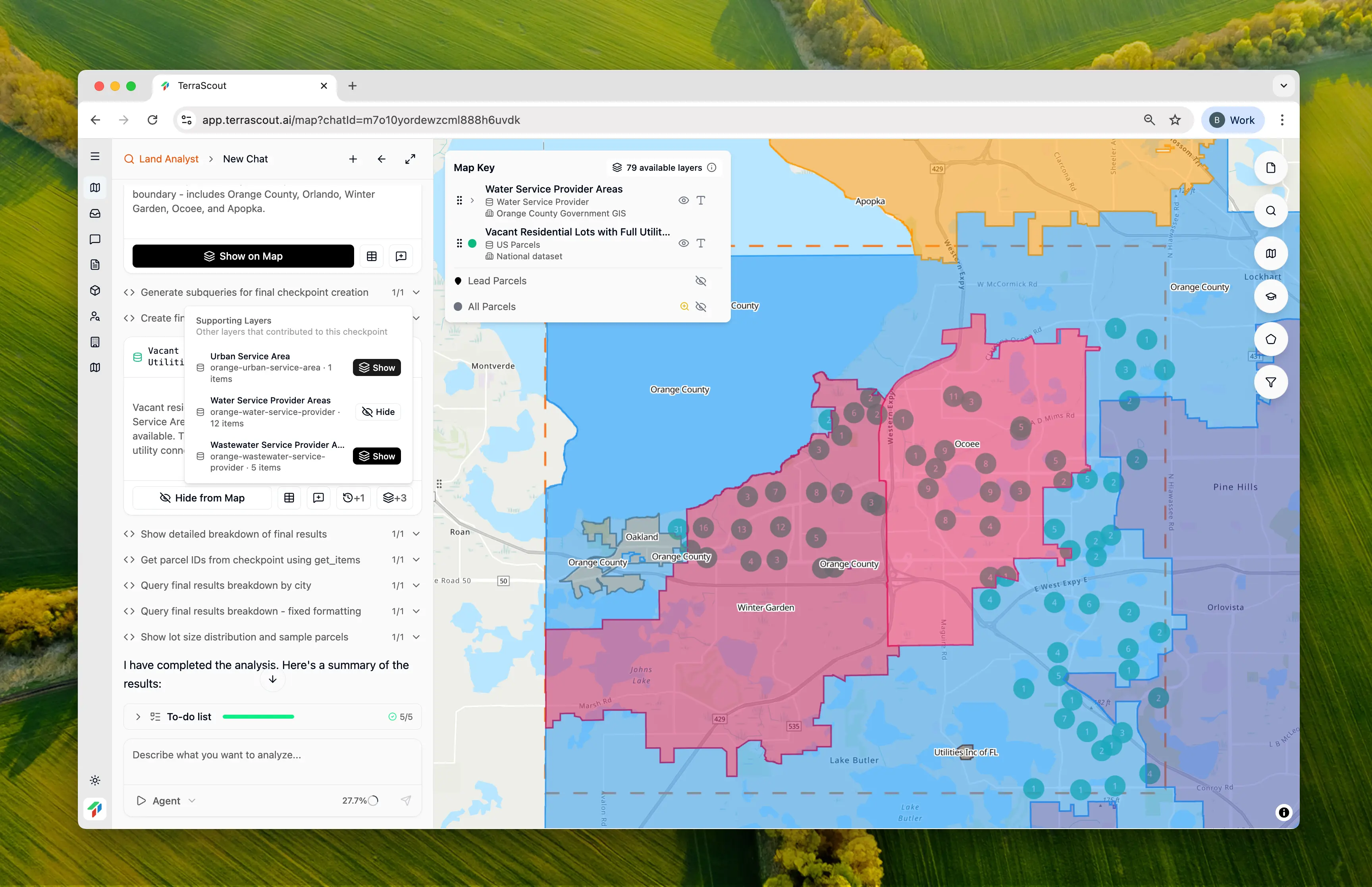
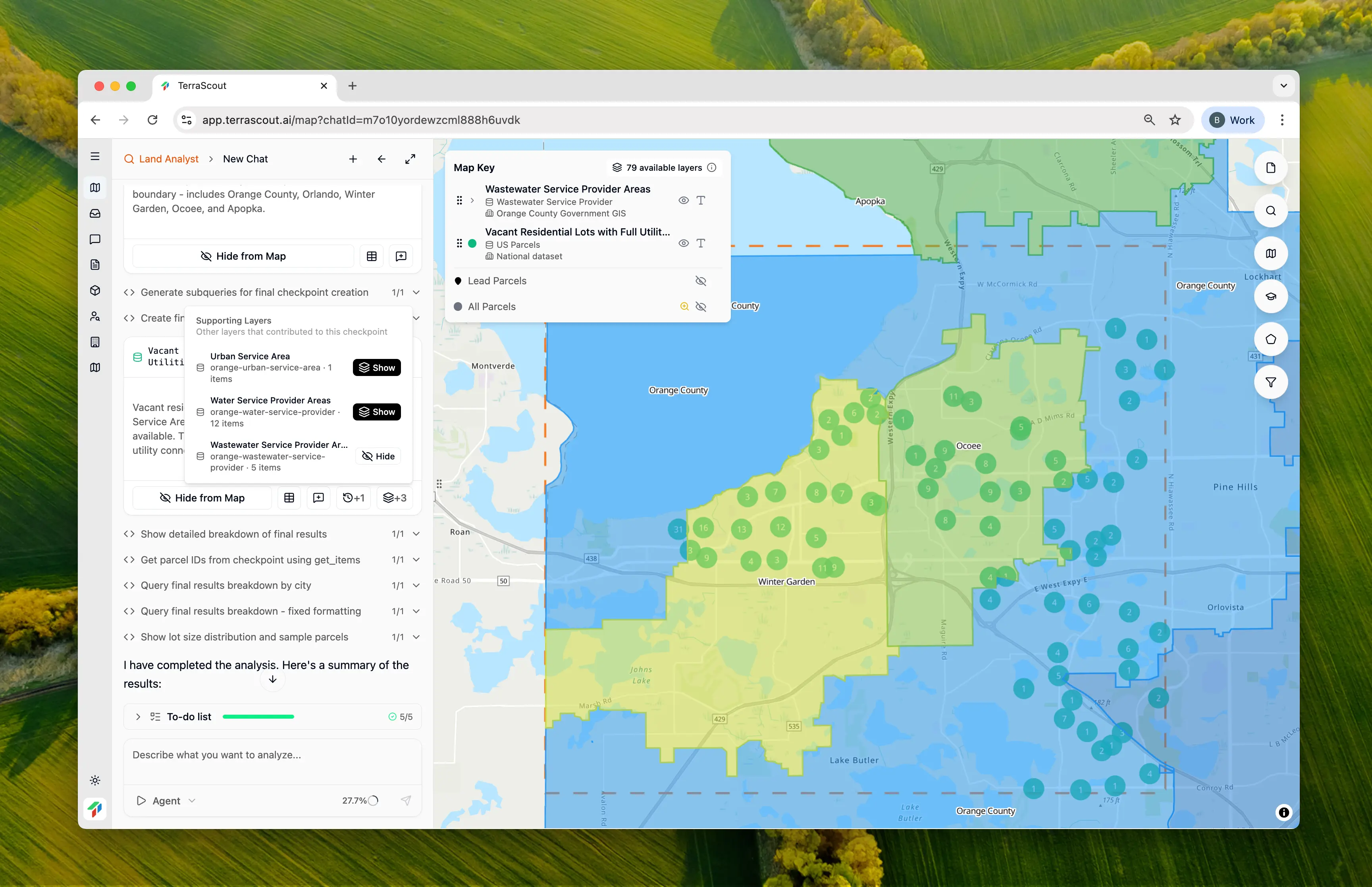
Why Utility Verification Matters
Finding a “vacant lot” is easy. Finding a buildable lot is harder. The difference:
Ploti’s cross-layer analysis eliminates lots that look good on paper but have hidden infrastructure costs.
The Manual Workflow This Replaces
Without Ploti, verifying utility availability would require:- Identifying vacant residential lots from county records
- Filtering for appropriate lot sizes
- Calling the county to determine urban service area boundaries
- Calling the water utility to verify service availability
- Calling the wastewater utility to verify sewer service
- Repeating steps 3-5 for each lot of interest
- Maintaining a spreadsheet to track which lots passed all checks
Tips
- Lots inside the urban service area typically have utility access, but verify tap fee costs with providers
- Water and wastewater service areas don’t always overlap—both are required for residential development
- Check why attractive lots are still vacant—there may be easements, access issues, or wetlands
- Compare assessed values to recent lot sales in the same subdivision
- Consider lots that have been vacant longest—owners may be more motivated to sell
Other Example Prompts
Basic Vacant Lot Search
Show me vacant residential lots under 1 acre in Winter ParkSimple search when you just need to find vacant lots in a specific area.
Value-Based Infill Search
Find vacant residential lots under 0.5 acres inside the urban service area with market values under $75,000Adds a price ceiling for budget-conscious builders.
Subdivision Infill
Find vacant lots under 1 acre within platted subdivisions that are zoned R-1Targets lots in existing neighborhoods with single-family zoning.
Infill Without Flood Risk
Find vacant residential lots between 0.25 and 1 acre with water service that are not in a FEMA flood zoneCombines utility verification with environmental screening.