
The Opportunity
Pad sites are attractive because:- Built-in traffic from anchor tenants (grocery, big-box)
- Established retail location with proven demand
- Smaller footprint than ground-up development (typically 0.5-2 acres)
- Often available when main center is fully leased
- Drive-through uses capture pass-by traffic
Walkthrough: Finding Pad Sites Near Major Retail Anchors
Let’s find pad site opportunities for a drive-through restaurant near Walmart, Target, Publix, and other grocery stores. We need small vacant commercial lots that can support drive-through operations.Step 1: Write the Research Request
Name the target market in the request. In this example, the geography spans Orlando, Winter Garden, Ocoee, and Windermere—major retail corridors with established anchor tenants.Step 2: Add the Criteria
We asked:Find pad site opportunities near Walmart, Target, or grocery stores. Looking for small vacant commercial lots (under 2 acres) that could work for a drive-through restaurant.This triggers a multi-layer analysis:
- POI discovery for retail anchors
- Small parcel filtering (under 2 acres)
- Vacancy detection
- Drive-through zoning research by municipality
Step 3: Watch the Discovery
Ploti discovered retail anchor locations and researched drive-through requirements: Anchor Stores Identified:
Drive-Through Zoning by Municipality:
Key Finding: Orlando has the most specific drive-through regulations with clear zoning districts where permitted per Sec. 58.740. Orange County prohibits drive-throughs in the Lake Apopka Rural Settlement (LARS) Overlay.
Step 4: Review the Research Approach
The research approach:- Map anchor stores (Walmart, Target, Publix, grocery/department stores)
- Map vacant commercial parcels (under 2 acres, commercial zoning)
- Spatial proximity filter (within ~1,000 ft of anchors)
- Refine by jurisdiction with appropriate drive-through zoning
- Return final sites with supporting anchor-store context
- Orlando Sec. 58.740 — Drive-Through General Requirements (permitted zones)
- Orlando Sec. 58.741 — Waiting Areas (6 spaces minimum for restaurants)
- Orange County Sec. 38-74 — Permitted Uses (Use Table 38-77)
- Orange County Sec. 38-1094 — LARS Overlay Prohibited Uses (drive-throughs prohibited)
Step 5: Review the Analysis Outputs
Once the data check was complete, Ploti ran the analysis. Ploti shows the filtering funnel at each step:
The progressive filtering shows how Ploti narrowed from 394 vacant commercial parcels to 24 prime pad site opportunities based on anchor proximity.
Step 6: Review the Results
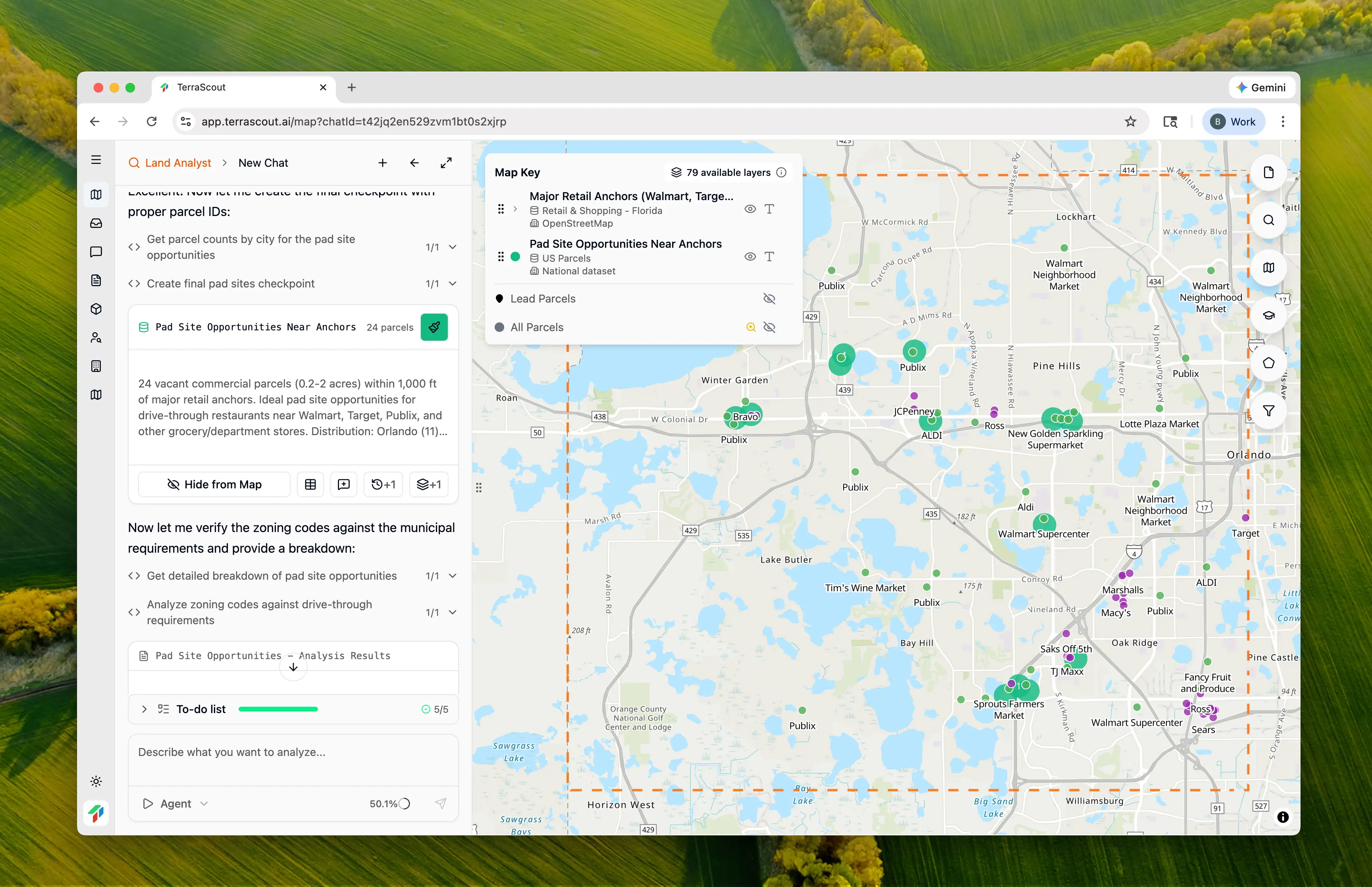
The map shows pad sites with the anchor store layer—toggle it to visualize the traffic generators near each opportunity.
Step 7: Examine Top Opportunities
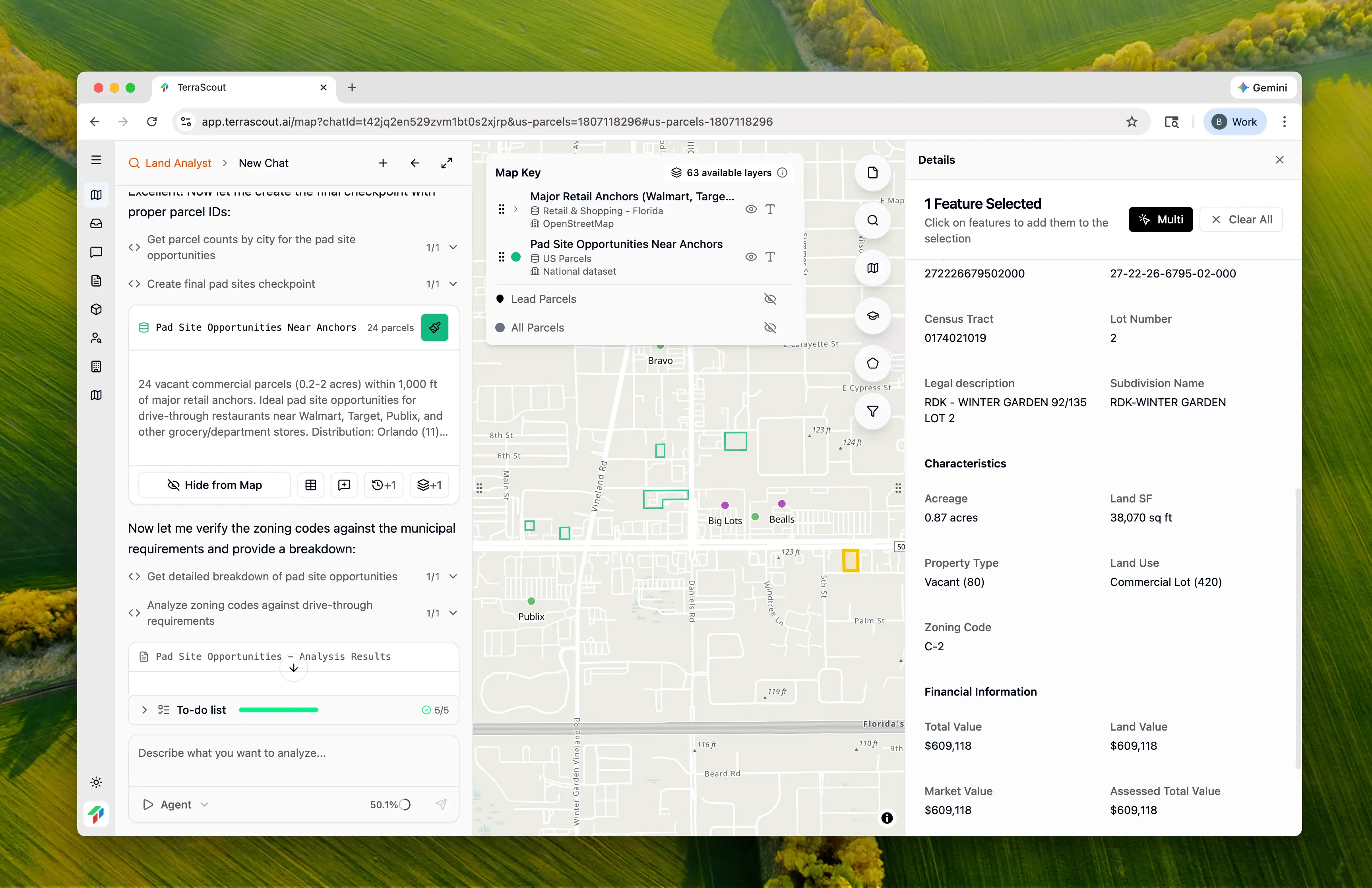
Best for Drive-Through: The Orlando AC-2 and AC-3 sites (Metrowest Blvd, International Dr) have drive-through uses explicitly permitted per Sec. 58.740—no conditional use or special exception required.
Step 8: Understand Key Corridors
The analysis revealed four key corridors for pad site opportunities:Why This Matters
This analysis demonstrates anchor-adjacent site selection:- POI discovery — Found 74 retail anchors automatically from mapping data
- Small parcel filtering — Focused on pad-appropriate sizes (0.2-2 acres)
- Proximity analysis — Spatial filter within 1,000 ft of traffic generators
- Drive-through zoning research — Municipality-specific permitted zones
- Supporting layers — Toggle anchor stores to visualize traffic sources
- Obtaining POI data for major retailers
- Mapping anchor locations across the metro
- Filtering parcel data for vacancy and size
- Performing spatial proximity analysis
- Researching drive-through zoning for each municipality
Taking It Further
With 24 pad sites identified, you can refine further:Which of these sites have the highest traffic counts on adjacent roads?Layer in AADT data for site quality ranking.
Show me the drive-through stacking requirements for AC-2 zoning in OrlandoResearch the 6-space waiting area requirement (Sec. 58.741).
Which pad sites are NOT in the LARS Overlay?Exclude areas where drive-throughs are prohibited.
What’s the typical land value for pad sites in this market?Compare assessed values across opportunities.
Key Insights
Why Anchor Proximity Drives Value
Pad sites near grocery anchors benefit from:- Frequency — Grocery shoppers visit 2-3x per week
- Dwell time — Shoppers already out of cars, willing to make secondary stops
- Captive audience — Customers see your business entering/exiting the center
- Proven demand — Anchor presence validates the retail location
Drive-Through Zoning is Municipality-Specific
Don’t assume drive-through is permitted in commercial zones:
Orlando AC-2 and AC-3 sites are the safest bets—drive-through explicitly listed as permitted use.
The 1,000-Foot Threshold
We used ~1,000 feet as the proximity filter because:- Walking distance from anchor parking lot
- Close enough for visibility from anchor
- Captures sites that feel “part of” the retail center
- Industry standard for pad site trade area
Tips
- Toggle the anchor layer — Seeing which store generates traffic helps prioritize sites
- Verify access — Pad sites need ingress/egress from the main road, not just anchor adjacency
- Check stacking requirements — Orlando requires 6 waiting spaces for drive-through restaurants
- Consider visibility — Corner parcels and road-facing sites perform better
- Research overlays — LARS, tourism, and corridor overlays have special requirements
- AC zones are premium — Orlando Activity Center zoning explicitly permits drive-through
Other Example Prompts
Bank Pad Sites
Find small commercial parcels under 1 acre near grocery stores for a bank branch with drive-throughBanks need similar pad site characteristics.
Pharmacy Pads
Show me vacant commercial lots near grocery anchors that could support a Walgreens or CVS with drive-throughPharmacy + grocery co-tenancy is common.
Coffee Shop Pads
Find pad site opportunities under 0.75 acres near Publix or Walmart for a drive-through coffee shopSmaller footprint for morning traffic capture.
Quick Service Multiple Sites
I need 5 pad sites across the Orlando metro for a QSR expansion. Find vacant commercial near grocery anchors in different submarkets.Multi-site analysis for expansion planning.
Non-Drive-Through Retail
Find pad sites near big-box retailers for a sit-down restaurant—don’t need drive-through capabilityDifferent zoning requirements when drive-through isn’t needed.