
The Opportunity
Retail site selection often follows anchor tenants:- Grocery stores generate consistent daily traffic
- Customers make secondary stops (QSR, pharmacy, services)
- Being near anchors without competition is the sweet spot
Walkthrough: Finding McDonald’s Sites Near Underserved Publix Stores
Let’s find potential McDonald’s locations by identifying Publix grocery stores that don’t have a McDonald’s nearby. These represent gaps where grocery traffic could support a new QSR.Step 1: Write the Research Request
Name the target market in the request. In this example, the geography spans Orlando, Winter Garden, Ocoee, and Windermere—capturing major grocery-anchored retail corridors.Step 2: Add the Criteria
We asked:Where are the Publix stores that DON’T have a McDonald’s nearby? Find commercial sites near those underserved Publix locations.This frames the problem as gap analysis—find the anchors first, then the opportunities near them. Ploti:
- Discovers POI data for both brands
- Performs spatial exclusion analysis
- Identifies vacant commercial parcels
- Researches zoning for restaurant uses
Step 3: Watch the Discovery
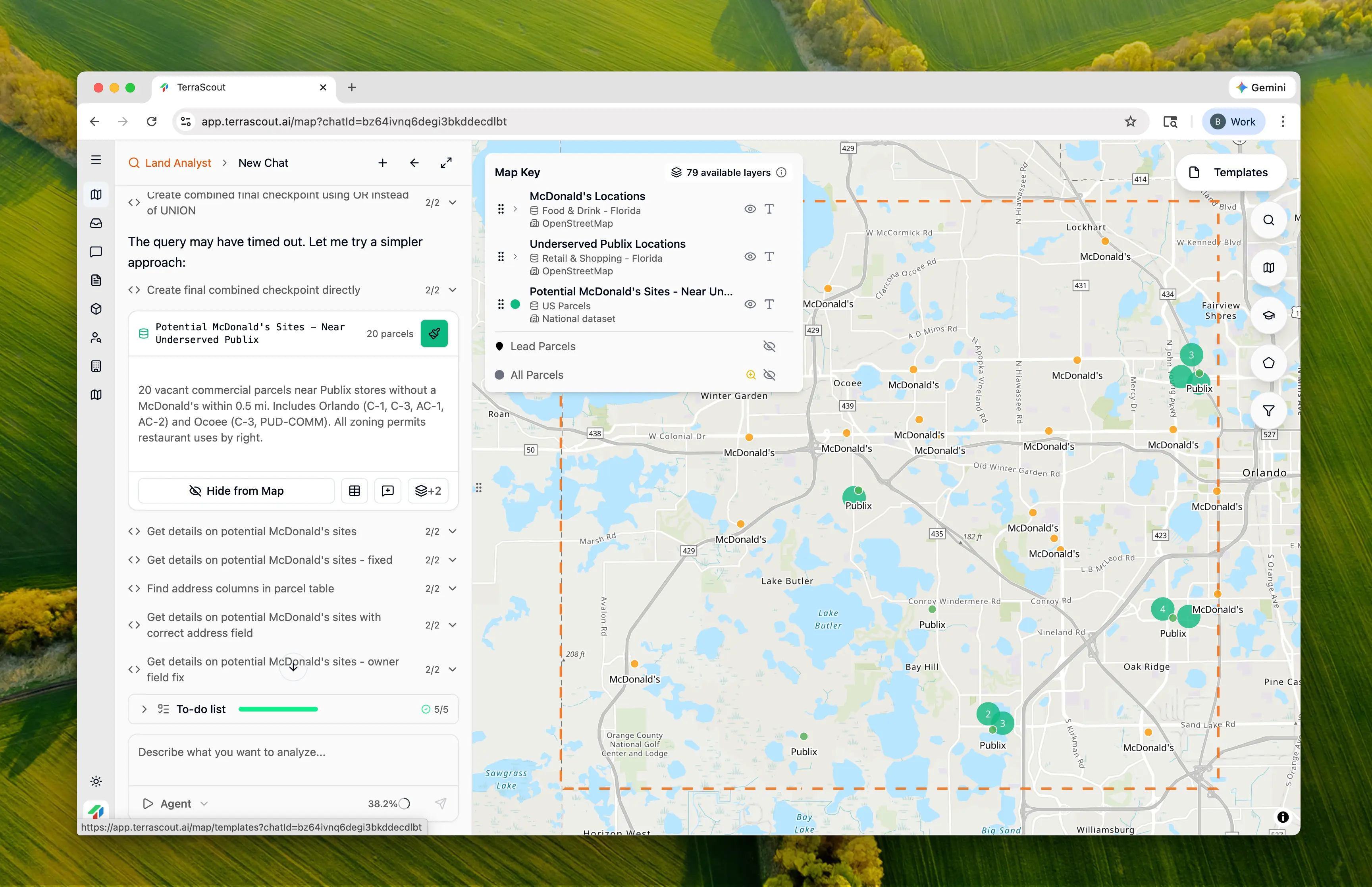
Ploti found POI data and performed the gap analysis: Locations Discovered:
Underserved Publix Locations Found:
Key Finding: 6 Publix stores have no McDonald’s within 0.5 miles—these are underserved locations where grocery traffic isn’t being captured by an existing McDonald’s.
Step 4: Review the Research Approach
The research approach:- Map underserved Publix locations (6 stores)
- Map all McDonald’s locations (reference layer)
- Find vacant commercial parcels in Orlando near underserved Publix
- Find vacant commercial parcels in Ocoee near underserved Publix
- Return the combined set of potential sites
- Orlando LDC Table FG-2A — Allowable uses in AC-N, AC-1, AC-2, AC-3 districts
- Sec. 58.341 — Activity Center Districts purpose and intent
- Orange County Sec. 38-851 — General Commercial Districts (C-1, C-2, C-3)
- Orange County Sec. 38-1552 — Fast food/restaurant permitted locations
- Ocoee § 5-3 — C-1, C-2, C-3, PUD-COMM district definitions
Step 5: Review the Analysis Outputs
Once the data check was complete, Ploti ran the analysis. Ploti returns multiple mapped outputs:Step 6: Review the Results
- Publix locations — The underserved anchor tenants
- McDonald’s locations — Existing coverage (to visualize the gaps)
- Vacant commercial parcels — Development opportunities
Step 7: Examine Specific Opportunities
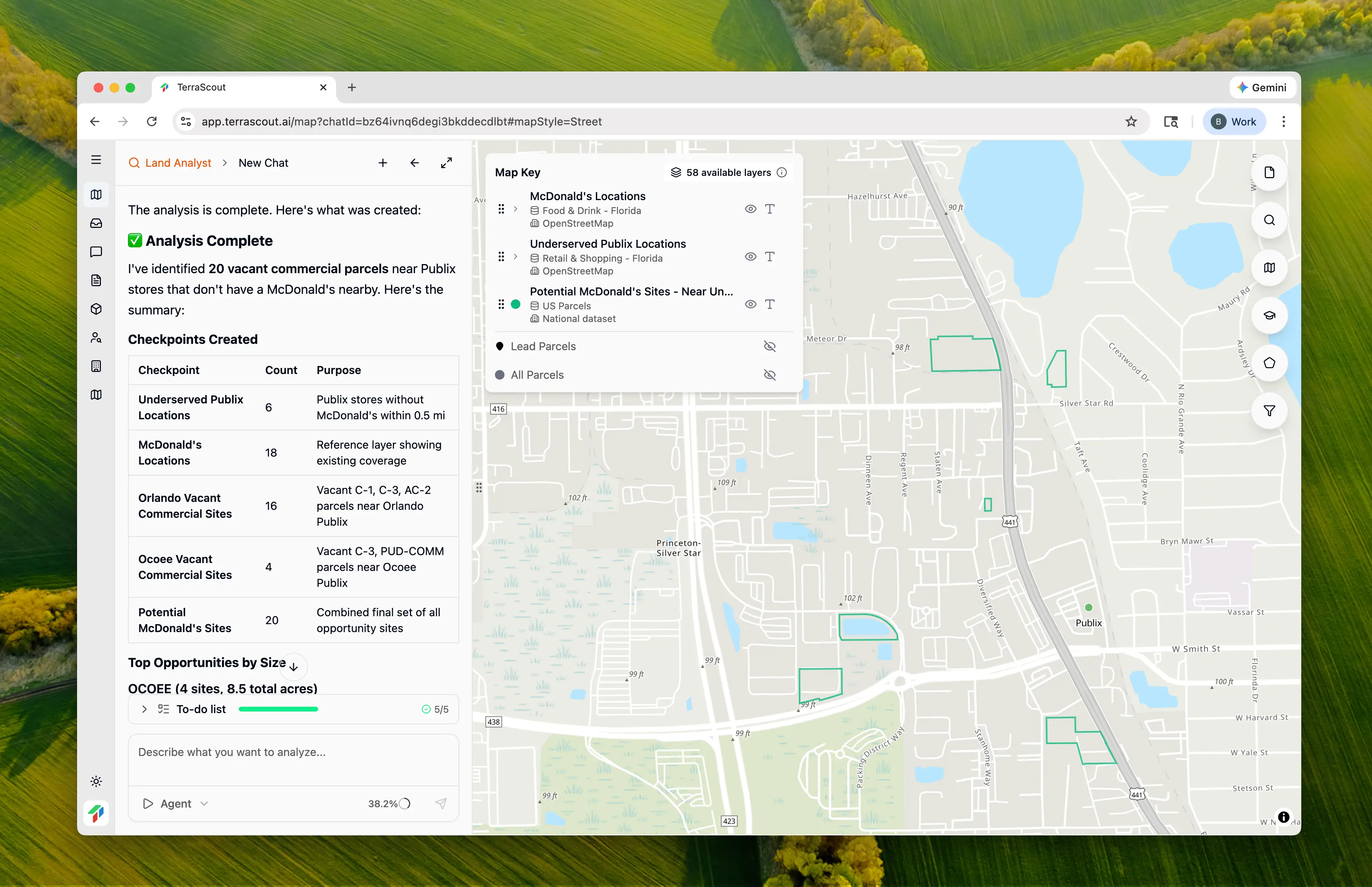
- The Publix anchor generating traffic
- Nearby McDonald’s locations (or lack thereof)
- Available commercial parcels for development
Step 8: Understand the Zoning
Each municipality has different commercial zoning codes, but all identified parcels permit restaurant uses:
Windermere note: No vacant commercial sites were found near the Windermere Publix—this area may not be viable for new development without rezoning.
Why This Matters
This analysis demonstrates multi-layer gap analysis:- POI data discovery — Found Publix and McDonald’s locations automatically from OSM data
- Spatial exclusion — Identified which anchors lack nearby competitors
- Vacancy filtering — Only showed parcels available for development (prop_ind=‘80’)
- Zoning verification — Confirmed restaurant uses are permitted
- Visual layering — All three datasets (Publix, McDonald’s, parcels) visible together
- Obtaining POI data for both brands
- Performing spatial buffer analysis
- Cross-referencing with parcel data
- Filtering for vacant parcels
- Researching zoning for each municipality
Taking It Further
With underserved locations identified, you can refine further:Which of these sites have the highest traffic counts?Layer in AADT data for site quality.
Show me the drive-through requirements for C-3 zoning in OrlandoResearch development standards for QSR.
Are any of these sites pad site opportunities in existing centers?Identify outparcel potential vs ground-up development.
What’s the population density within 3 miles of each site?Understand the customer base for each location.
Key Insights
Why Anchor Proximity Matters
Grocery stores like Publix generate:- Daily traffic — People shop for groceries 2-3x per week
- Predictable patterns — Morning and evening peaks
- Secondary trips — Customers add stops (coffee, lunch, pharmacy)
- Dwell time — Shoppers are already out of their cars
The 0.5-Mile Threshold
We used 0.5 miles as the “nearby” threshold because:- Walking distance for urban areas
- Quick driving distance for suburban
- Beyond 0.5 miles, customers may choose convenience over brand loyalty
- Industry standard for QSR trade area analysis
Why Some Locations Have No Sites
Two underserved Publix locations (Windermere and one Orlando location) had no vacant commercial sites nearby. This means:- Existing commercial is fully built out
- Rezoning would be required for new development
- These may be opportunity areas for existing building conversion
- Or simply not viable for new QSR development
Tips
- Toggle all layers — Seeing Publix, McDonald’s, and parcels together reveals the spatial story
- Check vacancy carefully — “Commercial zoning” doesn’t mean “available”—filter for vacant parcels
- Verify drive-through — Not all commercial zones allow drive-through; research specific requirements
- Consider pad sites — Some “vacant” parcels may be outparcels in existing centers
- Look at traffic — High anchor traffic + no competition = best opportunity
- Research lease rates — Sites near strong anchors command premium rents
Other Example Prompts
Different Anchor/Tenant Combination
Find Walgreens locations without a Starbucks nearby and show me commercial sites for a new coffee shopSame methodology, different brands.
Competitor Density Analysis
Show me areas with high Chick-fil-A density but few Popeyes locationsIdentify where competitors are winning.
Multi-Anchor Analysis
Find commercial sites near both a grocery store AND a gym but away from existing fast foodLayer multiple anchor types for site selection.
Underserved Trade Areas
Which retail centers have grocery anchors but no sit-down restaurants within the center?Find gaps within existing developments.
Drive-Through Specific
Find commercial parcels zoned for drive-through use near grocery stores without a coffee shopFocus on use-specific zoning requirements.