
The Opportunity
Traffic analysis helps you:- Identify high-visibility locations on the busiest corridors
- Compare sites objectively using actual traffic counts
- Classify roads into tiers by traffic volume
- Rank commercial sites by their exposure to potential customers
Walkthrough: Finding Commercial Sites on High-Traffic Corridors
Let’s identify the busiest traffic corridors and find commercial sites along them. We want to understand which roads carry the most traffic and rank available sites by their exposure.Step 1: Write the Research Request
Name the target market in the request. In this example, the geography spans Orlando, Winter Garden, Ocoee, and surrounding areas—capturing major highway corridors and commercial arterials.Step 2: Add the Criteria
We asked:Which roads have the highest traffic in this area? Show me commercial sites on the busiest corridors and rank them by daily traffic count.This triggers a multi-step analysis:
- Traffic corridor identification and ranking
- Commercial parcel filtering
- Spatial join to connect parcels with traffic data
- Ranking by AADT exposure
Step 3: Watch the Discovery
Ploti discovered FDOT AADT data and analyzed traffic patterns: Top Traffic Corridors Identified:
Commercial properties in the study area:
Step 4: Review the Research Approach
The research approach:- Map traffic corridors (AADT ≥ 50,000)
- Map commercial parcels (all commercial properties)
- Spatial join—find commercial parcels within ~720 ft of high-traffic roads
- Calculate traffic exposure—assign highest nearby AADT to each parcel
- Return ranked sites sorted by traffic count
- FDOT AADT 2024 — Annual Average Daily Traffic for state roads
- US Parcels — Property records with commercial classification codes
Step 5: Review the Analysis Outputs
Once the data check was complete, Ploti ran the analysis. Ploti returns tiered outputs:Step 6: Review the Results
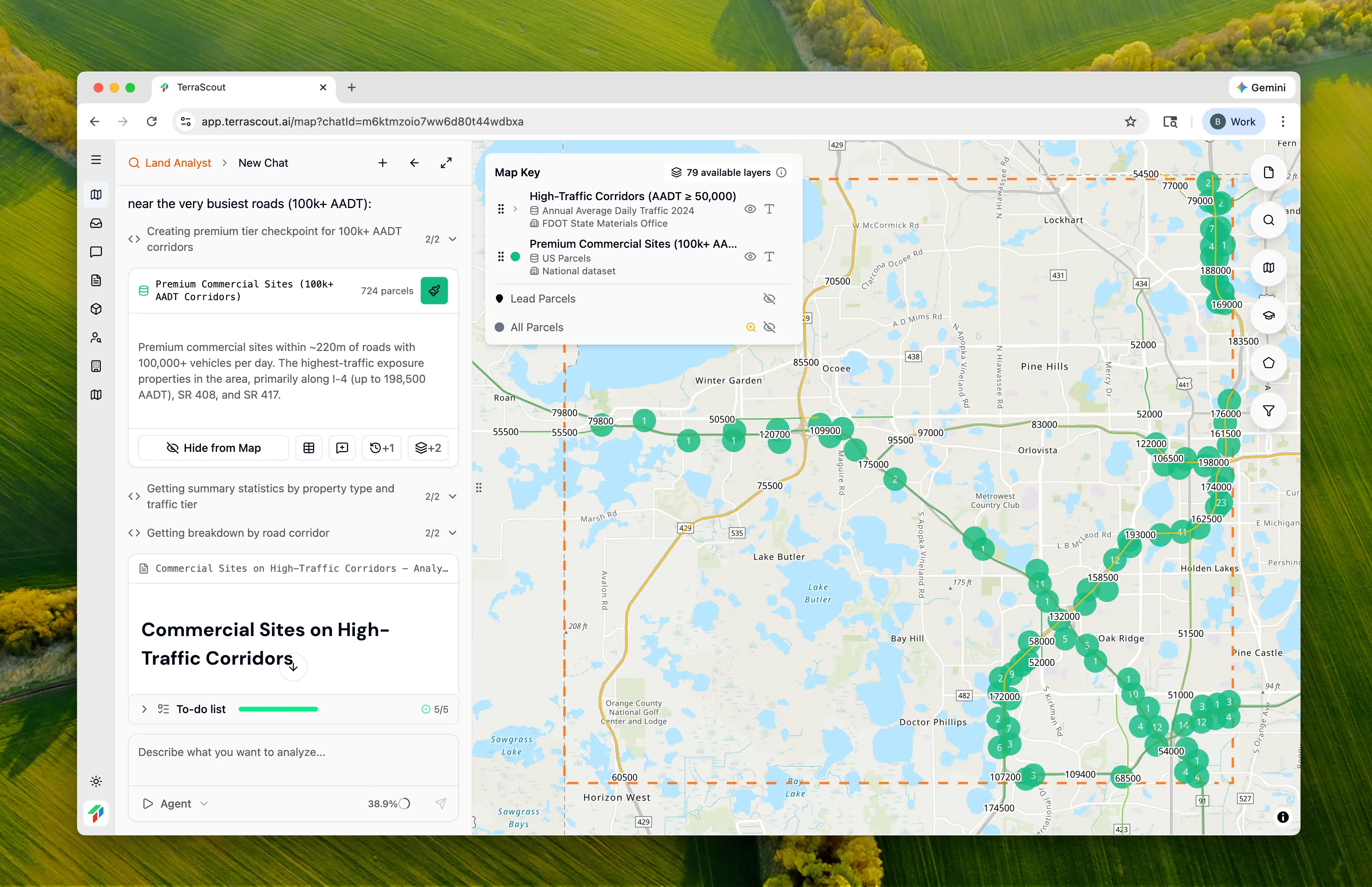
Sites by Property Type (High-Traffic):
Step 7: Examine Top-Ranked Sites
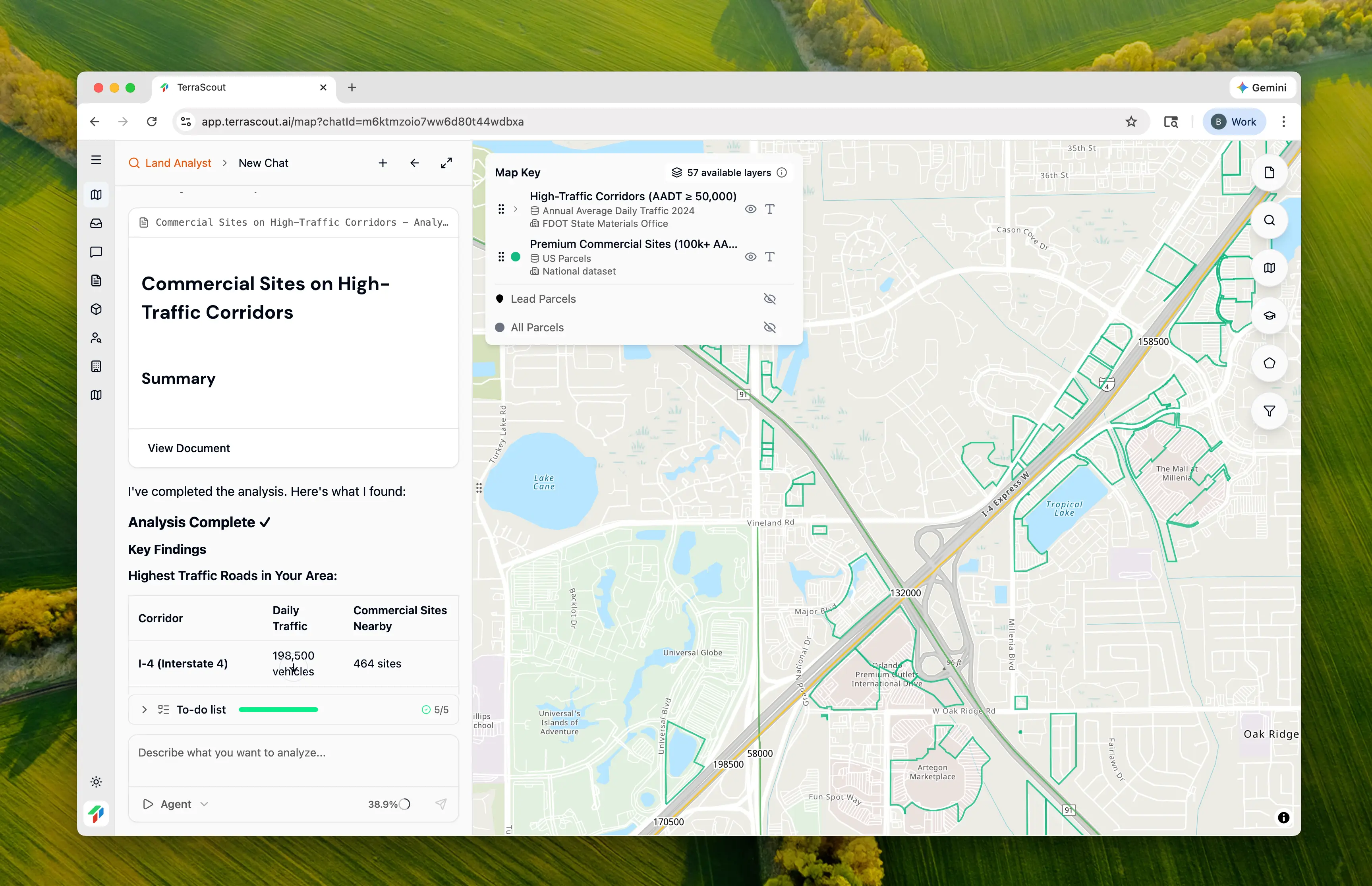
The top sites cluster around I-4 at International Drive (tourism corridor) and SR 408 in downtown Orlando—the two highest-traffic areas in the study area.
Step 8: Understand the Corridors
The analysis revealed distinct corridor profiles:Why This Matters
This analysis demonstrates traffic-based site ranking:- Corridor identification — Found and ranked roads by actual AADT data
- Tiered classification — Grouped sites by traffic exposure (150k+, 100k+, 75k+, 50k+)
- Spatial joining — Connected parcels to nearby traffic counts
- Quantified exposure — Each site has an objective traffic number
- Property type breakdown — Understand what’s available at each tier
- Obtaining FDOT traffic count data
- Mapping road segments geographically
- Filtering commercial parcels from property records
- Performing spatial joins between parcels and roads
- Ranking and categorizing results
Taking It Further
With traffic tiers established, you can refine further:Which premium sites (100k+ AADT) are retail properties under 2 acres?Find high-traffic pad site opportunities.
Show me commercial sites on SR 50 that are currently vacantFocus on a specific corridor with available inventory.
Compare traffic on International Drive vs Colonial DriveUnderstand corridor differences for site selection.
Which high-traffic sites are NOT near highway on-ramps?Filter for arterial frontage vs limited-access highway adjacency.
Key Insights
Why AADT Matters for Retail
AADT (Annual Average Daily Traffic) measures:- Exposure — How many potential customers see your location daily
- Market validation — High traffic indicates economic activity
- Comparable basis — Objective metric to compare sites
- 50,000+ AADT = Major arterial, strong retail potential
- 100,000+ AADT = Premium corridor, national retailer interest
- 150,000+ AADT = Highway-level traffic, maximum exposure
Traffic ≠ Access
High AADT doesn’t guarantee good retail sites:- Highways have traffic but limited access (SR 417, SR 429)
- Speed matters — 70 mph traffic can’t stop easily
- Medians may prevent left turns
- Frontage roads provide the access, not the highway itself
The I-4 / SR 408 Premium
Sites near I-4 and SR 408 have the highest traffic exposure (198,000+ AADT), but they’re also:- Most expensive
- Most competitive
- Often already developed
Tips
- Toggle the traffic layer — Visualize which roads carry the most vehicles
- Check access points — High AADT means nothing without ingress/egress
- Consider speed — Slower arterials (35-45 mph) are better for retail than 65 mph highways
- Look at both directions — Morning vs evening commute patterns matter
- Premium isn’t always best — 75,000 AADT with good access beats 150,000 with limited access
- Verify frontage — “Near” a highway isn’t the same as “visible from” a highway
Other Example Prompts
Specific Traffic Threshold
Find commercial sites on roads with at least 30,000 vehicles per day for a neighborhood retail centerLower threshold for local-serving retail.
Traffic Growth
Which corridors have seen traffic increases in the last 5 years? Show me commercial sites in growing areas.Identify emerging markets.
Arterial vs Highway
Find retail sites on arterial roads (not limited-access highways) with 40,000+ daily trafficFocus on accessible corridors.
Traffic + Vacancy
Show me vacant commercial parcels on roads with 50,000+ AADTCombine traffic analysis with availability.
Commute Direction
Find commercial sites on the inbound (eastbound) side of Colonial Drive for morning commuter captureDirection-specific analysis.