
The Opportunity
Understanding parking requirements helps you:- Quickly assess if a site can accommodate your intended use
- Calculate land needed for parking vs building footprint
- Identify jurisdictions with more favorable requirements
- Find reduction opportunities (shared parking, transit proximity, structured parking)
- Make informed decisions before spending money on architects
Walkthrough: Maximum Building Calculation
Let’s calculate the maximum office building that fits on a specific site, accounting for parking requirements. This is a common feasibility question that normally requires hiring an architect or land planner.Step 1: Ask the Question
We asked:I have a 3-acre site in Orlando’s AC-2 district. What’s the maximum office building I can fit given parking requirements? Assume surface parking only.This question requires Ploti to:
- Research AC-2 zoning district development standards (FAR, ISR, height, setbacks)
- Find office parking ratios in Orlando’s code
- Look up parking space dimensions and landscaping requirements
- Calculate the interplay between building size and parking demand
Step 2: Watch the Research
Ploti searches Orlando’s Land Development Code for multiple sections: Zoning Standards Found:- Table FG-1C — AC-2 district regulations (FAR, ISR, height limits)
- Sec. 58.341 — Activity Center district purpose and standards
- Sec. 61.322 — Parking space requirements by use type
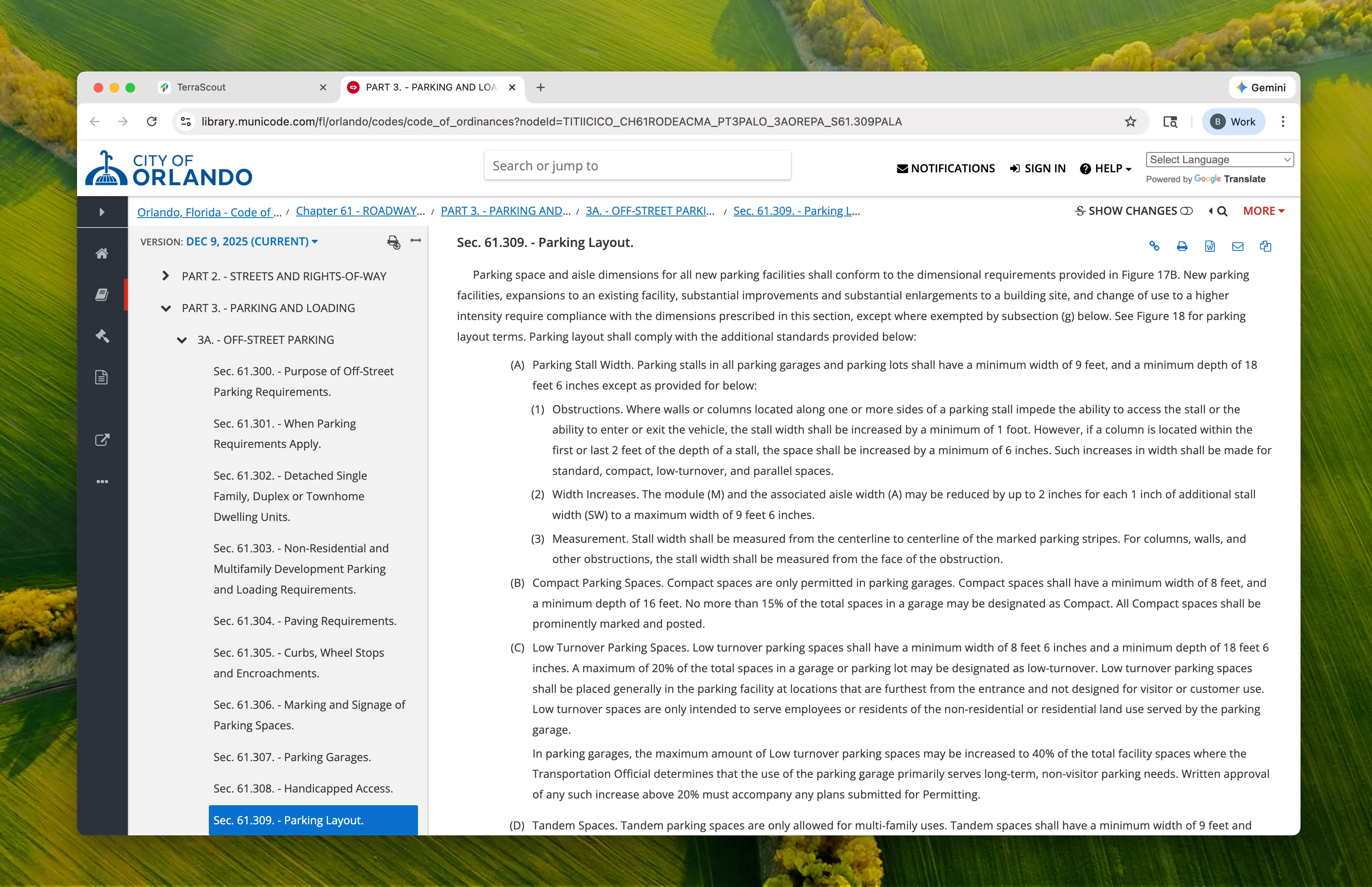
- Sec. 61.309 — Parking layout dimensions
- Sec. 61.312 — Parking lot landscaping requirements
Step 3: Review the Analysis
Parking Requirements:
Parking Space Dimensions (90° angle):
Step 4: Understand the Math
The key insight: ISR + parking demand is the constraint, not FAR. Here’s why:- Max Impervious Surface: 130,680 SF × 0.90 = 117,612 SF
- Office parking requires 2.5 spaces per 1,000 SF GFA
- Each parking space needs ~350 SF of land (including aisles, islands, circulation)
- So each 1,000 SF of office generates 875 SF of parking lot
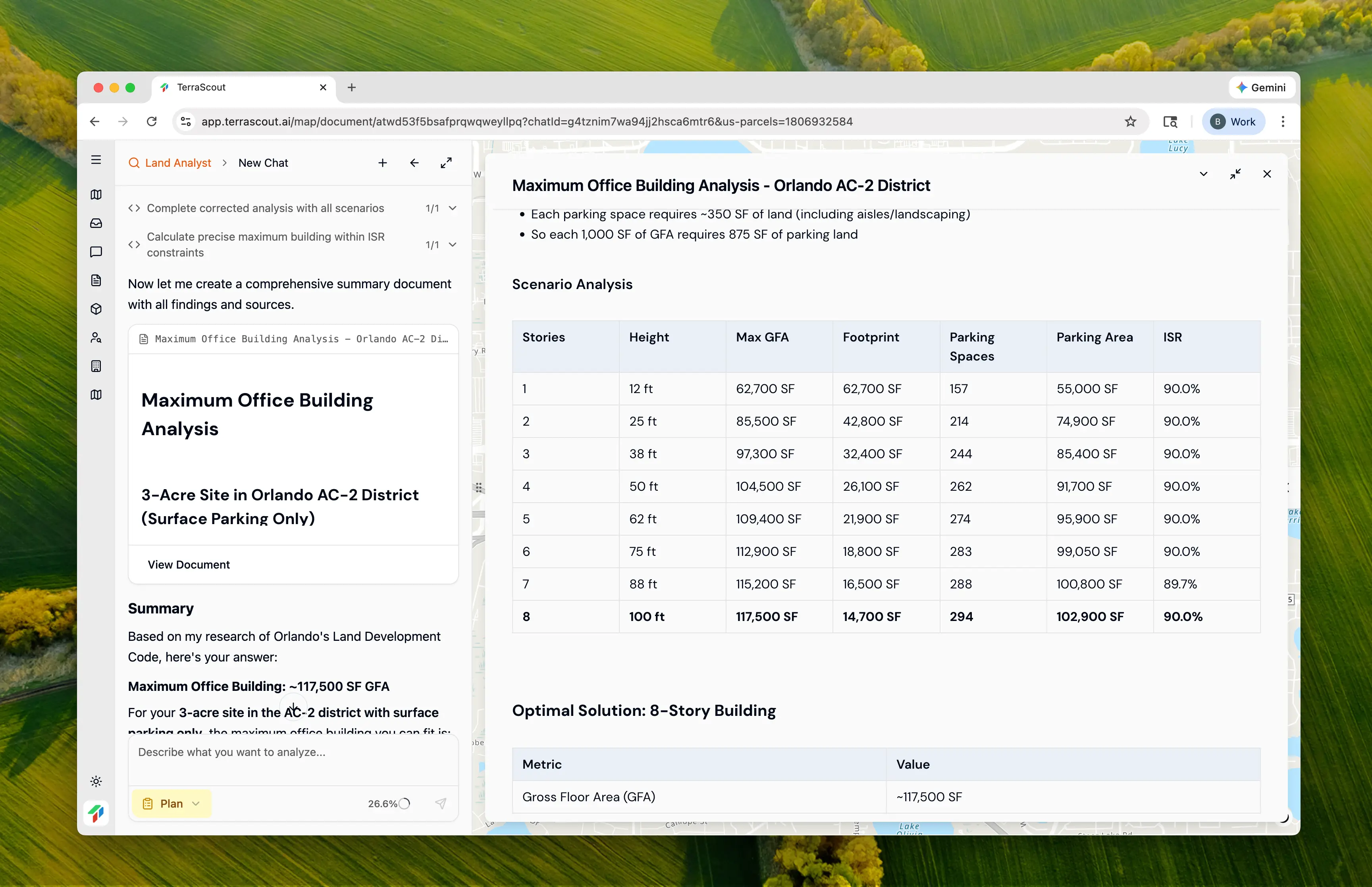
Step 5: Review the Scenario Analysis
Ploti calculated optimal building size at different heights:
Going taller helps by shrinking the building footprint, leaving more land for parking.
Step 6: Get the Answer
Maximum Office Building: ~117,500 SF GFAStep 7: Verify with Source Citations
- Orlando LDC Table FG-1C (Zoning District Regulations)
- Orlando LDC Sec. 61.322 (Parking Space Requirements)
- Orlando LDC Sec. 61.309 (Parking Layout)
- Orlando LDC Sec. 61.312 (Landscaping for Parking)
Why This Matters
This analysis demonstrates regulatory math—not just looking up requirements, but calculating their combined impact on feasibility:- Multi-section research — Found and synthesized 6+ code sections
- Constraint identification — Discovered ISR is limiting, not FAR
- Scenario modeling — Calculated optimal building at each height
- Actionable answer — Specific SF, dimensions, parking count
- Alternatives identified — Structured parking, density bonuses, transit reductions
- Finding and reading Orlando’s zoning tables
- Locating parking requirements in a separate chapter
- Understanding how ISR and FAR interact
- Manually calculating the parking/building tradeoff
- Running multiple scenarios to find the optimum
Taking It Further
The analysis identified several ways to exceed 117,500 SF:What if I use structured parking instead of surface?Structured parking would dramatically reduce land consumption, potentially unlocking the full 130,680 SF (1.0 FAR).
Are there density bonuses available in AC-2?AC-2 allows up to +1.0 additional FAR per Sec. 58.1100-58.1101 for public benefits like affordable housing contributions.
What parking reductions are available near SunRail?Transit proximity may qualify for reduced parking ratios, leaving more land for building.
Compare this to a site in Winter Garden’s C-2 zoneDifferent jurisdictions have different parking ratios and ISR limits—comparison helps with site selection.
Key Insights
Why Surface Parking Kills Density
At 350 SF per space (including aisles, landscaping, and circulation):- A 100,000 SF office needs 250 spaces = 2 acres just for parking
- Surface parking typically consumes 70-80% of a site
- Going vertical with the building only partially helps—you still need ground-level parking
The Structured Parking Tipping Point
Surface parking costs ~15,000-25,000+ per space. But structured parking uses only ~350 SF per space including the structure, not 350 SF of land. For dense sites where land is expensive, structured parking often makes economic sense despite higher construction costs.Jurisdiction Shopping
Parking requirements vary significantly:
A 20% difference in parking ratio can mean 20,000+ SF of additional building.
Tips
- Parking drives site selection — Compare parking requirements across jurisdictions before choosing a site
- Surface parking limits density — Expect 70-80% of your site consumed by parking for suburban office
- Height helps (somewhat) — Taller buildings have smaller footprints, leaving more land for parking
- ISR often binds before FAR — Don’t assume FAR is your limit; check impervious surface ratios
- Reductions exist — Transit proximity, shared parking, and bicycle facilities can reduce requirements
- Verify current code — Requirements change; always confirm with the planning department
Other Example Prompts
Retail Parking Comparison
Compare parking requirements for retail vs restaurant in Orange County. I’m planning 10,000 SF retail with a 3,000 SF restaurant pad.Restaurants typically require more parking per SF than retail.
Shared Parking Analysis
How does shared parking work for mixed-use in Orlando? I have office, retail, and residential uses with different peak hours.Mixed-use can reduce total parking through shared parking agreements.
Transit Reduction Research
What parking reductions are available within a quarter mile of SunRail stations in Orlando?TOD sites often qualify for 10-30% parking reductions.
Medical Office Requirements
What are parking requirements for medical office vs general office in Orange County? Medical typically needs more parking.Medical uses often have higher ratios due to patient turnover.
Parking Maximums
Does Orlando have parking maximums? I want to know if there’s a cap on how much parking I can provide.Some progressive jurisdictions limit parking to reduce environmental impact.