

Coverage areas
A coverage area is a US county you choose to work in. You pick them in Ploti, change them at any time, and pay per county: the first is free, and each one after starts at $50 a month. Coverage areas and pricing has the prices. Each county opens:- Its county and city records that Ploti has collected, such as parcels with owners and sales, zoning, permits and ordinances (the local zoning and land-use codes).
- Its state agencies’ data.
- National sources Ploti reads, such as FEMA flood zones, USGS, the Census, the EPA and HUD.
Asking for data Ploti doesn’t have
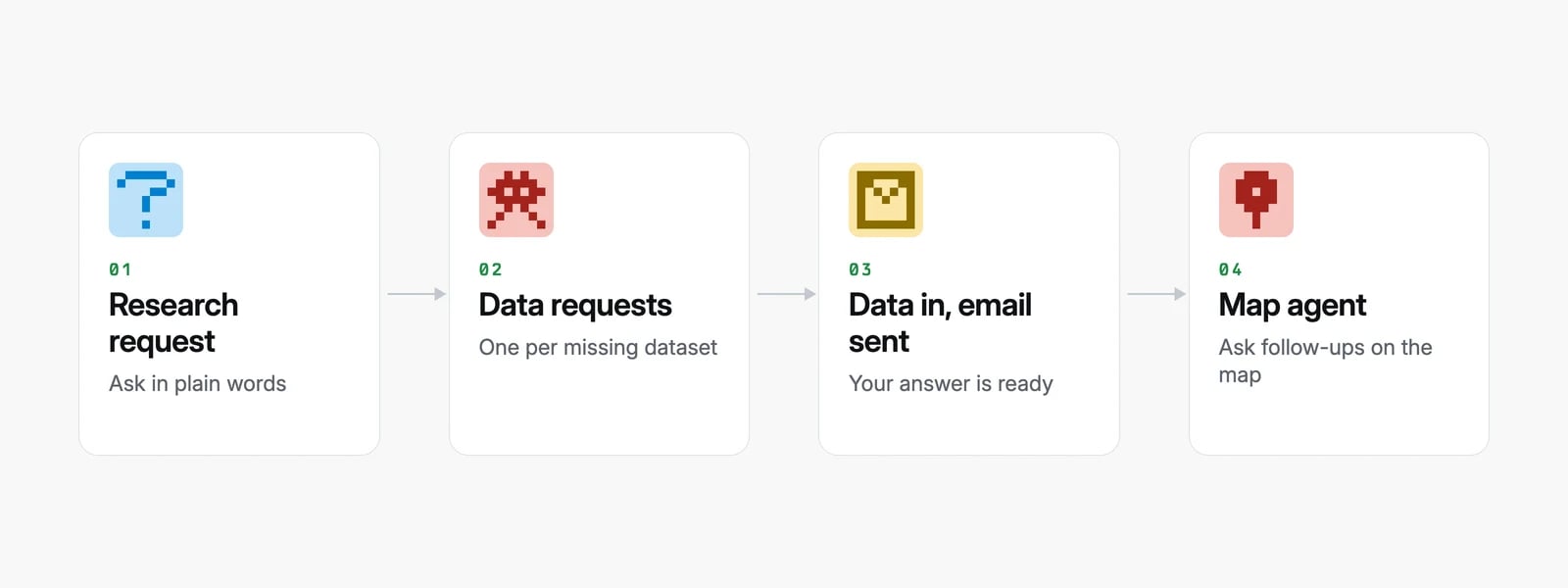
A research request is a question you hand to Ploti to answer from start to finish, including collecting any data it doesn’t have yet. For example: “Which parcels over 10 acres in Polk County, Florida, are zoned for industrial use and outside the flood zone?” A data request is one job inside it. A dataset is one table of records for one place, such as one county’s building permits, so the same kind of record in two counties is two datasets. Ploti starts one data request for each dataset the question is missing. You never file a data request yourself.1
You describe what you want to find out
In plain words, in the Ploti app or from an AI assistant such as ChatGPT
that you have connected to Ploti. You don’t need to know what data exists.
Ploti reads the places and the kinds of records from your description.
2
Ploti checks what it already has
Within minutes, the request’s page shows the data Ploti already holds for
the question and the data it still needs. If your question is too vague to
check, it asks you a few short questions first.
3
Ploti collects what is missing
For each missing dataset, Ploti’s data agents find the official source, such
as a county’s permit portal, and collect it. Where a county doesn’t publish
the data online, Ploti can email the county for it.
4
You get an email
Collecting can take hours or days, and you don’t need to wait on the page.
When every missing dataset has been collected, Ploti answers your question
and emails you that your research is ready.