> ## Documentation Index
> Fetch the complete documentation index at: https://terrascout.ai/docs/llms.txt
> Use this file to discover all available pages before exploring further.
# Logistics & Distribution Sites
> Find parcels suitable for warehouse and distribution facilities
Logistics and distribution facilities require large, flat parcels with industrial zoning and minimal environmental constraints. Ploti combines zoning research, flood analysis, wetland screening, and land assemblage identification to find sites that meet modern distribution center requirements.
## The Opportunity
Distribution center sites need:
* Large acreage (often 40+ acres for modern 500,000+ SF facilities)
* Industrial zoning allowing warehouse/distribution use
* Location outside flood hazard areas
* Minimal wetland impact to avoid permitting delays
* Room for truck courts, trailer parking, and future expansion
The challenge: Large industrial parcels are scarce. Ploti identifies both single-parcel opportunities and land assemblage candidates where adjacent parcels can combine.
## Walkthrough: Finding Distribution Center Sites
Let's find sites for a 500,000 SF distribution center requiring at least 40 acres. We need industrial zoning, flood-free locations, and minimal wetlands. We'll also identify assemblage opportunities where single parcels don't meet size requirements.
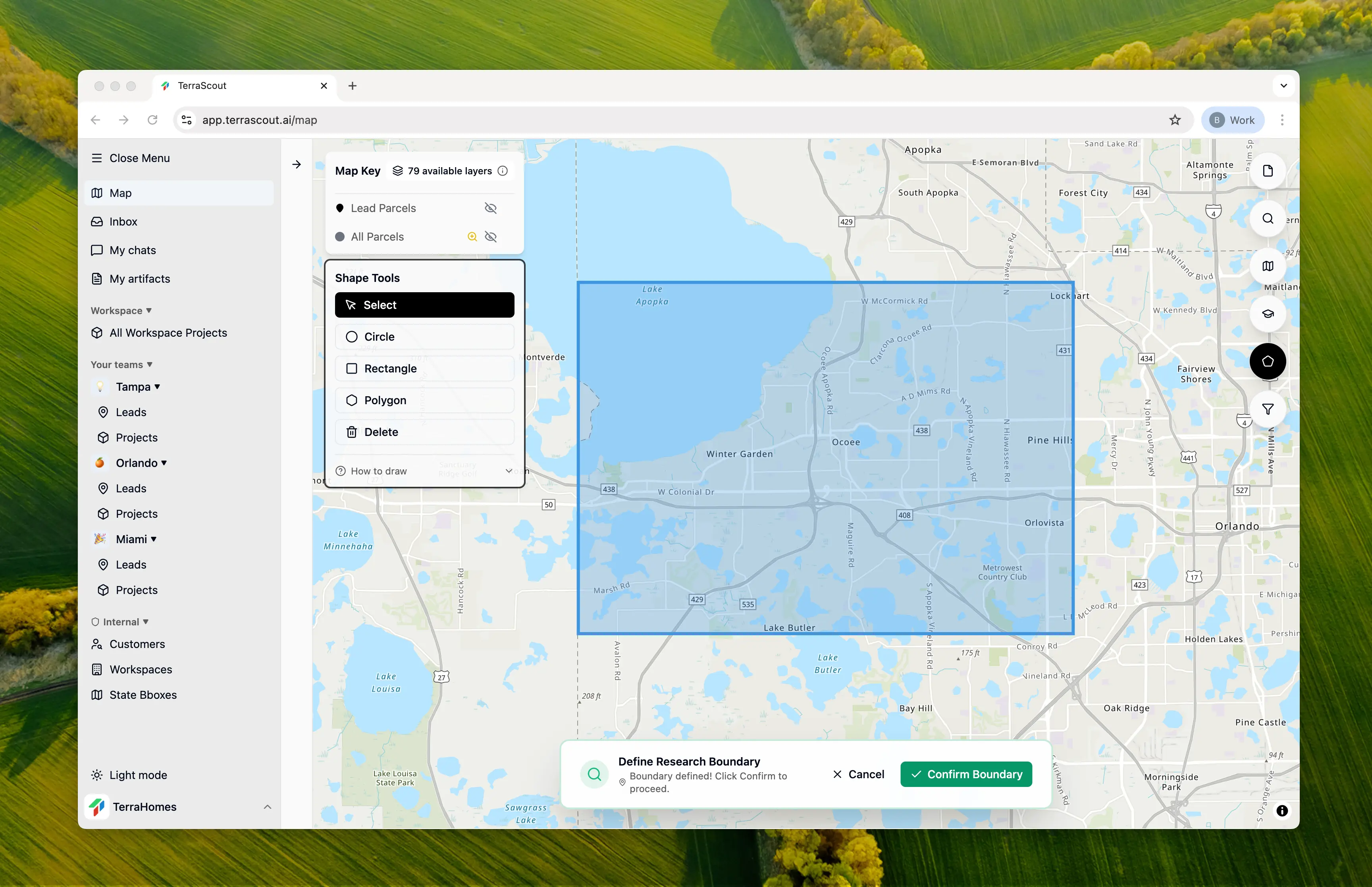
### Step 1: Select Your Search Area
Draw a boundary around your target market. In this example, we drew an area spanning Orlando, Winter Garden, Ocoee, and Oakland—established industrial corridors in Central Florida.
 ### Step 2: Ask the Question
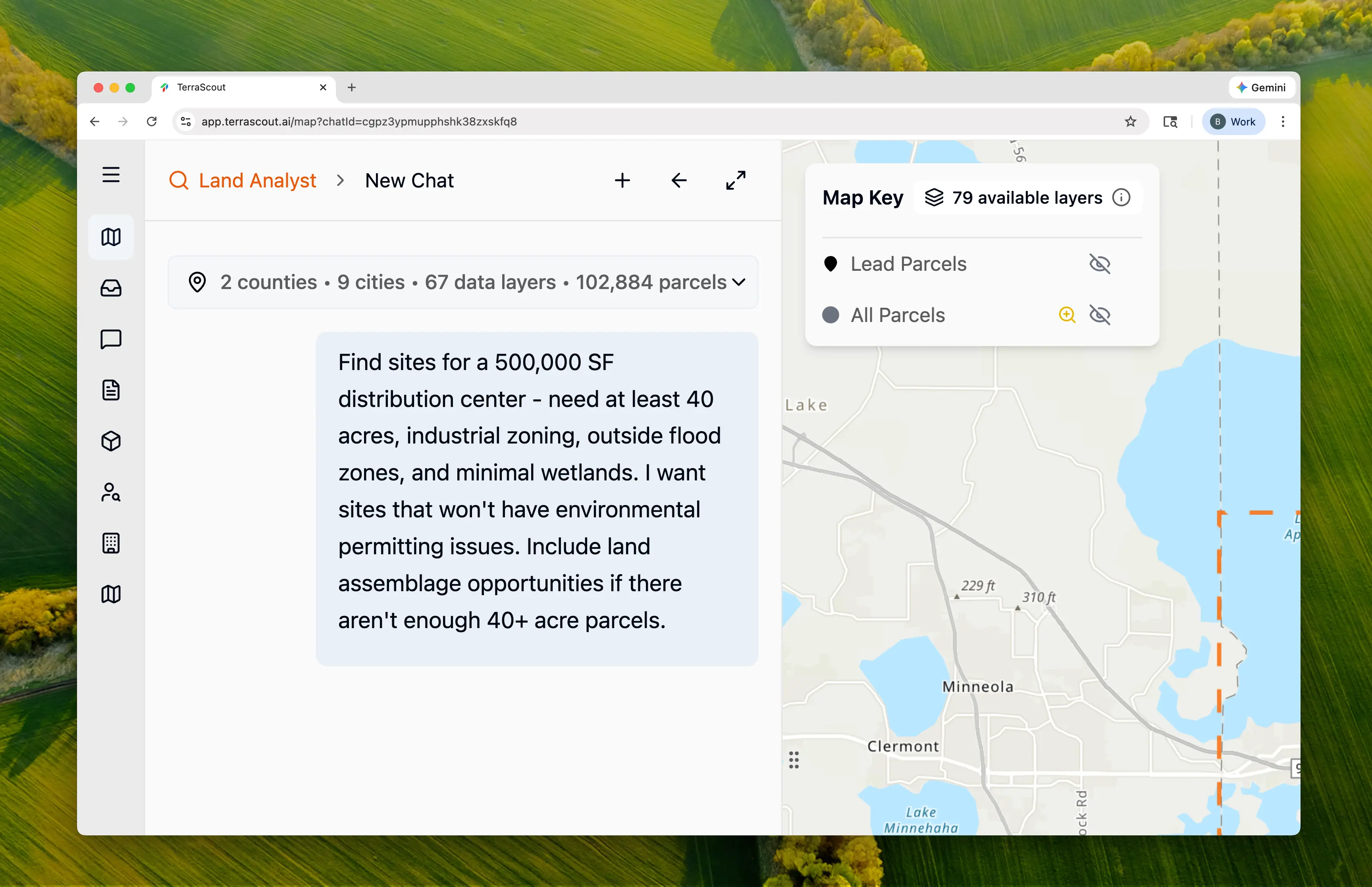 We asked:
> Find sites for a 500,000 SF distribution center - need at least 40 acres, industrial zoning, outside flood zones, and minimal wetlands. I want sites that won't have environmental permitting issues. Include land assemblage opportunities if there aren't enough 40+ acre parcels.
This triggers a complex multi-layer analysis:
* Industrial zoning research across 5 municipalities
* FEMA flood zone exclusion
* Wetland coverage calculation
* Adjacent parcel clustering for assemblage
### Step 3: Watch the Research
Ploti recognizes that your boundary spans 5 jurisdictions and researches industrial zoning codes for each:
**Industrial Zoning Codes Found:**
| Municipality | Industrial Codes | Parcels | Total Acres |
| ------------- | -------------------- | ------- | ----------- |
| Winter Garden | I-1, I-2, M-1 | 209 | 528.0 |
| Ocoee | I-1, I-2, PUD-IND | 170 | 554.8 |
| Orlando | I-P, I-G, IND-4, M-1 | 72 | 492.7 |
| Oakland | I-1, M-1 | 10 | 36.2 |
| Apopka | IND-4, IND-2 | 7 | 31.5 |
**Key Discovery:** Only 3 parcels in the entire boundary meet the 40+ acre requirement with existing industrial zoning. Land assemblage will be critical.
### Step 4: Review the Plan
We asked:
> Find sites for a 500,000 SF distribution center - need at least 40 acres, industrial zoning, outside flood zones, and minimal wetlands. I want sites that won't have environmental permitting issues. Include land assemblage opportunities if there aren't enough 40+ acre parcels.
This triggers a complex multi-layer analysis:
* Industrial zoning research across 5 municipalities
* FEMA flood zone exclusion
* Wetland coverage calculation
* Adjacent parcel clustering for assemblage
### Step 3: Watch the Research
Ploti recognizes that your boundary spans 5 jurisdictions and researches industrial zoning codes for each:
**Industrial Zoning Codes Found:**
| Municipality | Industrial Codes | Parcels | Total Acres |
| ------------- | -------------------- | ------- | ----------- |
| Winter Garden | I-1, I-2, M-1 | 209 | 528.0 |
| Ocoee | I-1, I-2, PUD-IND | 170 | 554.8 |
| Orlando | I-P, I-G, IND-4, M-1 | 72 | 492.7 |
| Oakland | I-1, M-1 | 10 | 36.2 |
| Apopka | IND-4, IND-2 | 7 | 31.5 |
**Key Discovery:** Only 3 parcels in the entire boundary meet the 40+ acre requirement with existing industrial zoning. Land assemblage will be critical.
### Step 4: Review the Plan
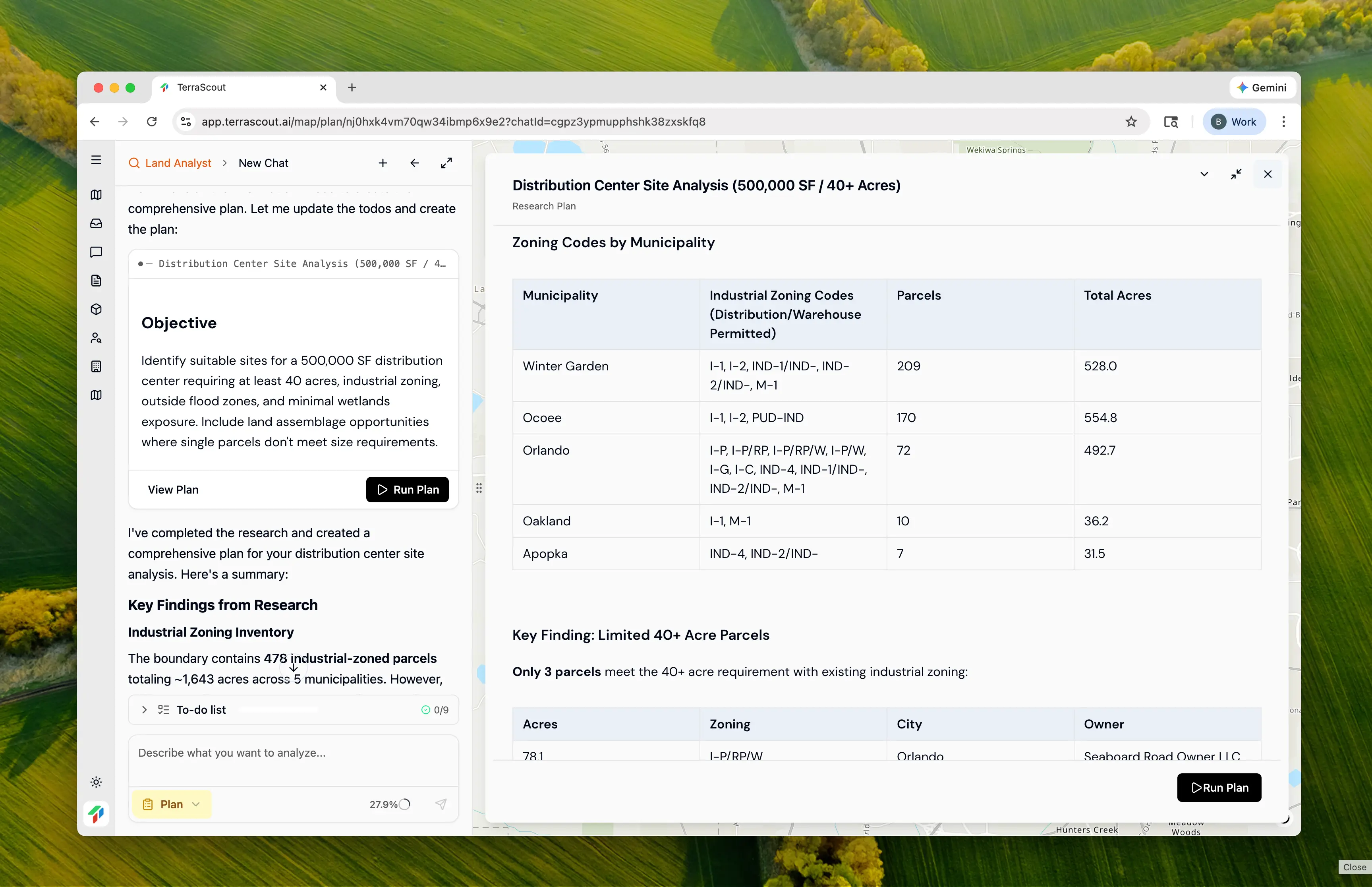 Ploti compiled a comprehensive research plan with:
**Ordinance Citations:**
* Orange County Code § 38-927 — I-1/I-5 Light Industrial (warehousing permitted)
* Orlando Code § 68.207 — Airport Support District for industrial
* Winter Garden Code § 118-727 — I-1 Light Industrial/Warehousing
* Ocoee LDC § 5-8 — I-1 Restricted Manufacturing/Warehousing
**Analysis Approach:**
1. Filter industrial parcels ≥10 acres (captures assemblage candidates)
2. Exclude parcels in SFHA flood zones
3. Calculate wetland overlap percentage
4. Filter for less than 20% wetland coverage
5. Segment into primary sites (≥40 ac) and assemblage opportunities (10-40 ac)
### Step 5: Run the Analysis
Click **Run Plan** to execute. Ploti creates checkpoints at each filtering step:
| Step | Filter | Count |
| ---- | --------------------------------- | --------------- |
| 1 | Industrial parcels ≥10 acres | 38 |
| 2 | Exclude flood zone parcels | 31 |
| 3 | Filter under 20% wetland coverage | 31 (all passed) |
| 4 | Primary sites ≥40 acres | **3** |
| 5 | Assemblage candidates 10-40 acres | **28** |
Excellent environmental profile: All 31 qualifying parcels have under 1% wetland coverage.
### Step 6: Review Primary Sites
Ploti compiled a comprehensive research plan with:
**Ordinance Citations:**
* Orange County Code § 38-927 — I-1/I-5 Light Industrial (warehousing permitted)
* Orlando Code § 68.207 — Airport Support District for industrial
* Winter Garden Code § 118-727 — I-1 Light Industrial/Warehousing
* Ocoee LDC § 5-8 — I-1 Restricted Manufacturing/Warehousing
**Analysis Approach:**
1. Filter industrial parcels ≥10 acres (captures assemblage candidates)
2. Exclude parcels in SFHA flood zones
3. Calculate wetland overlap percentage
4. Filter for less than 20% wetland coverage
5. Segment into primary sites (≥40 ac) and assemblage opportunities (10-40 ac)
### Step 5: Run the Analysis
Click **Run Plan** to execute. Ploti creates checkpoints at each filtering step:
| Step | Filter | Count |
| ---- | --------------------------------- | --------------- |
| 1 | Industrial parcels ≥10 acres | 38 |
| 2 | Exclude flood zone parcels | 31 |
| 3 | Filter under 20% wetland coverage | 31 (all passed) |
| 4 | Primary sites ≥40 acres | **3** |
| 5 | Assemblage candidates 10-40 acres | **28** |
Excellent environmental profile: All 31 qualifying parcels have under 1% wetland coverage.
### Step 6: Review Primary Sites
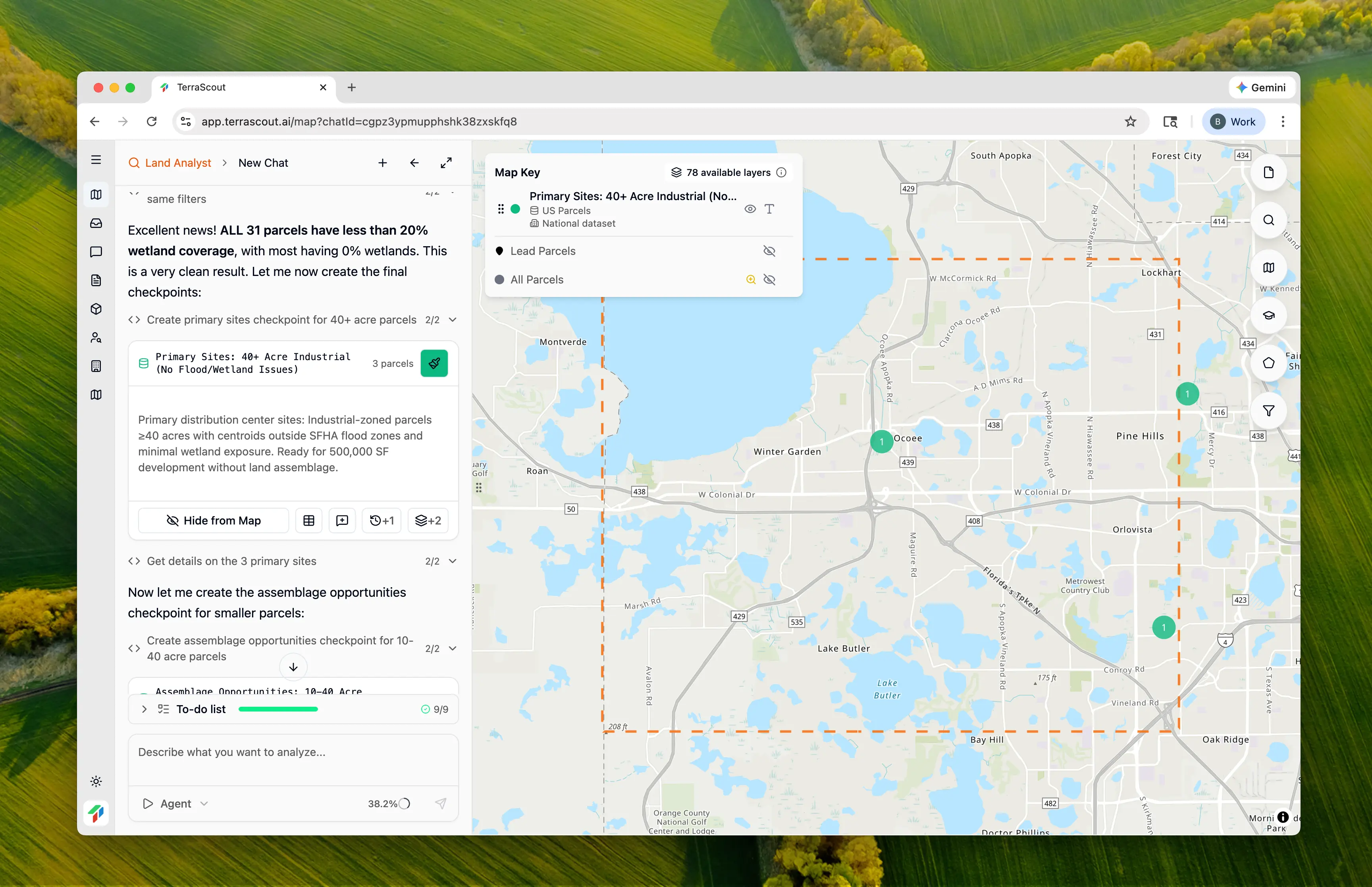 **3 parcels meet all criteria as single sites:**
| Site | Acres | Address | Zoning | Owner | Wetlands |
| ---- | ----- | --------------------------- | -------- | ----------------------- | -------- |
| 1 | 78.1 | 3015 Coast Line Dr, Orlando | I-P/RP/W | Seaboard Road Owner LLC | 0.0% |
| 2 | 44.6 | 5281 L B McLeod Rd, Orlando | I-P | B9 McLeod Owner LLC | 0.2% |
| 3 | 43.8 | 165 Maguire Rd, Ocoee | I-1 | Distribution 429 LLC | 0.0% |
**Site 1 (78.1 acres)** is the best option—largest parcel with cleanest environmental profile. The I-P/RP/W overlay indicates some regulatory considerations, but centroid analysis confirms a developable core.
**Site 3 (43.8 acres)** is notable: the owner name "Distribution 429 LLC" suggests the site may already be positioned for distribution use.
### Step 7: Review Assemblage Opportunities
**3 parcels meet all criteria as single sites:**
| Site | Acres | Address | Zoning | Owner | Wetlands |
| ---- | ----- | --------------------------- | -------- | ----------------------- | -------- |
| 1 | 78.1 | 3015 Coast Line Dr, Orlando | I-P/RP/W | Seaboard Road Owner LLC | 0.0% |
| 2 | 44.6 | 5281 L B McLeod Rd, Orlando | I-P | B9 McLeod Owner LLC | 0.2% |
| 3 | 43.8 | 165 Maguire Rd, Ocoee | I-1 | Distribution 429 LLC | 0.0% |
**Site 1 (78.1 acres)** is the best option—largest parcel with cleanest environmental profile. The I-P/RP/W overlay indicates some regulatory considerations, but centroid analysis confirms a developable core.
**Site 3 (43.8 acres)** is notable: the owner name "Distribution 429 LLC" suggests the site may already be positioned for distribution use.
### Step 7: Review Assemblage Opportunities
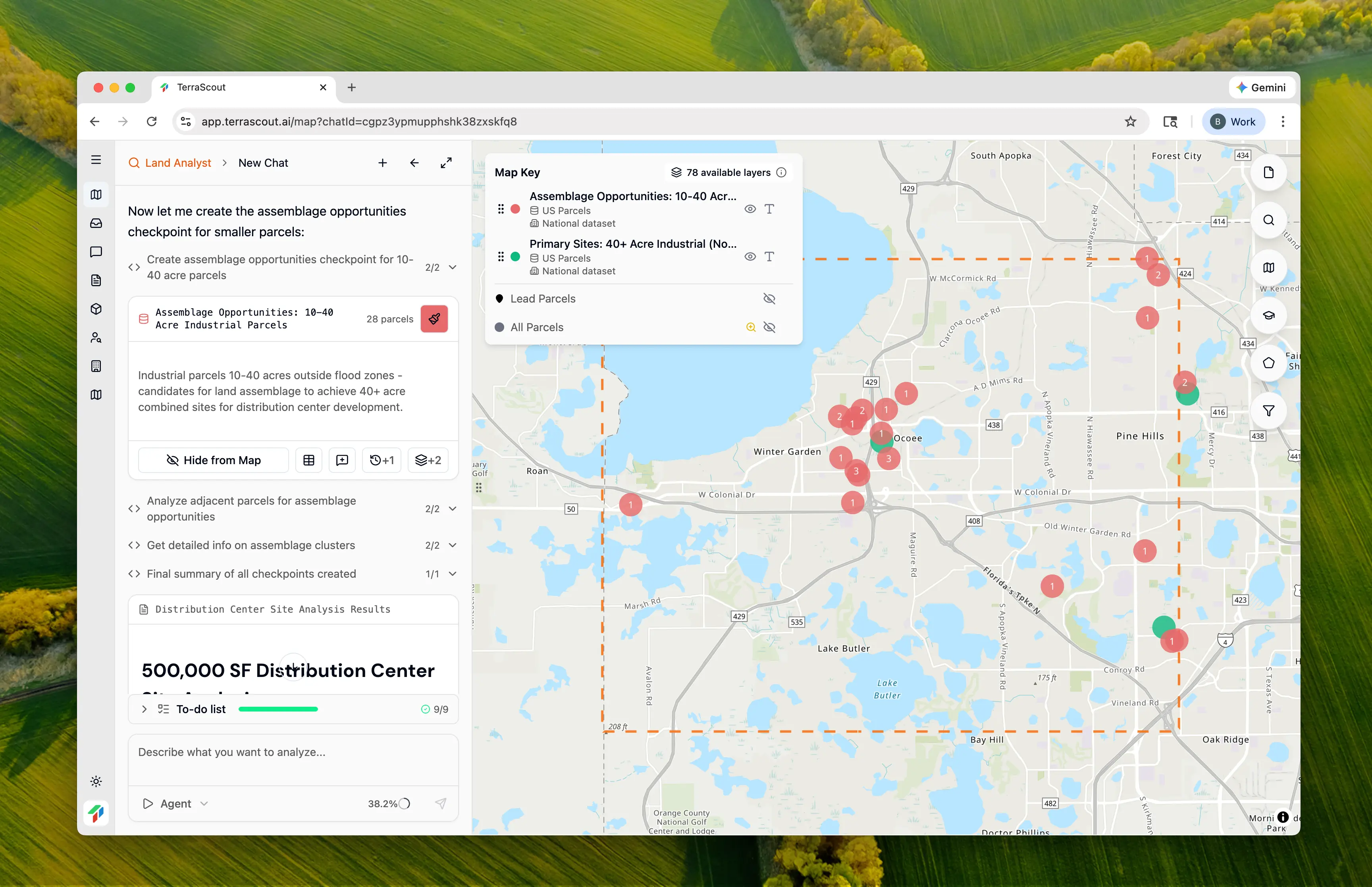 Ploti identified **2 assemblage clusters** where adjacent parcels can combine to 40+ acres:
**Cluster 1: 49.1 Combined Acres (Winter Garden)**
| Parcel | Acres | Address | Owner |
| ------ | ----- | --------------- | ----------------------- |
| A | 33.9 | 1275 E Story Rd | Manheim Remarketing Inc |
| B | 15.2 | E Story Rd | Manheim Remarketing |
**Advantage:** Same owner (Manheim) simplifies assemblage negotiation. I-2 General Industrial zoning.
**Cluster 2: 43.4 Combined Acres (Winter Garden)**
| Parcel | Acres | Address | Owner |
| ------ | ----- | ------------------------- | ----------------------------- |
| A | 25.1 | 115 N West Crown Point Rd | Advanced Drainage Systems Inc |
| B | 18.3 | 402 E Crown Point Rd | Duke Energy Florida Inc |
**Challenge:** Different owners require dual negotiation. Duke Energy parcel may have utility infrastructure considerations.
### Step 8: Visualize Assemblage vs Single Parcels
Ploti identified **2 assemblage clusters** where adjacent parcels can combine to 40+ acres:
**Cluster 1: 49.1 Combined Acres (Winter Garden)**
| Parcel | Acres | Address | Owner |
| ------ | ----- | --------------- | ----------------------- |
| A | 33.9 | 1275 E Story Rd | Manheim Remarketing Inc |
| B | 15.2 | E Story Rd | Manheim Remarketing |
**Advantage:** Same owner (Manheim) simplifies assemblage negotiation. I-2 General Industrial zoning.
**Cluster 2: 43.4 Combined Acres (Winter Garden)**
| Parcel | Acres | Address | Owner |
| ------ | ----- | ------------------------- | ----------------------------- |
| A | 25.1 | 115 N West Crown Point Rd | Advanced Drainage Systems Inc |
| B | 18.3 | 402 E Crown Point Rd | Duke Energy Florida Inc |
**Challenge:** Different owners require dual negotiation. Duke Energy parcel may have utility infrastructure considerations.
### Step 8: Visualize Assemblage vs Single Parcels
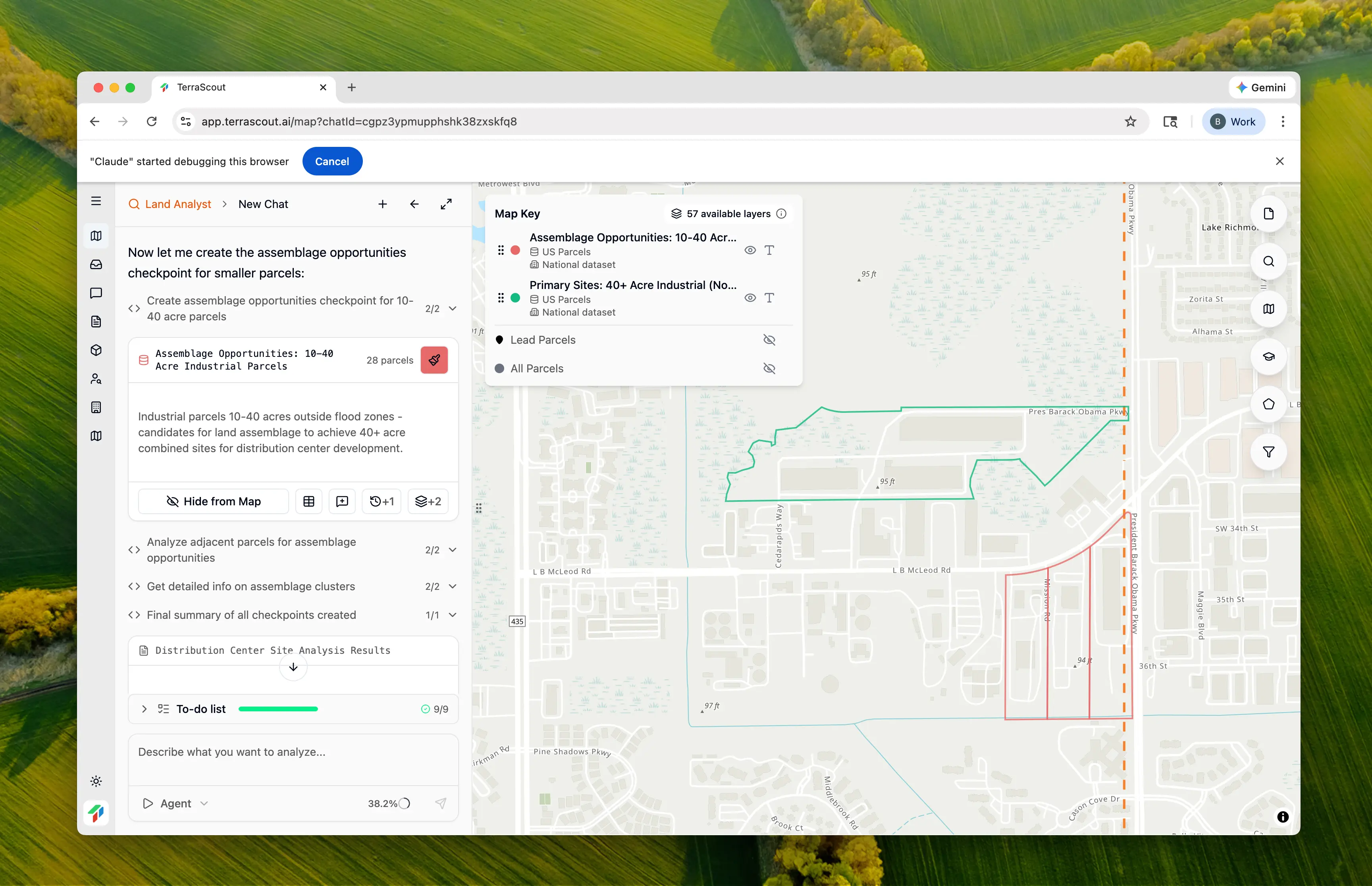 The map distinguishes between:
* **Green parcels** — Single sites meeting all criteria
* **Red parcels** — Assemblage opportunity candidates
This visualization helps you quickly understand which opportunities require land assemblage negotiations versus ready-to-go single parcels.
## Why This Matters
This analysis demonstrates **supply-constrained site selection**:
1. **Reality check** — Only 3 parcels in the entire market meet size requirements
2. **Assemblage identification** — Found 2 viable clusters when single parcels are scarce
3. **Same-owner detection** — Highlighted Cluster 1 as easier to assemble (same owner)
4. **Environmental pre-screening** — All sites have under 1% wetland coverage
5. **Multi-jurisdiction research** — Researched 5 different municipal codes
6. **Progressive filtering** — Showed exactly how each constraint narrowed results
Without Ploti, this analysis would require:
* Researching industrial zoning codes for 5 municipalities
* Downloading and overlaying FEMA flood maps
* Obtaining wetland data and calculating overlap percentages
* Manually identifying adjacent parcels for assemblage
* Cross-referencing ownership records
**That's 2-3 weeks of work.** Ploti completed it in under 5 minutes—and found that assemblage is required for most development opportunities in this market.
## Taking It Further
With only 3 primary sites, you might want to explore alternatives:
> What about parcels with agricultural zoning that have industrial Future Land Use?
Find rezoning candidates where FLU supports industrial but current zoning doesn't.
> Which of the assemblage parcels have the same owner?
Prioritize assemblages that don't require multiple negotiations.
> Show me the utility infrastructure available at each primary site
Verify water, sewer, and power availability before pursuing.
> What are the development standards for I-P zoning in Orlando?
Research setbacks, height limits, and truck court requirements.
## Key Insights
### Why Large Industrial Parcels Are Scarce
Modern distribution centers require 40-100+ acres:
* 500,000 SF building footprint: \~12 acres
* Truck courts and docks: \~8 acres
* Trailer parking: \~10 acres
* Stormwater and landscaping: \~5 acres
* Future expansion: remaining acreage
Most industrial land was platted decades ago for smaller facilities. Finding 40+ acre parcels often requires assemblage or greenfield development.
### Land Assemblage Success Factors
When evaluating assemblage opportunities:
* **Same owner** — Dramatically simpler negotiation (see Cluster 1)
* **Common zoning** — Avoids split-zoning complications
* **No intervening parcels** — True adjacency required
* **Similar timing** — Both owners willing to sell simultaneously
### Environmental Pre-Screening Saves Time
Wetland permitting can delay projects 12-24 months. By filtering for under 20% wetland coverage upfront:
* Avoid sites with obvious permitting issues
* Focus due diligence on viable candidates
* Reduce risk of mid-deal surprises
## Tips
* **Modern big-box needs 40-100 acres** — Don't underestimate land requirements for truck courts and trailer parking
* **Assemblage is often necessary** — Large single parcels are increasingly rare in established markets
* **Same-owner assemblage is gold** — Prioritize clusters where one entity controls multiple parcels
* **Check ceiling height limits** — Modern facilities need 36'+ clear height; verify zoning allows it
* **Flood zones kill deals** — Even partial SFHA overlap creates insurance and operational issues
* **Verify truck routes** — Site access from highways matters as much as the site itself
## Other Example Prompts
### Last-Mile Delivery Facilities
> Find smaller industrial parcels (5-15 acres) suitable for last-mile delivery within 10 miles of downtown Orlando
Smaller sites closer to population centers for final-mile operations.
### Cold Storage Sites
> Where can I build a cold storage facility in Orange County? Research the zoning requirements and find sites at least 15 acres.
Refrigerated warehouse may have different zoning requirements.
### Rail-Served Sites
> Find industrial parcels over 25 acres within 1 mile of an active rail line
Rail access enables intermodal distribution operations.
### Speculative Development
> Find vacant industrial-zoned land over 20 acres in growth centers or urban service areas
Target sites where infrastructure is planned for spec development.
### Cross-Dock Facilities
> Show me industrial parcels over 20 acres with frontage on two roads
Multiple access points support cross-dock operations.
The map distinguishes between:
* **Green parcels** — Single sites meeting all criteria
* **Red parcels** — Assemblage opportunity candidates
This visualization helps you quickly understand which opportunities require land assemblage negotiations versus ready-to-go single parcels.
## Why This Matters
This analysis demonstrates **supply-constrained site selection**:
1. **Reality check** — Only 3 parcels in the entire market meet size requirements
2. **Assemblage identification** — Found 2 viable clusters when single parcels are scarce
3. **Same-owner detection** — Highlighted Cluster 1 as easier to assemble (same owner)
4. **Environmental pre-screening** — All sites have under 1% wetland coverage
5. **Multi-jurisdiction research** — Researched 5 different municipal codes
6. **Progressive filtering** — Showed exactly how each constraint narrowed results
Without Ploti, this analysis would require:
* Researching industrial zoning codes for 5 municipalities
* Downloading and overlaying FEMA flood maps
* Obtaining wetland data and calculating overlap percentages
* Manually identifying adjacent parcels for assemblage
* Cross-referencing ownership records
**That's 2-3 weeks of work.** Ploti completed it in under 5 minutes—and found that assemblage is required for most development opportunities in this market.
## Taking It Further
With only 3 primary sites, you might want to explore alternatives:
> What about parcels with agricultural zoning that have industrial Future Land Use?
Find rezoning candidates where FLU supports industrial but current zoning doesn't.
> Which of the assemblage parcels have the same owner?
Prioritize assemblages that don't require multiple negotiations.
> Show me the utility infrastructure available at each primary site
Verify water, sewer, and power availability before pursuing.
> What are the development standards for I-P zoning in Orlando?
Research setbacks, height limits, and truck court requirements.
## Key Insights
### Why Large Industrial Parcels Are Scarce
Modern distribution centers require 40-100+ acres:
* 500,000 SF building footprint: \~12 acres
* Truck courts and docks: \~8 acres
* Trailer parking: \~10 acres
* Stormwater and landscaping: \~5 acres
* Future expansion: remaining acreage
Most industrial land was platted decades ago for smaller facilities. Finding 40+ acre parcels often requires assemblage or greenfield development.
### Land Assemblage Success Factors
When evaluating assemblage opportunities:
* **Same owner** — Dramatically simpler negotiation (see Cluster 1)
* **Common zoning** — Avoids split-zoning complications
* **No intervening parcels** — True adjacency required
* **Similar timing** — Both owners willing to sell simultaneously
### Environmental Pre-Screening Saves Time
Wetland permitting can delay projects 12-24 months. By filtering for under 20% wetland coverage upfront:
* Avoid sites with obvious permitting issues
* Focus due diligence on viable candidates
* Reduce risk of mid-deal surprises
## Tips
* **Modern big-box needs 40-100 acres** — Don't underestimate land requirements for truck courts and trailer parking
* **Assemblage is often necessary** — Large single parcels are increasingly rare in established markets
* **Same-owner assemblage is gold** — Prioritize clusters where one entity controls multiple parcels
* **Check ceiling height limits** — Modern facilities need 36'+ clear height; verify zoning allows it
* **Flood zones kill deals** — Even partial SFHA overlap creates insurance and operational issues
* **Verify truck routes** — Site access from highways matters as much as the site itself
## Other Example Prompts
### Last-Mile Delivery Facilities
> Find smaller industrial parcels (5-15 acres) suitable for last-mile delivery within 10 miles of downtown Orlando
Smaller sites closer to population centers for final-mile operations.
### Cold Storage Sites
> Where can I build a cold storage facility in Orange County? Research the zoning requirements and find sites at least 15 acres.
Refrigerated warehouse may have different zoning requirements.
### Rail-Served Sites
> Find industrial parcels over 25 acres within 1 mile of an active rail line
Rail access enables intermodal distribution operations.
### Speculative Development
> Find vacant industrial-zoned land over 20 acres in growth centers or urban service areas
Target sites where infrastructure is planned for spec development.
### Cross-Dock Facilities
> Show me industrial parcels over 20 acres with frontage on two roads
Multiple access points support cross-dock operations.