> ## Documentation Index
> Fetch the complete documentation index at: https://terrascout.ai/docs/llms.txt
> Use this file to discover all available pages before exploring further.
# Environmental Screening
> Find development-ready sites without environmental constraints
Environmental issues can kill deals or add months of permitting and mitigation costs. Ploti screens properties against multiple environmental layers simultaneously—flood zones, wetlands, conservation areas—to identify "clean" sites ready for development.
This example uses **regional datasets** (Orange County wetlands) in addition to national data (FEMA flood zones). Wetland screening is available in areas where we've integrated local environmental data. [Learn more about regional data coverage](/getting-started/regional-data).
## The Opportunity
Environmental screening helps you:
* Find sites without fatal flaws before investing time in due diligence
* Identify clean development parcels in a single query
* Screen out properties with flood insurance requirements or wetland permitting
* Focus your efforts on the most developable land
## Walkthrough: Finding Clean Development Sites
Let's find vacant land over 5 acres with no flood zone exposure and no wetlands—the "easy" sites that won't require environmental mitigation.
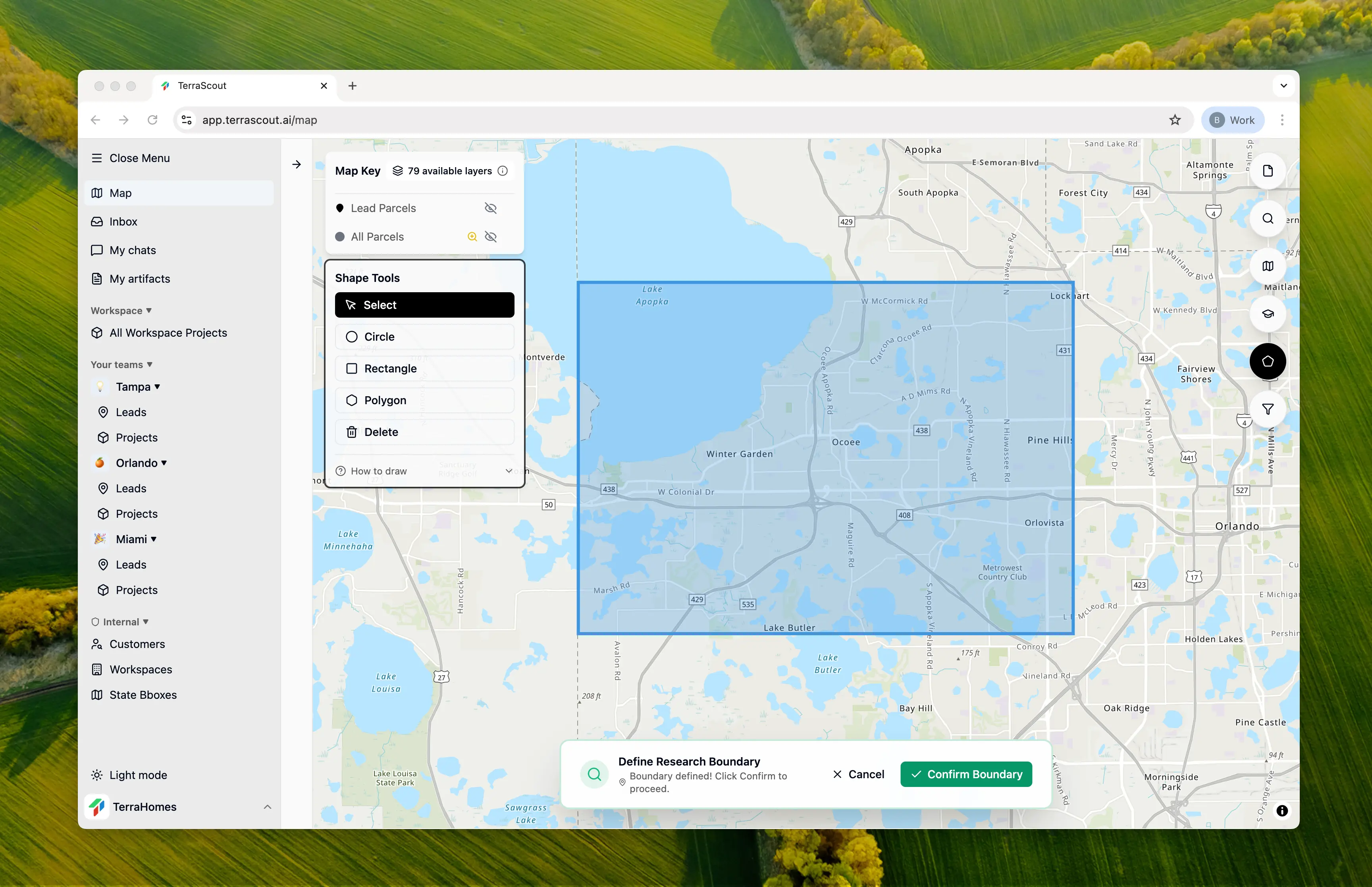
### Step 1: Select Your Search Area
First, select the boundary you want to search within.
 ### Step 2: Ask the Question
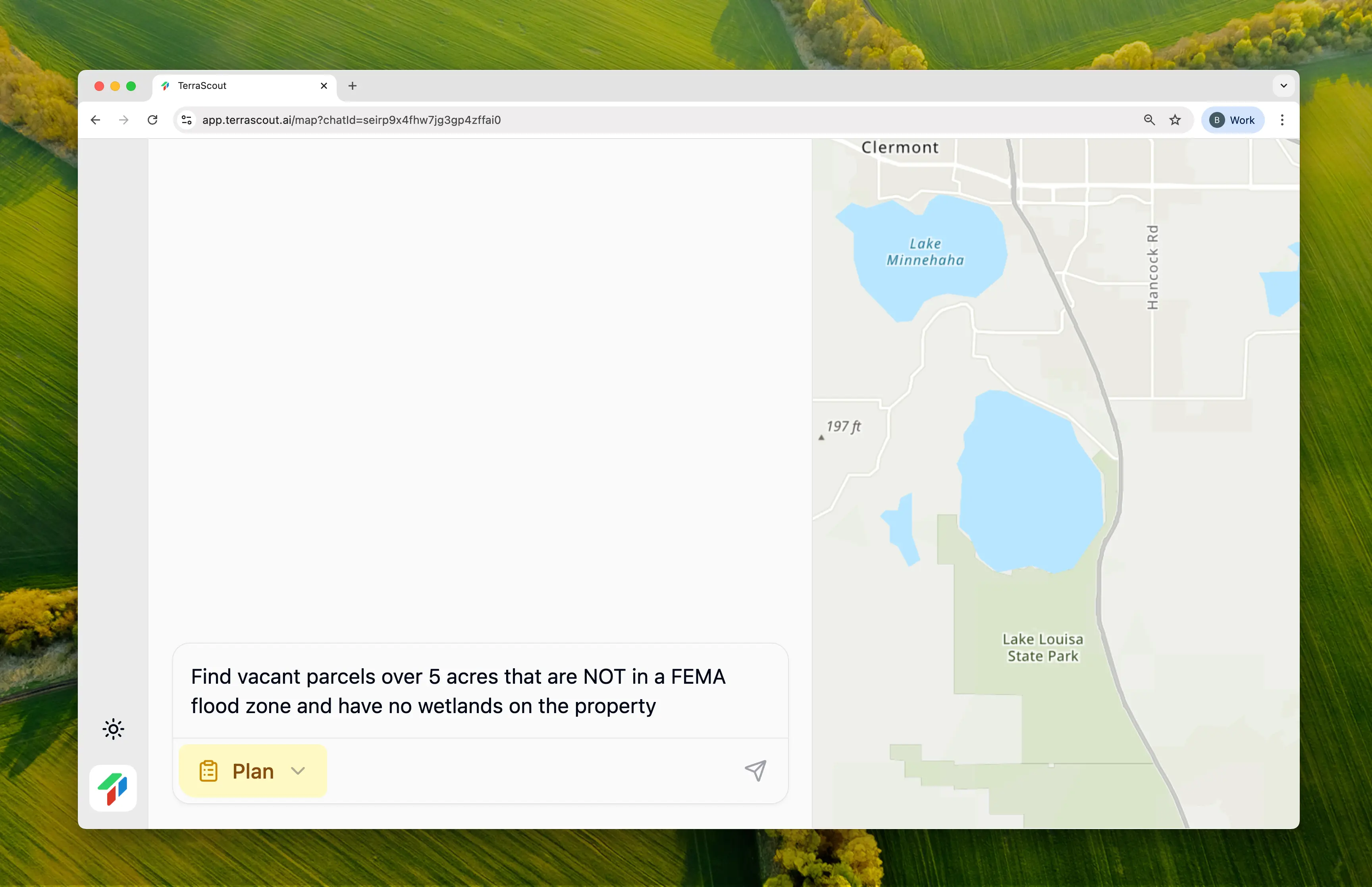 We asked:
> Find vacant parcels over 5 acres that are NOT in a FEMA flood zone and have no wetlands on the property
This query combines **negative filtering** across multiple layers:
* **Vacant land** (no improvements)
* **5+ acres** (meaningful development size)
* **NOT in flood zone** (exclude FEMA Special Flood Hazard Areas)
* **No wetlands** (exclude parcels intersecting wetland polygons)
### Step 3: Review the Plan
Ploti analyzes your request and creates a multi-layer analysis plan:
We asked:
> Find vacant parcels over 5 acres that are NOT in a FEMA flood zone and have no wetlands on the property
This query combines **negative filtering** across multiple layers:
* **Vacant land** (no improvements)
* **5+ acres** (meaningful development size)
* **NOT in flood zone** (exclude FEMA Special Flood Hazard Areas)
* **No wetlands** (exclude parcels intersecting wetland polygons)
### Step 3: Review the Plan
Ploti analyzes your request and creates a multi-layer analysis plan:
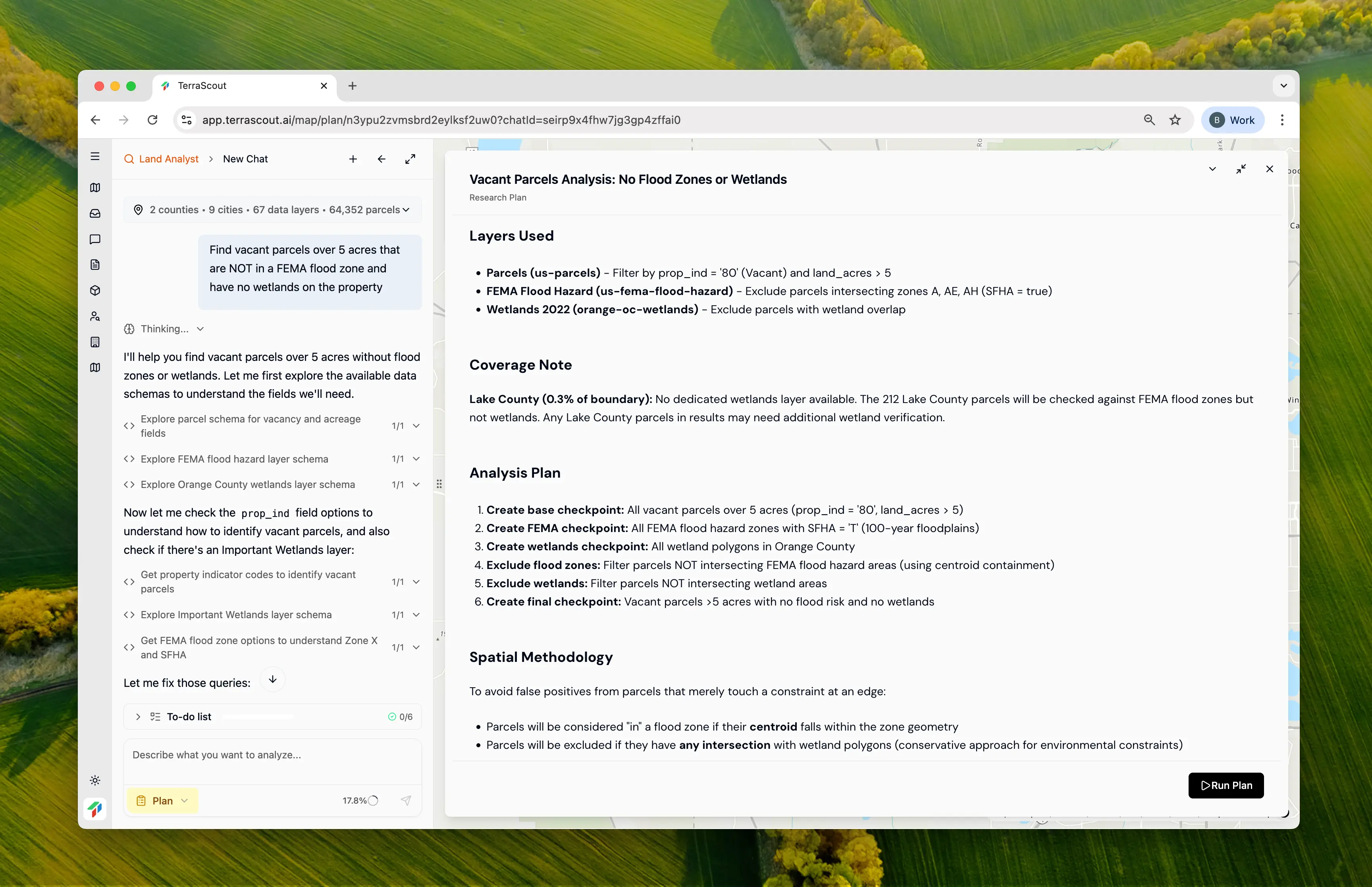 The agent identified the data sources it will use:
* **436 vacant parcels** over 5 acres as the starting point
* **363 FEMA flood zone polygons** to check against
* **1,871 wetland polygons** from the county wetlands layer
Notice the spatial methodology: parcels are excluded if their centroid falls within a flood zone, and if they have any intersection with wetland polygons.
### Step 4: See the Starting Point
The agent identified the data sources it will use:
* **436 vacant parcels** over 5 acres as the starting point
* **363 FEMA flood zone polygons** to check against
* **1,871 wetland polygons** from the county wetlands layer
Notice the spatial methodology: parcels are excluded if their centroid falls within a flood zone, and if they have any intersection with wetland polygons.
### Step 4: See the Starting Point
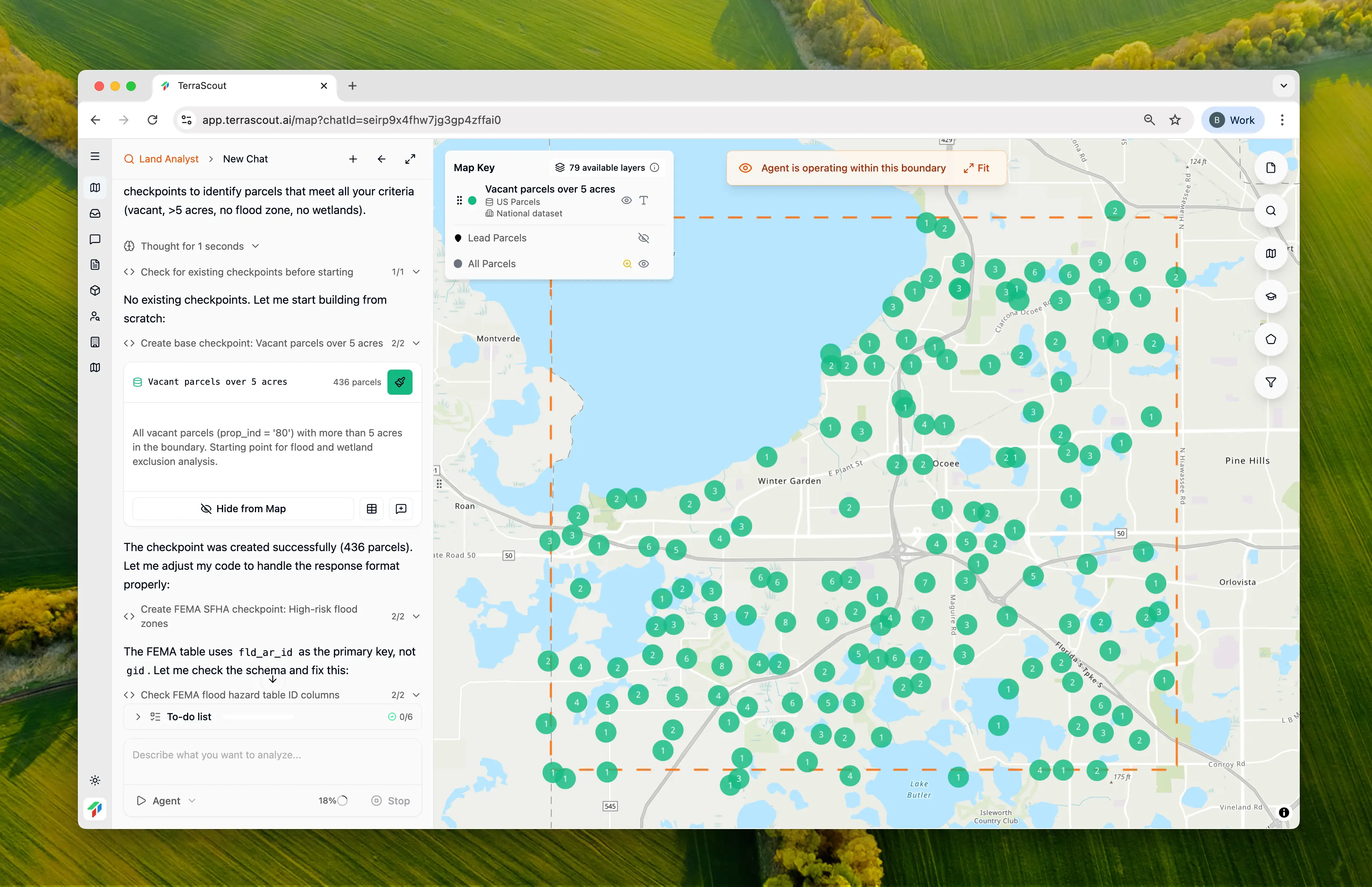 Ploti first identifies **436 vacant parcels** over 5 acres. On most platforms, this is where you'd stop—left to manually cross-reference flood maps and wetland data yourself.
### Step 5: Final Results with Environmental Exclusions
Ploti first identifies **436 vacant parcels** over 5 acres. On most platforms, this is where you'd stop—left to manually cross-reference flood maps and wetland data yourself.
### Step 5: Final Results with Environmental Exclusions
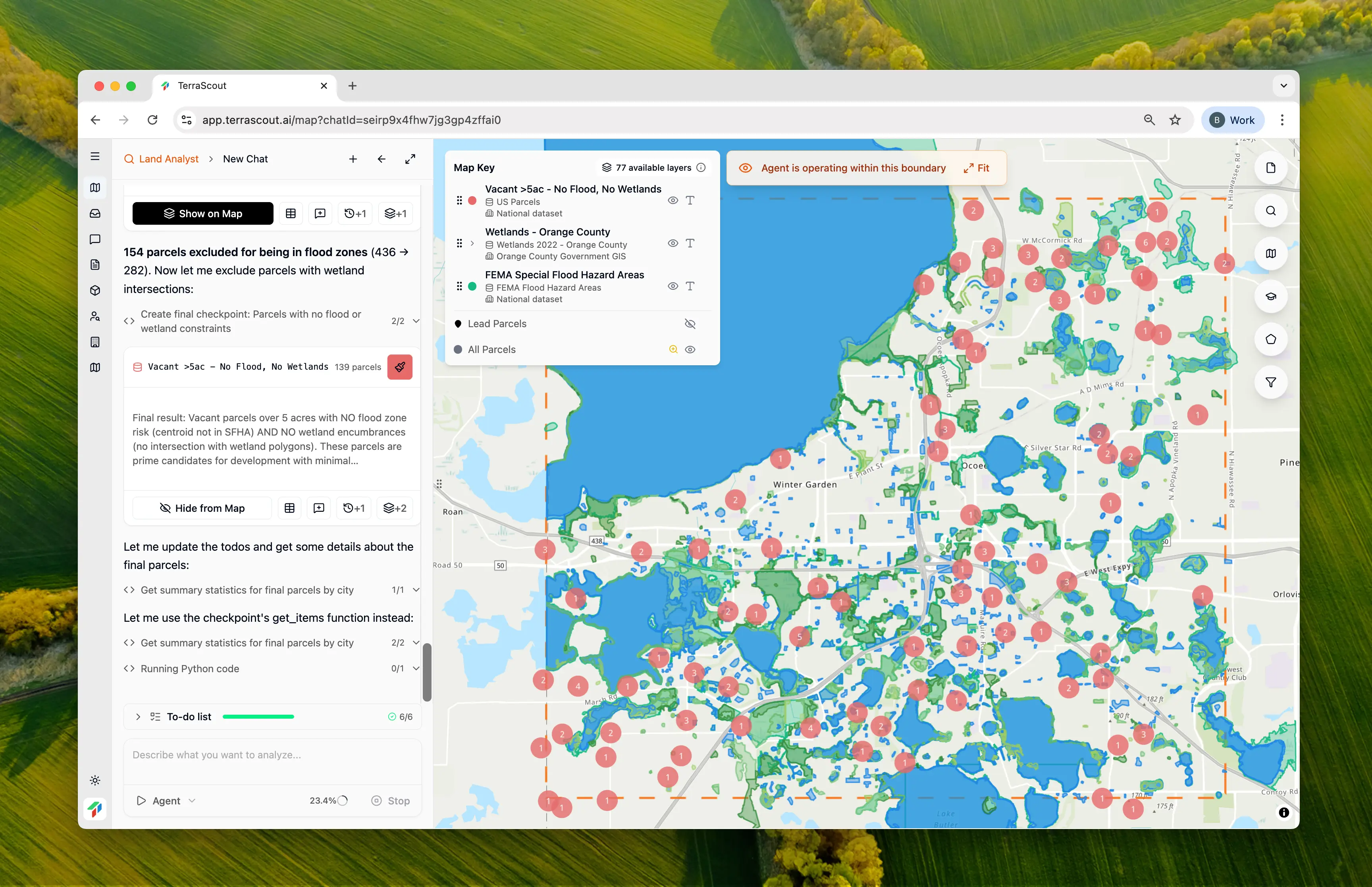 But Ploti doesn't stop there. By automatically cross-referencing flood zones and wetlands, it filters down to **139 parcels totaling 1,250 acres**—clean sites with no environmental constraints.
| Stage | Parcels | Removed |
| -------------------------- | ------- | ---------- |
| Starting: Vacant >5 acres | 436 | — |
| After flood zone exclusion | 282 | -154 (35%) |
| After wetland exclusion | 139 | -143 (33%) |
**68% of parcels had environmental issues.** Without cross-layer analysis, you'd be wasting time researching properties that were never viable.
### Step 6: Analyze the Summary
But Ploti doesn't stop there. By automatically cross-referencing flood zones and wetlands, it filters down to **139 parcels totaling 1,250 acres**—clean sites with no environmental constraints.
| Stage | Parcels | Removed |
| -------------------------- | ------- | ---------- |
| Starting: Vacant >5 acres | 436 | — |
| After flood zone exclusion | 282 | -154 (35%) |
| After wetland exclusion | 139 | -143 (33%) |
**68% of parcels had environmental issues.** Without cross-layer analysis, you'd be wasting time researching properties that were never viable.
### Step 6: Analyze the Summary
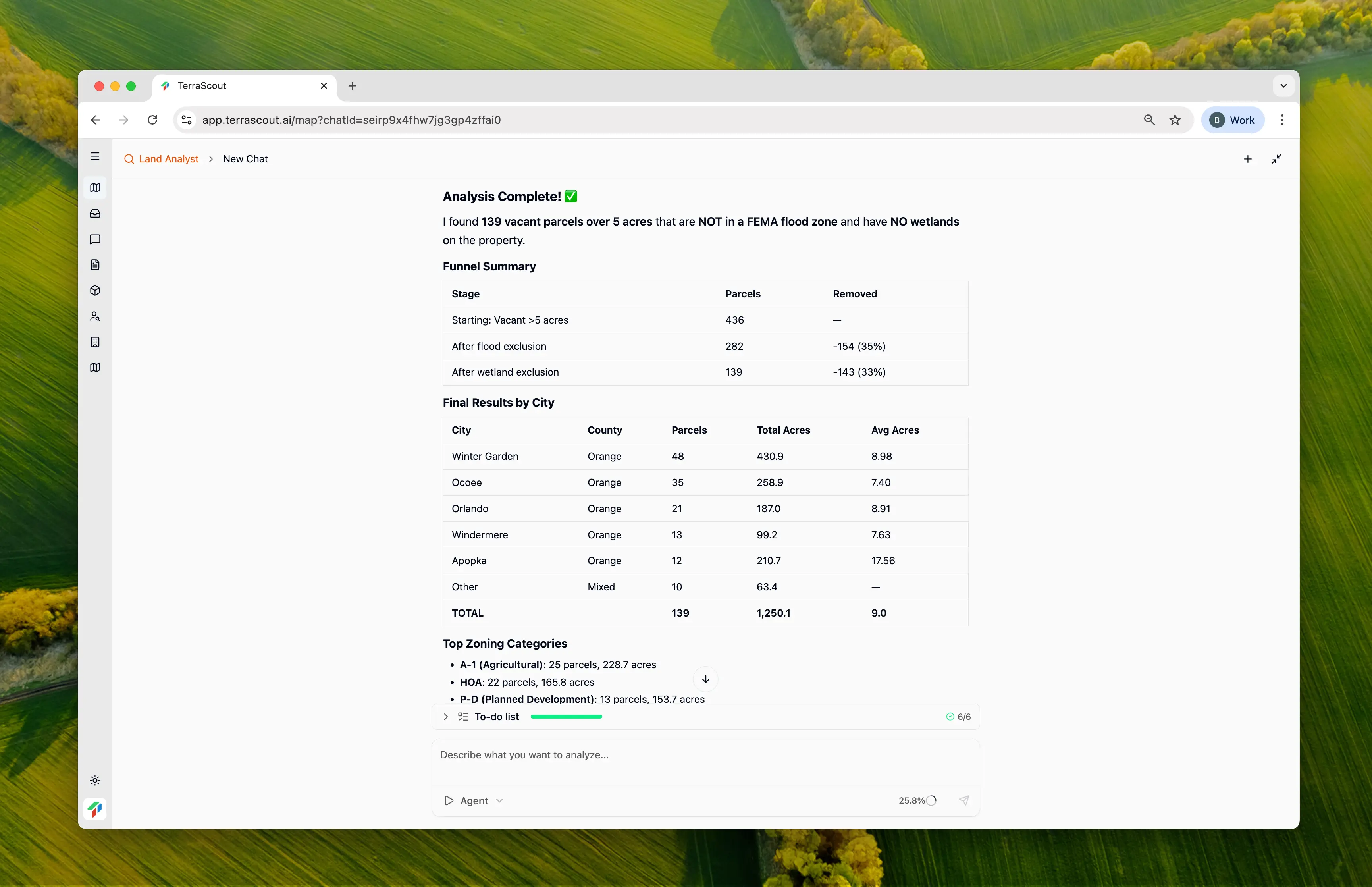 Ploti breaks down results by location:
| City | Parcels | Total Acres | Avg Size |
| ------------- | ------- | ----------- | ----------- |
| Winter Garden | 48 | 430.9 | 8.98 acres |
| Ocoee | 35 | 258.9 | 7.40 acres |
| Orlando | 21 | 187.0 | 8.91 acres |
| Windermere | 13 | 99.2 | 7.63 acres |
| Apopka | 12 | 210.7 | 17.56 acres |
The largest concentration of clean sites is in Winter Garden and Ocoee—areas with significant development activity.
### Step 7: Toggle Supporting Layers
One powerful feature: Ploti shows the environmental layers it used for exclusion. Toggle them on to visualize what you're avoiding:
Ploti breaks down results by location:
| City | Parcels | Total Acres | Avg Size |
| ------------- | ------- | ----------- | ----------- |
| Winter Garden | 48 | 430.9 | 8.98 acres |
| Ocoee | 35 | 258.9 | 7.40 acres |
| Orlando | 21 | 187.0 | 8.91 acres |
| Windermere | 13 | 99.2 | 7.63 acres |
| Apopka | 12 | 210.7 | 17.56 acres |
The largest concentration of clean sites is in Winter Garden and Ocoee—areas with significant development activity.
### Step 7: Toggle Supporting Layers
One powerful feature: Ploti shows the environmental layers it used for exclusion. Toggle them on to visualize what you're avoiding:
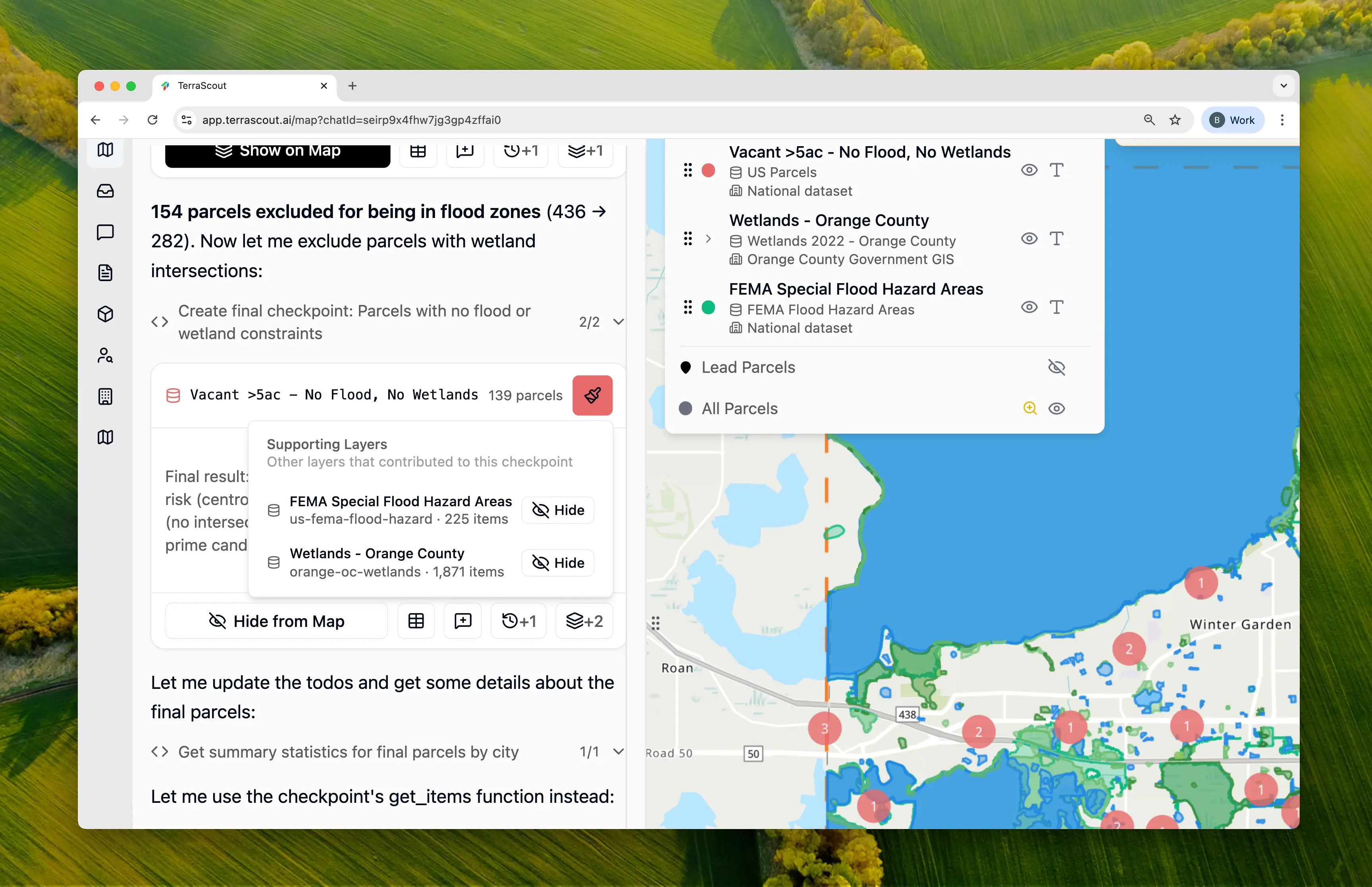 This lets you see:
* **FEMA Special Flood Hazard Areas** (225 zones in your boundary)
* **Wetlands** (1,871 polygons)
You can visually confirm that your final parcels are clear of these constraints.
## Why Multi-Layer Analysis Matters
This search combined data from three different sources:
1. **Parcel data** (property characteristics)
2. **FEMA flood hazard data** (federal flood maps)
3. **County wetlands data** (local environmental data)
Without Ploti, you'd need to manually overlay these layers in GIS software, write spatial queries to identify intersections, and filter down to your final list. Ploti handles this complexity in a single natural language request.
## The Time Savings
Without Ploti, this analysis would require:
1. Downloading parcel data and filtering for vacant land >5 acres
2. Obtaining FEMA flood maps and importing into GIS
3. Obtaining county wetlands shapefiles
4. Writing spatial queries to identify parcel-flood zone intersections
5. Writing spatial queries to identify parcel-wetland intersections
6. Combining exclusions and generating final list
7. Creating summary statistics by location
**That's a full day of GIS analyst work requiring specialized software and skills. Ploti did it in 2 minutes.**
This is the kind of analysis that previously required expensive GIS software (ArcGIS, QGIS) and trained analysts. Ploti puts institutional-grade environmental screening in the hands of any investor or developer.
## Tips
* Desktop screening isn't a substitute for Phase I environmental assessment—always verify before closing
* Wetland boundaries need field verification; mapped boundaries are approximate
* Consider proximity to constraints, not just intersection—a parcel adjacent to wetlands may still have permitting issues
* Some flood zone issues can be resolved with elevation certificates or LOMA applications
* Toggle on the supporting layers to understand the environmental context around your target parcels
## Other Example Prompts
### Flood Zone Analysis Only
> Find vacant parcels over 10 acres that are completely outside any FEMA flood zone
Simpler screen focusing only on flood risk.
### Wetland Impact Assessment
> How much of this parcel is covered by wetlands?
Check a specific parcel for wetland percentage before making an offer.
### Conservation Area Screen
> Find vacant parcels over 5 acres that don't intersect any preservation districts or conservation easements
Screen for conservation restrictions that may limit development.
### Comprehensive Environmental Screen
> Check this parcel for flood zones, wetlands, and soil types
Get a complete environmental picture for due diligence on a specific property.
This lets you see:
* **FEMA Special Flood Hazard Areas** (225 zones in your boundary)
* **Wetlands** (1,871 polygons)
You can visually confirm that your final parcels are clear of these constraints.
## Why Multi-Layer Analysis Matters
This search combined data from three different sources:
1. **Parcel data** (property characteristics)
2. **FEMA flood hazard data** (federal flood maps)
3. **County wetlands data** (local environmental data)
Without Ploti, you'd need to manually overlay these layers in GIS software, write spatial queries to identify intersections, and filter down to your final list. Ploti handles this complexity in a single natural language request.
## The Time Savings
Without Ploti, this analysis would require:
1. Downloading parcel data and filtering for vacant land >5 acres
2. Obtaining FEMA flood maps and importing into GIS
3. Obtaining county wetlands shapefiles
4. Writing spatial queries to identify parcel-flood zone intersections
5. Writing spatial queries to identify parcel-wetland intersections
6. Combining exclusions and generating final list
7. Creating summary statistics by location
**That's a full day of GIS analyst work requiring specialized software and skills. Ploti did it in 2 minutes.**
This is the kind of analysis that previously required expensive GIS software (ArcGIS, QGIS) and trained analysts. Ploti puts institutional-grade environmental screening in the hands of any investor or developer.
## Tips
* Desktop screening isn't a substitute for Phase I environmental assessment—always verify before closing
* Wetland boundaries need field verification; mapped boundaries are approximate
* Consider proximity to constraints, not just intersection—a parcel adjacent to wetlands may still have permitting issues
* Some flood zone issues can be resolved with elevation certificates or LOMA applications
* Toggle on the supporting layers to understand the environmental context around your target parcels
## Other Example Prompts
### Flood Zone Analysis Only
> Find vacant parcels over 10 acres that are completely outside any FEMA flood zone
Simpler screen focusing only on flood risk.
### Wetland Impact Assessment
> How much of this parcel is covered by wetlands?
Check a specific parcel for wetland percentage before making an offer.
### Conservation Area Screen
> Find vacant parcels over 5 acres that don't intersect any preservation districts or conservation easements
Screen for conservation restrictions that may limit development.
### Comprehensive Environmental Screen
> Check this parcel for flood zones, wetlands, and soil types
Get a complete environmental picture for due diligence on a specific property.