> ## Documentation Index
> Fetch the complete documentation index at: https://terrascout.ai/docs/llms.txt
> Use this file to discover all available pages before exploring further.
# Parking Requirements
> Research parking ratios and calculate site feasibility for commercial development
Parking often determines feasibility for commercial projects. Too little land for required parking can kill a deal—or force expensive structured parking. Ploti researches parking requirements across jurisdictions and calculates how parking constraints affect your maximum building size.
## The Opportunity
Understanding parking requirements helps you:
* Quickly assess if a site can accommodate your intended use
* Calculate land needed for parking vs building footprint
* Identify jurisdictions with more favorable requirements
* Find reduction opportunities (shared parking, transit proximity, structured parking)
* Make informed decisions before spending money on architects
## Walkthrough: Maximum Building Calculation
Let's calculate the maximum office building that fits on a specific site, accounting for parking requirements. This is a common feasibility question that normally requires hiring an architect or land planner.
### Step 1: Ask the Question
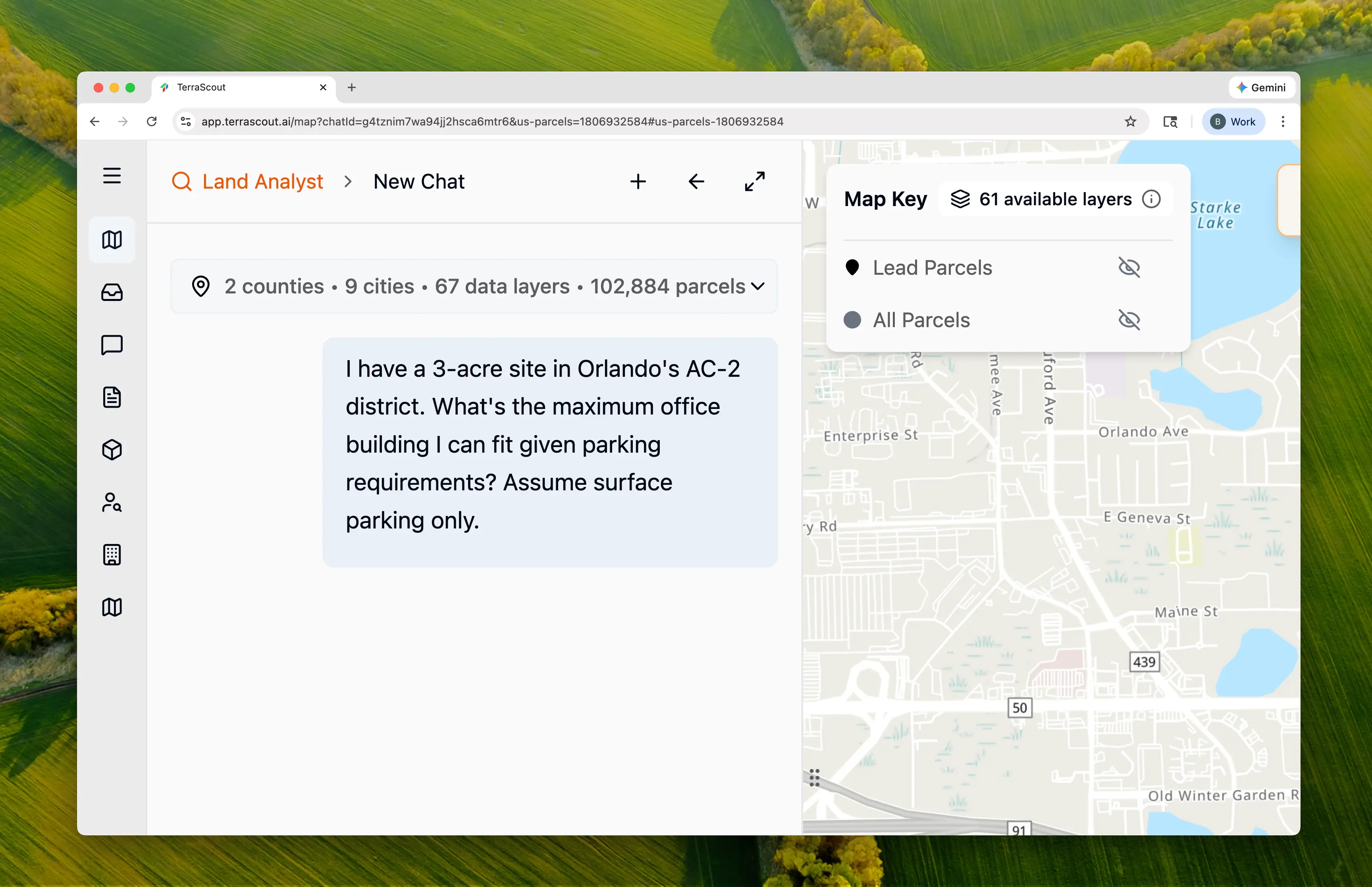 We asked:
> I have a 3-acre site in Orlando's AC-2 district. What's the maximum office building I can fit given parking requirements? Assume surface parking only.
This question requires Ploti to:
* Research AC-2 zoning district development standards (FAR, ISR, height, setbacks)
* Find office parking ratios in Orlando's code
* Look up parking space dimensions and landscaping requirements
* Calculate the interplay between building size and parking demand
### Step 2: Watch the Research
Ploti searches Orlando's Land Development Code for multiple sections:
**Zoning Standards Found:**
* Table FG-1C — AC-2 district regulations (FAR, ISR, height limits)
* Sec. 58.341 — Activity Center district purpose and standards
**Parking Requirements Found:**
* Sec. 61.322 — Parking space requirements by use type
* Sec. 61.309 — Parking layout dimensions
* Sec. 61.312 — Parking lot landscaping requirements
### Step 3: Review the Analysis
We asked:
> I have a 3-acre site in Orlando's AC-2 district. What's the maximum office building I can fit given parking requirements? Assume surface parking only.
This question requires Ploti to:
* Research AC-2 zoning district development standards (FAR, ISR, height, setbacks)
* Find office parking ratios in Orlando's code
* Look up parking space dimensions and landscaping requirements
* Calculate the interplay between building size and parking demand
### Step 2: Watch the Research
Ploti searches Orlando's Land Development Code for multiple sections:
**Zoning Standards Found:**
* Table FG-1C — AC-2 district regulations (FAR, ISR, height limits)
* Sec. 58.341 — Activity Center district purpose and standards
**Parking Requirements Found:**
* Sec. 61.322 — Parking space requirements by use type
* Sec. 61.309 — Parking layout dimensions
* Sec. 61.312 — Parking lot landscaping requirements
### Step 3: Review the Analysis
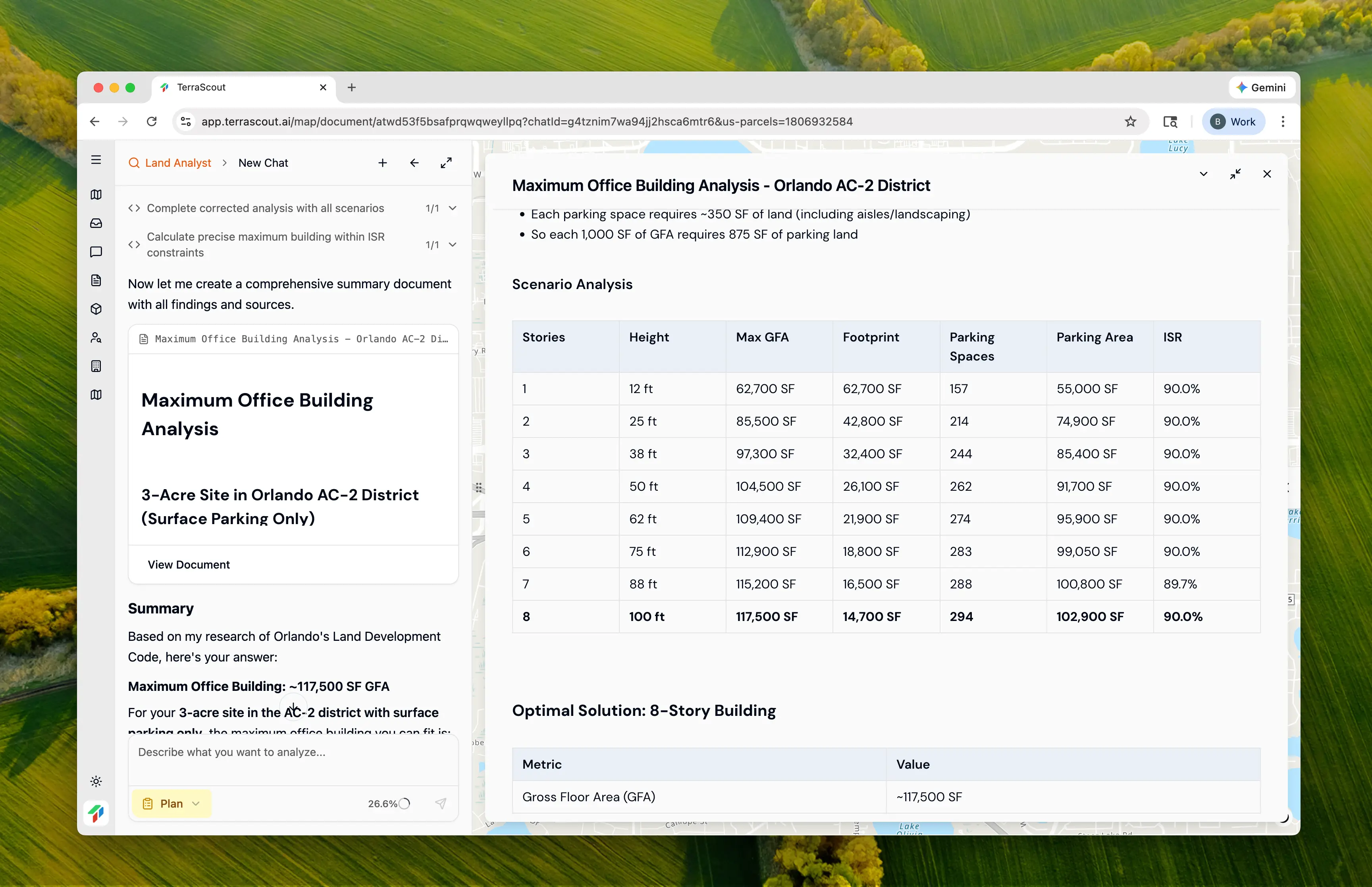 Ploti created a comprehensive analysis document with:
**AC-2 Zoning Standards:**
| Standard | AC-2 Requirement | Project Impact |
| ----------------- | ---------------- | ------------------------------------------------ |
| Maximum FAR | 1.00 | Would allow 130,680 SF — NOT the limiting factor |
| Maximum ISR | 0.90 (90%) | **LIMITING FACTOR** — caps impervious surface |
| Maximum Height | 100 ft | Allows 8 stories |
| Min Front Setback | 0 ft | Flexibility for layout |
**Parking Requirements:**
| Land Use | Minimum Required | Maximum Permitted |
| ---------------- | ---------------- | ----------------- |
| Office (general) | 2.5 per 1,000 SF | 4.0 per 1,000 SF |
**Parking Space Dimensions (90° angle):**
| Parameter | Dimension |
| ---------------------- | --------- |
| Stall Width | 9'-0" |
| Stall Depth | 18'-6" |
| Aisle Width | 24'-0" |
| Module (double-loaded) | 60'-0" |
### Step 4: Understand the Math
The key insight: **ISR + parking demand is the constraint, not FAR.**
Here's why:
* Max Impervious Surface: 130,680 SF × 0.90 = **117,612 SF**
* Office parking requires 2.5 spaces per 1,000 SF GFA
* Each parking space needs \~350 SF of land (including aisles, islands, circulation)
* So each 1,000 SF of office generates **875 SF of parking lot**
Both building footprint AND parking lot count toward the 90% ISR limit.
### Step 5: Review the Scenario Analysis
Ploti calculated optimal building size at different heights:
| Stories | Height | Max GFA | Footprint | Parking Spaces | Parking Area | ISR |
| ------- | ---------- | -------------- | ------------- | -------------- | -------------- | ------- |
| 1 | 12 ft | 62,700 SF | 62,700 SF | 157 | 55,000 SF | 90% |
| 2 | 25 ft | 85,500 SF | 42,800 SF | 214 | 74,900 SF | 90% |
| 4 | 50 ft | 104,500 SF | 26,100 SF | 262 | 91,700 SF | 90% |
| 6 | 75 ft | 112,900 SF | 18,800 SF | 283 | 99,050 SF | 90% |
| **8** | **100 ft** | **117,500 SF** | **14,700 SF** | **294** | **102,900 SF** | **90%** |
**Going taller helps** by shrinking the building footprint, leaving more land for parking.
### Step 6: Get the Answer
**Maximum Office Building: \~117,500 SF GFA**
| Metric | Value |
| ------------------ | --------------------------- |
| Gross Floor Area | \~117,500 SF |
| Configuration | 8 stories, \~100 ft tall |
| Building Footprint | \~14,700 SF (\~121' × 121') |
| Parking Required | 294 spaces |
| Parking Lot Area | \~2.36 acres (79% of site) |
| FAR Used | 0.90 (out of 1.00 allowed) |
### Step 7: Verify with Source Citations
Ploti created a comprehensive analysis document with:
**AC-2 Zoning Standards:**
| Standard | AC-2 Requirement | Project Impact |
| ----------------- | ---------------- | ------------------------------------------------ |
| Maximum FAR | 1.00 | Would allow 130,680 SF — NOT the limiting factor |
| Maximum ISR | 0.90 (90%) | **LIMITING FACTOR** — caps impervious surface |
| Maximum Height | 100 ft | Allows 8 stories |
| Min Front Setback | 0 ft | Flexibility for layout |
**Parking Requirements:**
| Land Use | Minimum Required | Maximum Permitted |
| ---------------- | ---------------- | ----------------- |
| Office (general) | 2.5 per 1,000 SF | 4.0 per 1,000 SF |
**Parking Space Dimensions (90° angle):**
| Parameter | Dimension |
| ---------------------- | --------- |
| Stall Width | 9'-0" |
| Stall Depth | 18'-6" |
| Aisle Width | 24'-0" |
| Module (double-loaded) | 60'-0" |
### Step 4: Understand the Math
The key insight: **ISR + parking demand is the constraint, not FAR.**
Here's why:
* Max Impervious Surface: 130,680 SF × 0.90 = **117,612 SF**
* Office parking requires 2.5 spaces per 1,000 SF GFA
* Each parking space needs \~350 SF of land (including aisles, islands, circulation)
* So each 1,000 SF of office generates **875 SF of parking lot**
Both building footprint AND parking lot count toward the 90% ISR limit.
### Step 5: Review the Scenario Analysis
Ploti calculated optimal building size at different heights:
| Stories | Height | Max GFA | Footprint | Parking Spaces | Parking Area | ISR |
| ------- | ---------- | -------------- | ------------- | -------------- | -------------- | ------- |
| 1 | 12 ft | 62,700 SF | 62,700 SF | 157 | 55,000 SF | 90% |
| 2 | 25 ft | 85,500 SF | 42,800 SF | 214 | 74,900 SF | 90% |
| 4 | 50 ft | 104,500 SF | 26,100 SF | 262 | 91,700 SF | 90% |
| 6 | 75 ft | 112,900 SF | 18,800 SF | 283 | 99,050 SF | 90% |
| **8** | **100 ft** | **117,500 SF** | **14,700 SF** | **294** | **102,900 SF** | **90%** |
**Going taller helps** by shrinking the building footprint, leaving more land for parking.
### Step 6: Get the Answer
**Maximum Office Building: \~117,500 SF GFA**
| Metric | Value |
| ------------------ | --------------------------- |
| Gross Floor Area | \~117,500 SF |
| Configuration | 8 stories, \~100 ft tall |
| Building Footprint | \~14,700 SF (\~121' × 121') |
| Parking Required | 294 spaces |
| Parking Lot Area | \~2.36 acres (79% of site) |
| FAR Used | 0.90 (out of 1.00 allowed) |
### Step 7: Verify with Source Citations
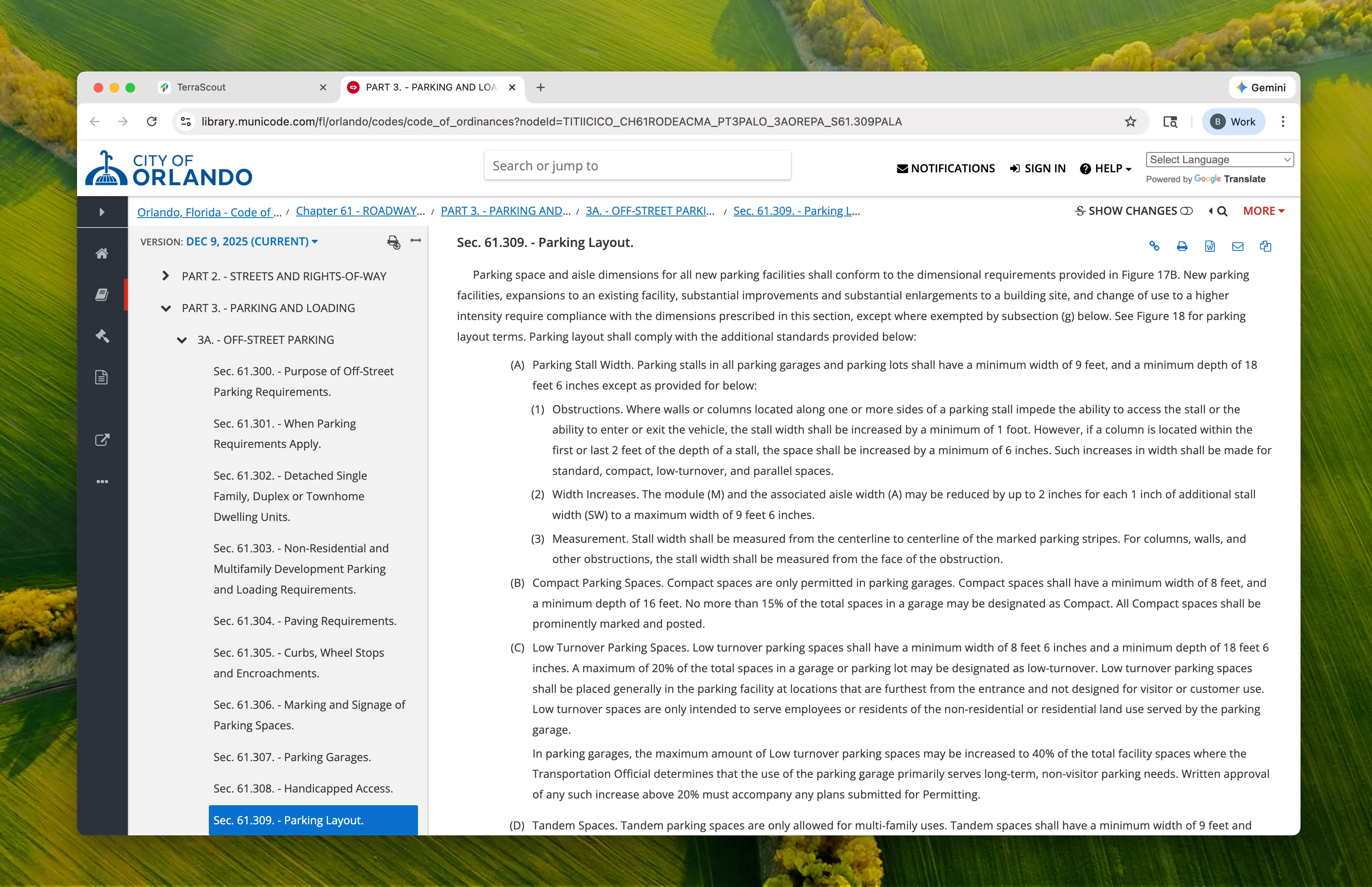 Every finding links to the actual code section:
* Orlando LDC Table FG-1C (Zoning District Regulations)
* Orlando LDC Sec. 61.322 (Parking Space Requirements)
* Orlando LDC Sec. 61.309 (Parking Layout)
* Orlando LDC Sec. 61.312 (Landscaping for Parking)
You can click through to verify any requirement or share citations with clients and attorneys.
## Why This Matters
This analysis demonstrates **regulatory math**—not just looking up requirements, but calculating their combined impact on feasibility:
1. **Multi-section research** — Found and synthesized 6+ code sections
2. **Constraint identification** — Discovered ISR is limiting, not FAR
3. **Scenario modeling** — Calculated optimal building at each height
4. **Actionable answer** — Specific SF, dimensions, parking count
5. **Alternatives identified** — Structured parking, density bonuses, transit reductions
Without Ploti, this analysis would require:
* Finding and reading Orlando's zoning tables
* Locating parking requirements in a separate chapter
* Understanding how ISR and FAR interact
* Manually calculating the parking/building tradeoff
* Running multiple scenarios to find the optimum
**That's a day of work for an experienced land planner.** Ploti completed it in under 3 minutes.
## Taking It Further
The analysis identified several ways to exceed 117,500 SF:
> What if I use structured parking instead of surface?
Structured parking would dramatically reduce land consumption, potentially unlocking the full 130,680 SF (1.0 FAR).
> Are there density bonuses available in AC-2?
AC-2 allows up to +1.0 additional FAR per Sec. 58.1100-58.1101 for public benefits like affordable housing contributions.
> What parking reductions are available near SunRail?
Transit proximity may qualify for reduced parking ratios, leaving more land for building.
> Compare this to a site in Winter Garden's C-2 zone
Different jurisdictions have different parking ratios and ISR limits—comparison helps with site selection.
## Key Insights
### Why Surface Parking Kills Density
At 350 SF per space (including aisles, landscaping, and circulation):
* A 100,000 SF office needs 250 spaces = **2 acres just for parking**
* Surface parking typically consumes 70-80% of a site
* Going vertical with the building only partially helps—you still need ground-level parking
### The Structured Parking Tipping Point
Surface parking costs \~$5,000-8,000 per space to build. Structured parking costs $15,000-25,000+ per space. But structured parking uses only \~350 SF per space *including the structure*, not 350 SF of *land*.
For dense sites where land is expensive, structured parking often makes economic sense despite higher construction costs.
### Jurisdiction Shopping
Parking requirements vary significantly:
| Jurisdiction | Office Parking Ratio | Impact on 3-acre site |
| ------------- | -------------------- | --------------------- |
| Orlando | 2.5 per 1,000 SF | 117,500 SF max |
| Orange County | 3.3 per 1,000 SF | \~105,000 SF max |
| Some cities | 4.0 per 1,000 SF | \~95,000 SF max |
A 20% difference in parking ratio can mean 20,000+ SF of additional building.
## Tips
* **Parking drives site selection** — Compare parking requirements across jurisdictions before choosing a site
* **Surface parking limits density** — Expect 70-80% of your site consumed by parking for suburban office
* **Height helps (somewhat)** — Taller buildings have smaller footprints, leaving more land for parking
* **ISR often binds before FAR** — Don't assume FAR is your limit; check impervious surface ratios
* **Reductions exist** — Transit proximity, shared parking, and bicycle facilities can reduce requirements
* **Verify current code** — Requirements change; always confirm with the planning department
## Other Example Prompts
### Retail Parking Comparison
> Compare parking requirements for retail vs restaurant in Orange County. I'm planning 10,000 SF retail with a 3,000 SF restaurant pad.
Restaurants typically require more parking per SF than retail.
### Shared Parking Analysis
> How does shared parking work for mixed-use in Orlando? I have office, retail, and residential uses with different peak hours.
Mixed-use can reduce total parking through shared parking agreements.
### Transit Reduction Research
> What parking reductions are available within a quarter mile of SunRail stations in Orlando?
TOD sites often qualify for 10-30% parking reductions.
### Medical Office Requirements
> What are parking requirements for medical office vs general office in Orange County? Medical typically needs more parking.
Medical uses often have higher ratios due to patient turnover.
### Parking Maximums
> Does Orlando have parking maximums? I want to know if there's a cap on how much parking I can provide.
Some progressive jurisdictions limit parking to reduce environmental impact.
Every finding links to the actual code section:
* Orlando LDC Table FG-1C (Zoning District Regulations)
* Orlando LDC Sec. 61.322 (Parking Space Requirements)
* Orlando LDC Sec. 61.309 (Parking Layout)
* Orlando LDC Sec. 61.312 (Landscaping for Parking)
You can click through to verify any requirement or share citations with clients and attorneys.
## Why This Matters
This analysis demonstrates **regulatory math**—not just looking up requirements, but calculating their combined impact on feasibility:
1. **Multi-section research** — Found and synthesized 6+ code sections
2. **Constraint identification** — Discovered ISR is limiting, not FAR
3. **Scenario modeling** — Calculated optimal building at each height
4. **Actionable answer** — Specific SF, dimensions, parking count
5. **Alternatives identified** — Structured parking, density bonuses, transit reductions
Without Ploti, this analysis would require:
* Finding and reading Orlando's zoning tables
* Locating parking requirements in a separate chapter
* Understanding how ISR and FAR interact
* Manually calculating the parking/building tradeoff
* Running multiple scenarios to find the optimum
**That's a day of work for an experienced land planner.** Ploti completed it in under 3 minutes.
## Taking It Further
The analysis identified several ways to exceed 117,500 SF:
> What if I use structured parking instead of surface?
Structured parking would dramatically reduce land consumption, potentially unlocking the full 130,680 SF (1.0 FAR).
> Are there density bonuses available in AC-2?
AC-2 allows up to +1.0 additional FAR per Sec. 58.1100-58.1101 for public benefits like affordable housing contributions.
> What parking reductions are available near SunRail?
Transit proximity may qualify for reduced parking ratios, leaving more land for building.
> Compare this to a site in Winter Garden's C-2 zone
Different jurisdictions have different parking ratios and ISR limits—comparison helps with site selection.
## Key Insights
### Why Surface Parking Kills Density
At 350 SF per space (including aisles, landscaping, and circulation):
* A 100,000 SF office needs 250 spaces = **2 acres just for parking**
* Surface parking typically consumes 70-80% of a site
* Going vertical with the building only partially helps—you still need ground-level parking
### The Structured Parking Tipping Point
Surface parking costs \~$5,000-8,000 per space to build. Structured parking costs $15,000-25,000+ per space. But structured parking uses only \~350 SF per space *including the structure*, not 350 SF of *land*.
For dense sites where land is expensive, structured parking often makes economic sense despite higher construction costs.
### Jurisdiction Shopping
Parking requirements vary significantly:
| Jurisdiction | Office Parking Ratio | Impact on 3-acre site |
| ------------- | -------------------- | --------------------- |
| Orlando | 2.5 per 1,000 SF | 117,500 SF max |
| Orange County | 3.3 per 1,000 SF | \~105,000 SF max |
| Some cities | 4.0 per 1,000 SF | \~95,000 SF max |
A 20% difference in parking ratio can mean 20,000+ SF of additional building.
## Tips
* **Parking drives site selection** — Compare parking requirements across jurisdictions before choosing a site
* **Surface parking limits density** — Expect 70-80% of your site consumed by parking for suburban office
* **Height helps (somewhat)** — Taller buildings have smaller footprints, leaving more land for parking
* **ISR often binds before FAR** — Don't assume FAR is your limit; check impervious surface ratios
* **Reductions exist** — Transit proximity, shared parking, and bicycle facilities can reduce requirements
* **Verify current code** — Requirements change; always confirm with the planning department
## Other Example Prompts
### Retail Parking Comparison
> Compare parking requirements for retail vs restaurant in Orange County. I'm planning 10,000 SF retail with a 3,000 SF restaurant pad.
Restaurants typically require more parking per SF than retail.
### Shared Parking Analysis
> How does shared parking work for mixed-use in Orlando? I have office, retail, and residential uses with different peak hours.
Mixed-use can reduce total parking through shared parking agreements.
### Transit Reduction Research
> What parking reductions are available within a quarter mile of SunRail stations in Orlando?
TOD sites often qualify for 10-30% parking reductions.
### Medical Office Requirements
> What are parking requirements for medical office vs general office in Orange County? Medical typically needs more parking.
Medical uses often have higher ratios due to patient turnover.
### Parking Maximums
> Does Orlando have parking maximums? I want to know if there's a cap on how much parking I can provide.
Some progressive jurisdictions limit parking to reduce environmental impact.